Short deck poker, also called 6+ Hold’em, is a fast, high-variance version of Texas Hold’em played with a stripped-down 36-card deck. Removing the low cards makes big hands come more often and reshuffles a couple of the rankings — most famously, a flush now beats a full house. The game grew out of high-stakes cash games in Macau and became a fixture of the super-high-roller tournament circuit, but the rules are simple enough for any Hold’em player to pick up in a single session. This guide covers the deck, the hand rankings, the betting structure, the odds and the common mistakes, so you know exactly what changes before you sit down.
Key Points
- 36-card deck: all 2s, 3s, 4s and 5s are removed, leaving 6 through Ace in each suit.
- Flushes beat full houses — this ranking change is universal in short deck.
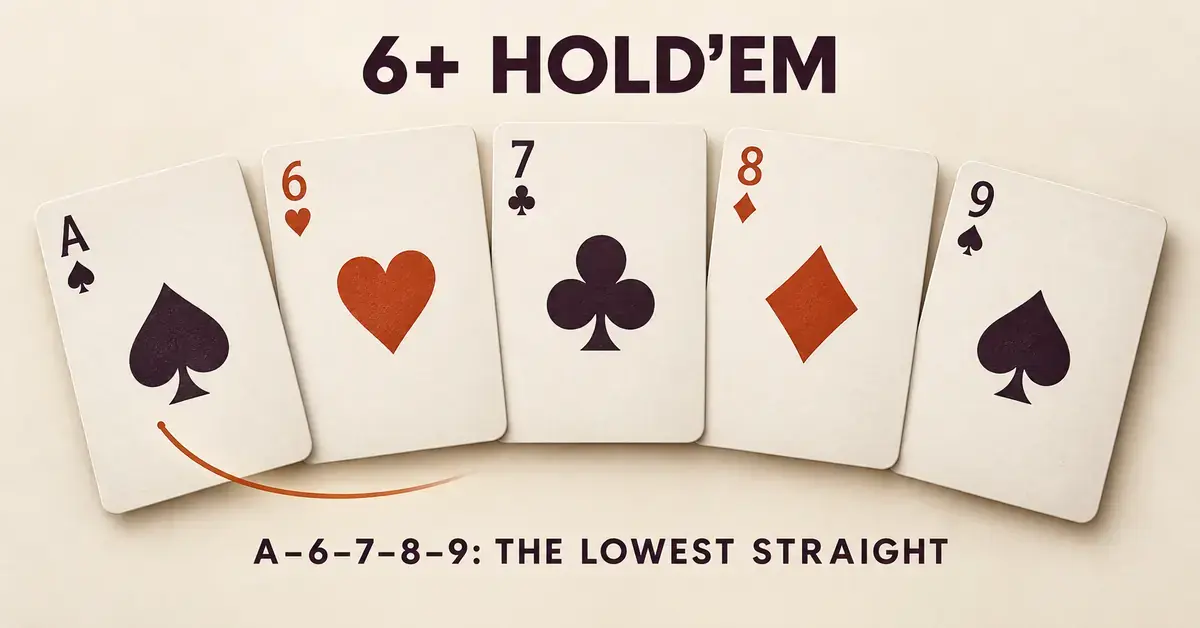
- Lowest straight is A-6-7-8-9; the ace plays low as the missing "five".
- Usually ante-only: every player antes and the button posts a double ante — no blinds.
- Trips vs straight varies: some rooms let three of a kind beat a straight, so confirm the house rules.
- Otherwise it is Texas Hold’em: two hole cards, a flop, turn and river, best five-card hand wins.
What is short deck poker?
Short deck poker is Texas Hold’em played with the lowest cards taken out of the deck. Each player still receives two private hole cards, there is still a flop, turn and river of community cards, and you still make the best five-card hand from any combination of your two cards and the five on the board. The only structural differences are the smaller deck and two adjustments to the hand rankings that the smaller deck forces. Because the name "six-plus" refers to the lowest card still in play (the six), the two names — short deck and 6+ Hold’em — mean the same game.
If you have never played the parent game, read our step-by-step Texas Hold’em rules first; everything there still applies except the points below. Short deck is one of several community-card games covered in our overview of poker variants.
Which cards are removed from the deck?
Short deck removes every 2, 3, 4 and 5 — 16 cards in total — leaving a 36-card deck. Each suit keeps nine cards: 6, 7, 8, 9, 10, Jack, Queen, King and Ace. That is the single change that drives everything else about the game.
Two consequences matter. First, there are only nine cards of each suit instead of thirteen, so flushes are harder to complete — which is why the rankings put a flush above a full house. Second, with fewer cards between players and the board, hands connect far more often, so you will see more sets, straights and big pairs than in a full-deck game.
Short deck poker hand rankings
The hand rankings are the same as standard poker with up to two changes. Only the first change is universal; the second varies from room to room, so always confirm the house rules before you play.
Flushes beat full houses (always)
In every modern short-deck game, a flush outranks a full house. With only nine cards per suit, a flush is statistically harder to make than a full house, so it is promoted above it. This is the one ranking change you can count on everywhere, from a home game to the Triton Poker Series.
Three of a kind vs a straight (varies)
The second change is whether three of a kind beats a straight. In the smaller deck, straights are easier to make than trips, so some rule sets promote three of a kind above a straight. Many major tournaments and high-roller events keep the traditional order, with a straight still beating three of a kind. Because both versions are in active use, you must check which one your table uses — it changes which hand wins a large number of pots.
Here is the full order from strongest to weakest, in the common version where a straight still beats three of a kind:
- Royal flush
- Straight flush
- Four of a kind
- Flush
- Full house
- Straight
- Three of a kind
- Two pair
- One pair
- High card
In the alternative version, three of a kind and the straight swap places, so three of a kind sits directly above the straight. For a full refresher on how each hand is built, see our poker hand rankings guide.
What is the lowest straight in short deck?
The lowest straight in short deck is A-6-7-8-9. Because the 2, 3, 4 and 5 are gone, the ace does double duty: it still plays high in a 10-J-Q-K-A straight, and it plays low as the "five" in the A-6-7-8-9 wheel. There is no A-2-3-4-5, since those cards do not exist in the deck.
How a hand of short deck is played
A short-deck hand runs through the same four betting rounds as Hold’em — preflop, flop, turn and river — but most games use a different way of putting money in the pot before the cards are dealt.
The ante and the button ante
Most short-deck games are played ante-only, with no small blind or big blind. Every player at the table posts the same ante, and the player on the button posts a double ante (sometimes called the button ante). Preflop action then starts with the player to the left of the button, who can fold, call by matching one more ante, or raise. The button acts last on the first round, which gives the extra ante some positional value. Some casinos and home games instead use conventional blinds; if your table does, it often pairs with the trips-beat-straight ranking. If the ante-and-button-ante idea is new to you, our guide to how betting works in poker covers blinds, antes and the basic actions.
The deal and the betting rounds
Each player is dealt two hole cards face down. After the preflop betting round, three community cards (the flop) are dealt, followed by a round of betting, then a single turn card and more betting, then the river card and the final round. From the flop onward, action starts with the first active player to the dealer’s left, who may check or bet. Short deck is almost always played no-limit, meaning you can bet any amount up to your entire stack on any round.
The showdown
If two or more players remain after the final betting round, they turn their cards face up and the best five-card hand wins, using the short-deck rankings above. The usual tie-breaking rules apply — kickers and split pots work exactly as they do in Hold’em.
How short deck differs from Texas Hold’em
The table below summarises the practical differences between short deck and the full-deck game. The headline is that strong hands arrive far more often, which pushes the action and the variance up.
Short Deck vs Texas Hold'em
| Feature | Short Deck (6+ Hold’em) | Texas Hold’em |
|---|---|---|
| Cards in deck | 36 | 52 |
| Cards per suit | 9 | 13 |
| Flush vs full house | Flush wins | Full house wins |
| Lowest straight | A-6-7-8-9 | A-2-3-4-5 |
| Betting structure | Usually ante-only (button ante) | Small blind + big blind |
| Flop a set with a pocket pair | ~17% | ~12% |
| Flush-draw outs after the flop | 5 | 9 |
| Chance of pocket aces | ~0.95% (1 in 105) | ~0.45% (1 in 221) |
Short deck is also worth comparing with Pot-Limit Omaha, the other big-action variant: Omaha raises the action by giving you four hole cards, while short deck does it by shrinking the deck. Both reward players who can recalibrate their sense of what a "good" hand is.
Why the odds change in short deck
The smaller deck changes the maths in ways you can feel on every street. These figures compare short deck with regular hold’em and come from published probability work; treat them as close approximations rather than exact table values.
- You flop a set more often. With a pocket pair, you flop three of a kind about 17% of the time, versus roughly 12% in the full-deck game.
- Draws complete more often. An open-ended straight draw has eight outs in both games, but those outs are a bigger slice of a 36-card deck. It completes by the river about 45.6% of the time in short deck, compared with about 31.5% in regular hold’em.
- Flushes have fewer outs. Because each suit has only nine cards, a four-card flush on the flop has just five cards left to hit, not nine — one reason flushes are promoted above full houses.
- Big pairs come more often. You will be dealt pocket aces about 0.95% of the time (roughly 1 in 105), versus about 0.45% (1 in 221) in the full-deck game — close to twice as often.
Because draws hit more frequently, the old shortcuts need adjusting too. If you normally use the Rule of 2 and 4 to turn outs into a percentage, bump it up for short deck — an open-ended draw is closer to three times your outs on the next card, not two.
Basic short deck strategy for beginners
The key adjustment is that the bar for a strong hand rises. Because sets, straights and big pairs appear so often, hands that win in regular hold’em — top pair, an overpair, even a lone set — are worth less, and you need to be more willing to fold them to heavy action. A few starting principles:
- Value suited and connected cards. Straights and flushes are easier to make and rank highly, so suited connectors and suited aces gain value relative to offsuit big cards.
- Respect the set-over-set threat. Because everyone flops sets more often, a single set is no longer the near-lock it is in regular hold’em; cooler spots where a bigger set beats a smaller one are common.
- Re-rank in your head. Keep reminding yourself that a flush beats a full house, and know whether trips beat a straight at your table before the first hand is dealt.
- Expect swings. More made hands and more draws mean bigger pots and higher variance, which makes sensible bankroll management even more important than usual.
Common mistakes in short deck poker
Most short-deck errors come from players running on Hold’em autopilot. The frequent ones:
- Forgetting the ranking changes. Betting a full house for maximum value into an obvious flush, or folding trips to a straight when trips actually win at that table, both cost whole stacks.
- Overvaluing one pair. Top pair and overpairs win far fewer showdowns here; stacking off with them is a classic leak.
- Chasing flushes too hard. With only five outs rather than nine, a flush draw is weaker than it feels — and the hand you are drawing to can still lose to a straight flush more often than you would expect.
- Not confirming the house rules. The trips-versus-straight rule is not standardised. Assuming the wrong version is the single biggest avoidable mistake in the game.
- Playing too passively. Short deck rewards aggression because equities run closer together; endlessly calling instead of betting or raising surrenders that edge.
Where did short deck poker come from?
Short deck emerged in the high-stakes cash games of Macau in the mid-2010s, where a group of Asian businessmen and professional players began stripping the low cards to create a more action-packed game. It reached a global audience through the super-high-roller tournament circuit, most visibly the Triton Poker Series, which ran short-deck (ante-only) events from 2018. North American pro Jason Somerville was an early promoter, calling it a potential "next big thing" and adding it to his live series, and major online rooms began spreading the format around 2019. Today it sits as a popular side game rather than a replacement for no-limit Hold’em.
Who is short deck poker for?
Short deck suits players who already know Texas Hold’em and want more action and bigger swings. Because hands connect so often, it rewards comfort with close decisions and a willingness to put chips in with hands that are good-but-not-certain. It is less suited to absolute beginners — learning standard Hold’em and the hand rankings first makes the short-deck adjustments far easier to absorb — and to risk-averse players who dislike variance, since the swings are larger than in the full-deck game.
A note on responsible play
This guide explains the rules of short deck poker for information only; it is not betting advice, and no variant, chart or tip changes the fact that poker involves risk and that the house or the rake takes its share over time. Short deck’s higher variance means bankrolls can swing hard in both directions, so only ever play with money you can afford to lose and set limits before you sit down. In Canada, only provincially licensed operators may legally offer real-money poker, and the legal age is 18 or 19 depending on your province. If gambling is affecting you or someone you know, free, confidential help is available — see our responsible gambling resources for Canadian helplines and self-exclusion options.
Sources
Frequently asked questions (FAQ)
Does a flush beat a full house in short deck poker?
Yes. In every standard short-deck game a flush beats a full house, because with only nine cards per suit a flush is harder to make. This is the one ranking change that applies everywhere the game is played.
How many cards are in a short deck?
Thirty-six. The 2s, 3s, 4s and 5s are removed from a standard 52-card deck, leaving 6 through Ace in each of the four suits — nine cards per suit.
What is the lowest straight in 6+ Hold’em?
A-6-7-8-9. The ace plays low in place of the missing five, as well as high in a 10-J-Q-K-A straight. There is no A-2-3-4-5 because those cards are not in the deck.
Do three of a kind beat a straight in short deck?
It depends on the table. Some rule sets promote three of a kind above a straight, while many tournaments keep the traditional order with a straight winning. Always confirm which version your game uses before you play.
Is short deck poker the same as Texas Hold’em?
Almost. The flow of play is identical, but short deck uses a 36-card deck, ranks a flush above a full house, changes the lowest straight and is usually played with antes instead of blinds. Everything else follows Texas Hold’em.
