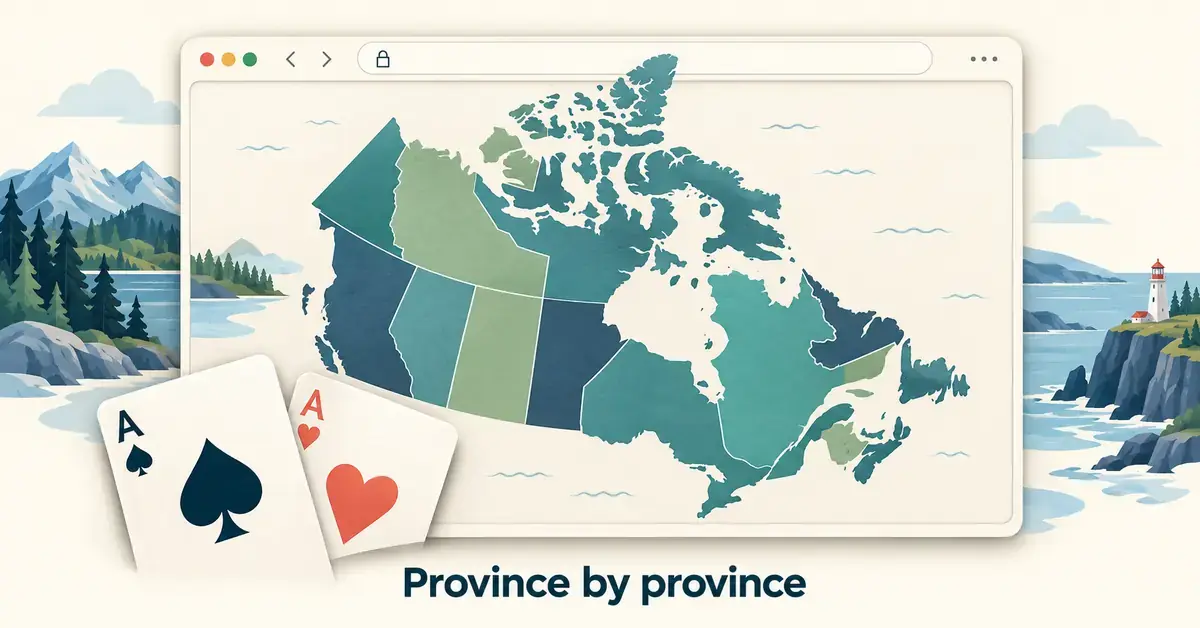
Online poker is legal in Canada, but with an important condition: the game has to be run by a provincial authority or by an operator that province has licensed. There is no single national online poker licence and no Canada-wide “legal” or “illegal” switch. Instead, each province decides what online gambling looks like inside its own borders, so the honest answer to “is online poker legal in Canada?” is “yes, where you play on a provincially sanctioned site” — and that site is different depending on where you live. This guide explains the law in plain English and then walks through the situation province by province.
Key Points
- Legal when provincially sanctioned: online poker is legal in Canada on sites a province conducts, manages or licenses — there is no national licence or single national answer.
- Two open markets: Ontario (licensed since April 2022, 19+) and Alberta (licensed since 13 July 2026, 18+) allow competing private operators.
- Single-platform provinces: British Columbia, Manitoba and Saskatchewan use PlayNow, and Quebec uses Espacejeux; Atlantic Canada’s provincial body runs casino and sports more than a dedicated poker room.
- Grey market: offshore sites are not provincially licensed, carry no Canadian player protections and sit in a legal grey area.
- Legal age: 18 in Alberta, Manitoba and Quebec; 19 everywhere else.
- Shared liquidity: whether Ontario can pool players with international markets is before the Supreme Court of Canada (heard October 2026, decision pending).
Is online poker legal in Canada? The short answer
Yes — online poker is legal in Canada when you play on a site that a province conducts, manages or licenses. The catch is that “a province” does the authorising, not the federal government. Two provinces, Ontario and Alberta, have opened competitive markets where private operators can apply for a licence. The rest of the country offers online poker only through a single government-run platform, if it offers a dedicated poker room at all. Playing on those sanctioned options is clearly legal for adults of the right age. Everything else — the many offshore sites that accept Canadian players without a provincial licence — sits in a long-standing legal grey area, which the next sections unpack.
How Canadian gambling law actually works
Gambling in Canada is governed by the federal Criminal Code, which treats most betting as prohibited and then carves out exceptions. The key exception is section 207(1)(a): it allows a provincial government to “conduct and manage” a lottery scheme in that province, on its own or jointly with another province. Courts have long read “lottery scheme” broadly enough to include casino games and computer- or internet-based gaming.
Two practical consequences follow from that single clause. First, a legal online poker site in Canada is one that a province conducts and manages (directly, or through an operator it has licensed and that works within its framework). Second, because the authority is provincial, the rules — platforms, legal age, whether a poker room even exists — change the moment you cross a provincial line. That is why a national “is it legal” question only has provincial answers.
Regulated sites vs. grey-market sites: the key distinction
The single most useful thing to understand is the difference between a regulated site and a grey-market one, because it drives both legality and your protections.
- Provincially regulated sites are conducted or licensed by your province. They carry local player protections: identity and age verification, deposit and loss limits, self-exclusion tools, segregated player funds and a regulator you can complain to. These are the unambiguously legal option.
- Grey-market (offshore) sites are run from outside Canada and are not licensed by any Canadian province. They are not Canadian-regulated, so the local protections above do not apply, and there is no provincial regulator to turn to in a dispute. Enforcement against these operators has historically been minimal, but “rarely prosecuted” is not the same as “licensed and safe.”
This guide stays neutral and does not name or recommend operators. It describes what each province sanctions so you can tell a regulated option from a grey-market one. For the national overview and safe-play basics, see our guide to poker laws in Canada.
Online poker province by province
Below is the current landscape in each province and territory. Platforms and availability change, so always confirm on the official provincial site before you play.
Ontario
Ontario has Canada’s most open online poker market. Since April 2022 it has run a regulated, competitive iGaming market overseen by the Alcohol and Gaming Commission of Ontario (AGCO), with iGaming Ontario (iGO) acting as the conduct-and-manage body that licensed private operators work under. The legal age is 19, and licensed sites must meet strict player-protection standards. Because this is the deepest market in the country, we cover it separately in our dedicated guide to online poker in Ontario.
Alberta
Alberta became the second province with a competitive market when its regulated iGaming market launched on 13 July 2026 under the iGaming Alberta Act. The new framework created the Alberta iGaming Corporation (AiGC) to conduct and manage the market, with the Alberta Gaming, Liquor and Cannabis Commission (AGLC) as regulator. Licensed private operators can offer online poker to Alberta adults, and the legal age is 18. Because the market is new, the roster of live operators is still settling, so check that a site is AGLC-registered before depositing.
British Columbia, Manitoba and Saskatchewan
These provinces do not license private operators. Instead they use PlayNow, the platform built and run by the British Columbia Lottery Corporation (BCLC). British Columbia offers it directly; Manitoba offers PlayNow through an arrangement with BCLC; and Saskatchewan launched PlayNow in November 2022, operated locally by the Saskatchewan Indian Gaming Authority (SIGA). PlayNow has historically run a dedicated online poker room, and British Columbia, Manitoba and Quebec share their poker player pool through an interprovincial compact known as the Canada Poker Network, which gives those tables more players to fill them. The legal age is 19 in British Columbia and Saskatchewan and 18 in Manitoba.
Quebec
Quebec offers online poker through Espacejeux, the platform run by the provincial lottery corporation Loto-Québec. Quebec has not opened licensing to private operators, so Espacejeux is the sanctioned route, and its poker tables are connected to the shared Canada Poker Network pool alongside British Columbia and Manitoba. The legal age is 18. Quebec once tried to force internet providers to block unlicensed gambling sites, but that measure was struck down in court, leaving Espacejeux as the legal option rather than a blocker on everything else.
Atlantic Canada
New Brunswick, Nova Scotia, Prince Edward Island and Newfoundland and Labrador share a single regional body, the Atlantic Lottery Corporation (ALC), which runs the region’s sanctioned online gambling. ALC’s online offering centres on casino and sports products; a dedicated, always-on online poker room has not been a core part of it, so Atlantic players have the fewest home-grown poker options. The legal age across the Atlantic provinces is 19.
The territories
Yukon, the Northwest Territories and Nunavut do not operate their own online poker platforms. Residents fall under the same federal framework, and the legal age for gambling is generally 19. In practice there is no territorially conducted online poker room, so sanctioned options are limited.
Province-by-Province Comparison
| Province / region | Market type | Sanctioned platform / regulator | Legal age | Dedicated online poker? |
|---|---|---|---|---|
| Ontario | Competitive, licensed | iGaming Ontario / AGCO | 19 | Yes (multiple licensed sites) |
| Alberta | Competitive, licensed | Alberta iGaming Corporation / AGLC | 18 | Yes (since 13 July 2026) |
| British Columbia | Single government platform | PlayNow (BCLC) | 19 | Yes (Canada Poker Network pool) |
| Manitoba | Single government platform | PlayNow (via BCLC) | 18 | Yes (Canada Poker Network pool) |
| Saskatchewan | Single government platform | PlayNow (operated by SIGA) | 19 | Yes (rolled out after 2022 launch) |
| Quebec | Single government platform | Espacejeux (Loto-Québec) | 18 | Yes (Canada Poker Network pool) |
| Atlantic Canada (NB, NS, PEI, NL) | Single regional body | Atlantic Lottery Corporation | 19 | Limited (casino/sports focus) |
| Territories (YT, NT, NU) | No provincial platform | None dedicated | 19 (general) | No dedicated room |
Why “shared liquidity” is the big legal question right now
Shared liquidity means combining players from different places into one pool so the tables and tournaments are busier. It matters for poker more than for slots, because poker needs opponents: a ring-fenced provincial pool can feel empty, while a larger pool runs more games at more stakes.
Domestically, this already happens: the Canada Poker Network links British Columbia, Manitoba and Quebec. The bigger fight is about linking a Canadian province’s players with international pools. In November 2025 the Ontario Court of Appeal ruled 4–1 that Ontario’s international pooled-liquidity model could be lawful under the Criminal Code — provided Ontario keeps “conducting and managing” its own part of the scheme through iGaming Ontario. Several provincial lottery corporations appealed, and the Supreme Court of Canada heard arguments on 7 October 2026 and reserved its decision. As of this writing no final ruling has been released, so the rules for connecting Ontario players to the global player pool are not yet settled. Nothing here changes whether online poker is legal in your province today; it affects how big the player pools may eventually get.
What about offshore poker sites?
Offshore sites are the grey market described earlier: operators based outside Canada that accept Canadian players without a provincial licence. The legal reality has two parts worth separating.
- For the operator: taking bets from Canadians without provincial authorisation is widely regarded by Canadian gaming lawyers as offside the Criminal Code, yet charges against offshore poker operators have been rare to non-existent, which is why so many still serve the market.
- For the player: individual recreational players are not the target of enforcement, but playing offshore means no Canadian regulator stands behind you. If a site freezes a withdrawal, voids a bonus or simply disappears, there is no provincial body to escalate to.
The safer, unambiguously legal path is the sanctioned option in your province. That is also the only way you get mandatory age checks, deposit limits and self-exclusion built in.
Legal age to play online poker by province
The legal age to gamble online is set provincially and it is not the same everywhere. It is 18 in Alberta, Manitoba and Quebec, and 19 in every other province and in the territories. You must meet the age where you are physically located, and regulated sites verify it before you can play for real money. For the full breakdown and the ID rules, see our guide to the legal gambling age in Canada by province.
Are online poker winnings taxed in Canada?
For most recreational players, poker winnings in Canada are treated as a non-taxable windfall rather than income, so a casual player typically does not pay tax on them. The picture can change for someone whose play rises to the level of a “business of gambling,” where the Canada Revenue Agency may treat winnings as taxable business income. The line is fact-specific and this is not tax advice — our explainer on whether poker winnings are taxable in Canada covers how the distinction is drawn, and you should confirm your own situation with a professional or the CRA.
Common misconceptions about online poker legality in Canada
A few myths come up again and again. Clearing them up prevents expensive mistakes.
- “There’s a national online poker law.” There isn’t. Authority is provincial, so the legal option depends on your province, not on Canada as a whole.
- “If a site lets Canadians sign up, it must be licensed here.” Not necessarily. Many offshore sites accept Canadian players without any provincial licence; being reachable is not the same as being regulated.
- “Ontario and Alberta rules apply across Canada.” They don’t. A site licensed by the AGCO or the AGLC is authorised for that province’s players, not for the whole country.
- “The legal age is 18 everywhere.” It is 18 only in Alberta, Manitoba and Quebec; it is 19 elsewhere.
- “The Supreme Court case decides whether online poker is legal.” It doesn’t. That case is about linking Ontario players to international pools, not about whether provincially run poker is allowed.
Responsible gambling and legal disclaimer
This article is general information, not legal, financial or tax advice. Gambling laws and platforms in Canada change, and the Supreme Court matter above was undecided at the time of writing — verify the current position with the official provincial regulator or a qualified professional before you act. Only adults of the legal age in their own province may gamble, and only provincially sanctioned sites are regulated in Canada. Poker involves real financial risk; never wager money you cannot afford to lose. If gambling is affecting you or someone you know, confidential help and self-exclusion tools are available across the country — see our responsible gambling resources for Canada for provincial help lines and support.
Sources
- Criminal Code, section 207 (Permitted lotteries) — Justice Laws Website
- Alcohol and Gaming Commission of Ontario — iGaming
- iGaming Ontario
- Government of Alberta — Alberta’s iGaming Strategy
- BLG — Ontario Court of Appeal decision on international pooled liquidity
- Pokerfuse — Canada’s Supreme Court hears Ontario online poker shared-liquidity case
- PlayNow (British Columbia Lottery Corporation)
- Loto-Québec (Espacejeux)
- Atlantic Lottery Corporation
Frequently Asked Questions (FAQ)
Is it illegal to play online poker in Canada?
No. Playing online poker on a provincially run or provincially licensed site is legal for adults of the right age. The grey area is around offshore sites that have no Canadian provincial licence — using them is not clearly legal and comes with none of the local player protections.
Which Canadian provinces have legal online poker?
All provinces can offer sanctioned online gambling, but the poker options differ. Ontario and Alberta have competitive licensed markets; British Columbia, Manitoba, Saskatchewan and Quebec offer poker through a single government platform (PlayNow or Espacejeux); and Atlantic Canada’s provincial body focuses on casino and sports rather than a dedicated poker room.
What is the legal age for online poker in Canada?
It is set by each province: 18 in Alberta, Manitoba and Quebec, and 19 in every other province and in the territories. Regulated sites verify your age before you can play for real money.
Are offshore poker sites legal in Canada?
Offshore sites are not licensed by any Canadian province, so they sit outside the regulated system. Enforcement against players is effectively unheard of, but there is no Canadian regulator to protect you, so a provincially sanctioned site is the safer and clearly legal choice.
Can Ontario players play against international opponents online?
That is exactly the question before the Supreme Court of Canada. The Ontario Court of Appeal ruled in late 2025 that international pooled liquidity could be lawful, the decision was appealed, and the Supreme Court heard the case in October 2026 and has not yet released a final ruling.
