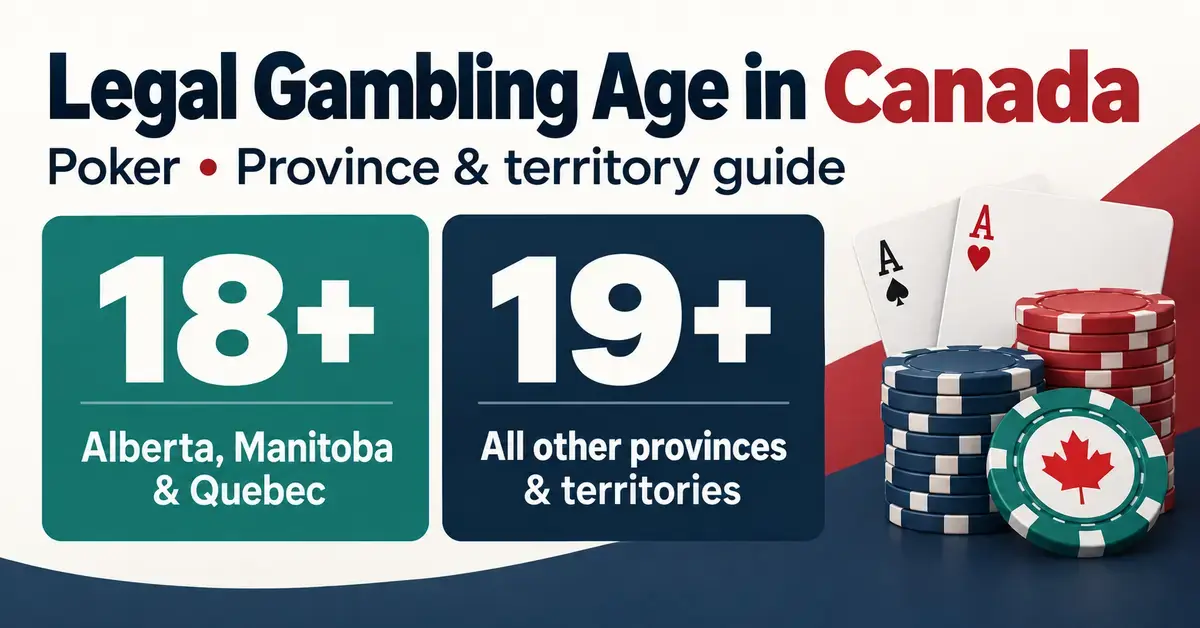
The legal gambling age in Canada is either 18 or 19, and which one applies depends on the province or territory you are in. You can play poker for real money at 18 in Alberta, Manitoba and Quebec; everywhere else in Canada the minimum age is 19. The age is set provincially, it applies the same way to live poker rooms and regulated online poker, and it holds no matter how old you are in another province. This guide breaks the rules down province by province, explains the 18-versus-19 split, and covers the legality caveat every Canadian poker player should understand before sitting down.
Key Points
- Two ages only: 18 in Alberta, Manitoba and Quebec; 19 in every other province and territory.
- Set provincially: Canada has no single national gambling age — each province and territory decides.
- Same age for all poker: live card rooms and regulated online poker use the provincial gambling age.
- Adult ≠ gambling age: in Ontario, Saskatchewan and PEI you are an adult at 18 but cannot gamble until 19.
- Where you play matters: the age of the province you are physically in applies, not your home province.
- Licensed play only: poker is legal only when conducted or licensed by a province.
What is the legal gambling age in Canada?
There is no single national gambling age in Canada. Gambling, including poker, is regulated by each province and territory, so the minimum age is set locally rather than by the federal government. In practice this produces just two numbers:
- 18 in Alberta, Manitoba and Quebec.
- 19 in British Columbia, Saskatchewan, Ontario, New Brunswick, Nova Scotia, Prince Edward Island, Newfoundland and Labrador, and in all three territories (Yukon, the Northwest Territories and Nunavut).
The age applies to the player, not the game. Whether you are buying into a casino poker tournament, joining a cash game in a card room, or logging in to a provincially regulated online poker site, the same minimum age for your province is the one that counts. The table below shows every province and territory at a glance.
Gambling Age by Province
| Province / Territory | Minimum gambling age | Note |
|---|---|---|
| Alberta | 18 | Regulated competitive online market opened July 2026 |
| Manitoba | 18 | — |
| Quebec | 18 | Online play via Loto-Québec |
| British Columbia | 19 | Online play via BCLC PlayNow |
| Saskatchewan | 19 | Adult at 18, but gamble at 19 |
| Ontario | 19 | Lottery tickets at 18; casino & online at 19 |
| New Brunswick | 19 | — |
| Nova Scotia | 19 | — |
| Prince Edward Island | 19 | Adult at 18, but gamble at 19 |
| Newfoundland and Labrador | 19 | — |
| Yukon | 19 | — |
| Northwest Territories | 19 | — |
| Nunavut | 19 | — |
Why is the gambling age 18 in some provinces and 19 in others?
The split exists because each province sets its own gambling age, and most of them tie it to a local benchmark such as the age of majority or the legal drinking age. Alberta, Manitoba and Quebec set both their drinking age and their gambling age at 18, so poker follows at 18. The other provinces and territories draw the line at 19 for alcohol and apply the same threshold to gambling.
Because the age is provincial, your home province does not travel with you. A 19-year-old from Ontario can legally play poker in an Alberta casino, because Alberta’s minimum is 18. An 18-year-old from Alberta, however, cannot legally play in a British Columbia casino, because B.C.’s minimum is 19. The rule that matters is always the one in the province where you are physically playing.
Provinces where you are an adult at 18 but cannot gamble until 19
A common point of confusion is that the gambling age is not always the same as the age of majority — the age at which you are legally an adult. The age of majority is 18 in Alberta, Manitoba, Ontario, Prince Edward Island, Quebec and Saskatchewan, and 19 in the rest of the country. That means in Ontario, Saskatchewan and Prince Edward Island you become a legal adult at 18 but still cannot gamble until you turn 19. Being an adult, being able to vote, or being old enough to sign a contract does not automatically make you old enough to play poker for money.
Does the same age apply to every kind of poker?
Yes — within a given province, one gambling age applies across casino poker, regulated online poker and most other forms of play, with narrow exceptions for products like lottery tickets. Here is how it works for the poker a Canadian is most likely to encounter.
Live poker in casinos and card rooms
Casino and commercial card-room poker uses the provincial gambling age — 18 in Alberta, Manitoba and Quebec, 19 elsewhere. Venues check photo ID at the door and again at the cage, so expect to show valid government-issued identification that proves your age before you can buy chips or register for a tournament.
Online poker
Regulated online poker uses the same provincial age as live play. In Ontario, the licensed online market is restricted to players 19 and over. In Alberta, the newer regulated market is open at 18. Operators verify your date of birth and identity during sign-up, before you can deposit or play.
Home games, charity and “social” poker
Private home games and licensed charity poker events are not a loophole around the age rules. Charitable gaming is run under a provincial licence and applies the provincial minimum age. Even for a casual kitchen-table game, playing for money with minors present is something to avoid — the safe standard is to apply your province’s gambling age to any real-money poker.
The single-age caveat: lottery is the usual exception
Where a province does split the age, it is almost always lottery products, not poker, that sit lower. Ontario is the clearest example: the gambling age for casino and online play is 19, but lottery and scratch tickets can be bought at 18. That exception does not extend to poker — if you want to play cards for money in Ontario, the number is 19.
Is online poker legal in Canada, and at what age?
Online poker is legal in Canada only when it is conducted or licensed by a province, and the minimum age is that province’s gambling age. Two provinces run open, competitive online markets that private operators can join:
- Ontario launched its regulated iGaming market on 4 April 2022, run by iGaming Ontario (iGO), a subsidiary of the Alcohol and Gaming Commission of Ontario (AGCO). Online poker is included and the minimum age is 19. At launch, Ontario’s online poker ran on segregated player pools rather than shared global liquidity.
- Alberta opened its own competitive regulated online market on 13 July 2026 under the iGaming Alberta Act, overseen by the Alberta iGaming Corporation alongside the Alberta Gaming, Liquor and Cannabis Commission (AGLC). The minimum age there is 18.
In every other province, legal online poker and betting run through the provincial lottery corporation’s own platform (for example, Loto-Québec’s site in Quebec or BCLC’s PlayNow in British Columbia), again at the provincial age. Offshore or “grey-market” poker sites that are not conducted or licensed by a Canadian province fall outside this framework; they are not provincially regulated, their age checks and player protections are not supervised by a Canadian regulator, and you have little recourse if something goes wrong. For a fuller picture of how the law applies, see our overview of poker in Canada.
Only provincially licensed play is legal
Being old enough is only half the question — the game itself also has to be legal. Under Canada’s Criminal Code, gambling is prohibited by default, with a key exception that lets a provincial government “conduct and manage” lottery schemes, including casino games and poker, within its borders. Licensed charitable and religious organisations and licensed fairs and exhibitions can also run gaming under provincial licences. The practical result: poker played at a provincially run or provincially licensed venue or site is legal; commercial poker operated outside that provincial framework is not. Meeting the age requirement does not make an unlicensed operator legal.
How is your age checked when you play poker?
Age is verified by document and identity checks, not an honour system. In a casino or card room, staff ask for valid government-issued photo ID — such as a driver’s licence or passport — at entry and when you cash in or register for an event. On regulated online sites, you complete an identity and age verification step during registration, where the operator confirms your date of birth (and often your identity and location) before letting you deposit or play. Regulators treat the age check as a core safeguard, and operators that let underage players through face enforcement action, so expect the verification to be strict.
Common mistakes about the gambling age in Canada
Even experienced players get tripped up by the details. The most frequent errors:
- Assuming it is 18 everywhere. It is 18 only in Alberta, Manitoba and Quebec. In the other ten jurisdictions it is 19.
- Treating the age of majority as the gambling age. In Ontario, Saskatchewan and Prince Edward Island you are a legal adult at 18 but still cannot gamble until 19.
- Thinking your home-province age follows you. The age that applies is the one where you are physically playing, not where you live.
- Confusing lottery age with poker age. Ontario’s 18 limit is for lottery and scratch tickets; poker is 19.
- Believing an offshore site is fine if you meet its age. Being old enough does not make an unlicensed, non-provincial operator legal or supervised in Canada.
- Playing for money with minors in a home game. The provincial gambling age is the safe standard even informally.
If you are still learning the game itself before worrying about where you can play it, start with our guide to how to play poker, and build from there with our poker strategy fundamentals.
Responsible Gambling & Legal Disclaimer
This article is general information about the legal age to play poker in Canada and is not legal advice. Gambling laws and ages are set and periodically changed by each province and territory; always confirm the current rules with the relevant provincial regulator or a qualified professional before you play. Poker is a form of gambling and carries a real risk of financial loss — no guide, strategy or demo play changes the odds of the game. Only play at venues and sites that are conducted or licensed by your province, and never play if you are under the legal age where you are.
If gambling is causing you or someone you know harm, free, confidential help is available in Canada. ConnexOntario offers support 24/7 at 1-866-531-2600 (or text CONNEX to 247247); outside Ontario, each province has its own helpline and regulator. For mental-health crisis support anywhere in Canada, call or text 9-8-8. You can also set deposit and time limits or self-exclude through your provincial operator. For verified help lines and tools province by province, see our responsible gambling resource.
Sources
- Legal Line — What is the legal age to gamble?
- Legal Line — Is gaming/gambling legal in Canada?
- AGCO — “Conduct and manage” in the Criminal Code
- Justice Laws Canada — Criminal Code, section 207
- iGaming Ontario (iGO)
- Alberta Gaming, Liquor and Cannabis (AGLC)
- Age of majority by province and territory in Canada
Frequently Asked Questions (FAQ)
What is the legal gambling age in Canada?
It is 18 in Alberta, Manitoba and Quebec, and 19 in every other province and territory. There is no single national age because gambling is regulated provincially.
Can you play poker at 18 in Canada?
Only in Alberta, Manitoba and Quebec, where the gambling age is 18. In the rest of Canada you must be 19 to play poker for money, whether live or on a regulated online site.
Why is the gambling age 19 in Ontario when you are an adult at 18?
Ontario’s age of majority is 18, but the province sets its gambling and drinking age at 19. Being a legal adult does not lower the gambling age, so you must be 19 to play poker in Ontario. The same gap applies in Saskatchewan and Prince Edward Island.
Does my home province’s gambling age apply when I travel?
No. The age that applies is the one in the province where you are physically playing. An 18-year-old from Alberta cannot legally play in a British Columbia casino, where the minimum is 19.
Is online poker legal in Canada, and what age do I need to be?
Online poker is legal when it is run or licensed by a province. Ontario’s regulated market is open at 19 and Alberta’s at 18; elsewhere, play runs through the provincial lottery corporation’s site at the provincial age. Offshore sites are not provincially regulated.
