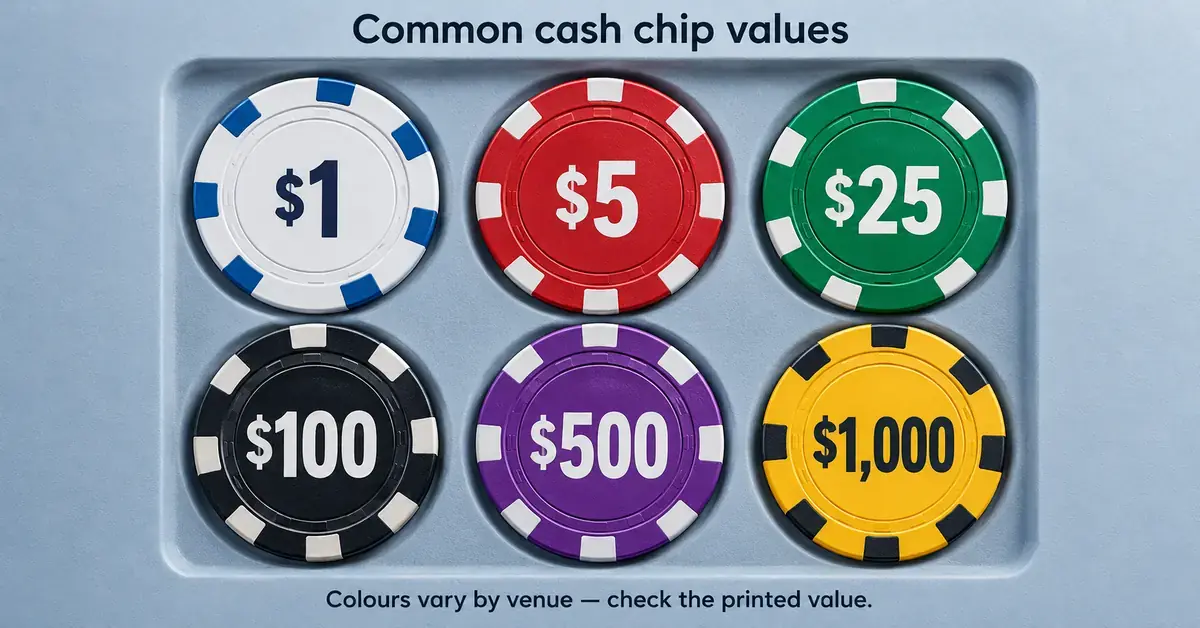
Poker chip denominations are the fixed cash or point values assigned to each colour of chip on the table, so that a stack of coloured discs can stand in for money without anyone counting bills on every pot. If you have ever wondered why the red chips are worth $5 and the black ones $100, or how to split a set of chips fairly for a home game, this guide explains the colours, the values and the method for setting them. One thing to say up front: there is no single worldwide standard, but there is a widely shared convention that most Canadian and North American rooms follow closely.
Key Points
- Each chip colour maps to a fixed denomination (value), so coloured discs can stand in for money at the table.
- The common North American cash scheme: white $1, red $5, green $25, black $100, purple $500, yellow/orange $1,000.
- There is no single worldwide standard — colours vary by venue, tour and even by table, so read the printed value.
- Tournament chips have no cash value; they are scoring units with large round denominations.
- For a home game, use three to four denominations, weighted toward the smallest, with roughly 4x–5x gaps between steps.
What does “poker chip denomination” actually mean?
A denomination is the value printed on, or assigned to, a single chip. Each colour in a set maps to one denomination, so players can read the table at a glance: a short stack of black chips can be worth far more than a tall stack of white ones. Denominations let the game move quickly, because a bet of $275 is three green chips ($25 each) and two black chips ($100 each) rather than a fistful of loose cash.
Chips serve two jobs. In a cash game they represent real money you can cash out at any time. In a tournament they are scoring units that only matter until you bust or the event ends. That difference, explained below, is the single biggest reason the same colour can mean $25 in one game and 25,000 in another.
What are the standard poker chip colours and values?
The most widely used cash-game scheme in North American card rooms runs white $1, red $5, green $25, black $100, purple $500 and yellow or orange $1,000. These six are the backbone of nearly every poker room, and red, green and black in particular are close to universal. Lower-stakes rooms add fractional chips such as $0.25 and $0.50, and some venues slot a $10 chip (often blue) or a $50 chip between the staples.
Standard Cash Chip Values
| Chip colour | Common cash value | Notes |
|---|---|---|
| White (or grey/blue) | $1 | Everyday workhorse chip |
| Red | $5 | Near-universal |
| Blue | $10 | Varies; $50 in some rooms |
| Green | $25 | Near-universal |
| Black | $100 | Near-universal |
| Purple | $500 | High-limit games |
| Yellow or orange | $1,000 | High-limit games |
| Larger plaques | $5,000+ | Colours and shapes vary by venue |
Treat that chart as the common convention, not a rule book. Casinos choose their own colours, and the trickiest ones are blue and orange: blue is $10 in some rooms and $50 in others, while orange shows up as both $1,000 and, in a few sets, a low chip. Always check the value printed on the chip or the room’s posted chip sheet before you sit down.
Why is there no single official colour standard?
There is no universal standard because no central body ever set one, and casinos, tournament tours and home sets all evolved their own conventions. Regulators approve a casino’s specific chip designs for security and anti-counterfeiting reasons, but they do not dictate a nationwide colour-to-value map. The result is that colours are consistent enough to be intuitive yet vary from venue to venue, and even between a room’s cash tables and its tournament area.
For players this means two habits are worth keeping: read the printed value rather than trusting the colour, and never assume a borrowed or second-hand chip set uses the same scheme as the casino down the road.
How do cash chips differ from tournament chips?
Cash chips equal real money and can be exchanged at the cashier for their face value; tournament chips have no cash value at all. When you buy into a tournament, your entry fee goes into the prize pool and you receive a starting stack of tournament chips that only score your standing in the event. You cannot walk to the cage and cash them in — the payout comes from where you finish, not from the chips in front of you.
Because of that, tournament denominations are usually much larger numbers. A buy-in might hand you a 10,000-chip starting stack built from 25s, 100s, 500s and 1,000s, and as the event runs the smallest chips are removed from play. Tournament chips are also often a different physical design or marked “no cash value” so they can never be confused with the room’s cash chips.
What colours do the big tournament series use?
Major tours each run their own denomination ladders, and the numbers climb into the millions in long events. The values below are representative of the sets used by the World Series of Poker (WSOP), the European Poker Tour (EPT) and the World Poker Tour (WPT); exact colours can change season to season, so they illustrate the scale rather than a fixed rule.
| Denomination | WSOP (typical) | EPT (typical) | WPT (typical) |
|---|---|---|---|
| 25 | Green | Green | — |
| 100 | Black | Black | Black |
| 500 | Light blue | Purple | Red |
| 1,000 | Yellow | Red | Yellow |
| 5,000 | Orange | Yellow | Blue |
| 25,000 | Dark green | Grey | Green |
| 100,000 | Lavender | Pink | — |
Deep events add oversized high-value chips — the WSOP Main Event eventually introduces 1,000,000 and 5,000,000 chips — but these are rare novelties for the final stages, not everyday denominations. You will find the authoritative chart for any given event on that tour’s own chip sheet.
How do you set denominations for a home game?
Set your denominations to match the blinds (for cash) or the starting stack (for a tournament), then keep the ladder short and the gaps roughly four to five times each step. A tight, predictable ladder is what makes a home game run smoothly; too many close values just slow down counting and making change. Three or four colours is plenty for most home games, and five is the sensible maximum.
For a home cash game
Pick the smallest chip so it covers the small blind, then build up from there. A classic $1/$2 home game uses $1, $5, $25 and $100 chips. A $200 buy-in splits cleanly into a stack that is weighted toward the smaller chips, because those handle the blinds and most pots. This is also where sensible bankroll management starts: decide the buy-in before anyone sits down.
| Chip | Value | Count | Subtotal |
|---|---|---|---|
| White | $1 | 20 | $20 |
| Red | $5 | 16 | $80 |
| Green | $25 | 4 | $100 |
| Buy-in total | $200 | ||
For a home tournament
Give everyone an identical starting stack and use round denominations that let players make change for the blinds. A 3,000-chip stack built from 25s, 100s, 500s and a single 1,000 works well and leaves room for the blinds to climb. Knowing how blinds and antes work helps you choose a smallest chip that the opening blind level can actually use.
| Chip | Value | Count | Subtotal |
|---|---|---|---|
| Green | 25 | 8 | 200 |
| Black | 100 | 8 | 800 |
| Purple | 500 | 2 | 1,000 |
| Yellow | 1,000 | 1 | 1,000 |
| Starting stack | 3,000 | ||
For the full picture on equipment, blind structures and house rules, see our companion guide to hosting a home poker game.
How many chips do you need per player?
Plan on roughly 25 to 50 chips per player, weighted heavily toward the smallest denomination, and check the total against your set size. Most retail sets contain 300, 500 or 1,000 chips, so a 500-chip set comfortably seats a full table of eight to ten players once you leave spare chips for rebuys and colour-ups.
- Weight the small chips. A common rule of thumb puts about 40% of a stack’s value in the smallest chip, 40% in the middle and 20% in the largest, so there are always enough small chips to post blinds and pay small pots.
- Keep spares. Hold back extra small-denomination chips for making change and for rebuys or add-ons.
- Match the set. Multiply your per-player count by the number of seats and confirm it fits the box before game night.
What are colouring up and a chip race?
Colouring up is the process of removing low-value chips from play as blinds rise, swapping them for larger denominations so stacks stay manageable. In a tournament, once the 25 chips are no longer needed for any blind or ante, the dealer exchanges them for 100s and higher. This does not change anyone’s total — it just reduces clutter and speeds up the game.
When a player’s leftover small chips do not divide evenly into the next denomination, the room runs a chip race: the odd chips are counted, and players draw cards for the few rounded-up chips so no value is lost. Colouring up is standard at organised poker tournaments in Canada and is worth copying at a serious home tournament.
What are the most common mistakes when setting denominations?
The most common mistake is using too many denominations, which slows the game and confuses new players. Below are the errors that trip up home hosts most often, each with a simple fix.
- Too many colours. Five is the ceiling; three or four is ideal. Extra denominations rarely add anything but counting time.
- Not enough small chips. If players cannot post a small blind without breaking a big chip every hand, the game grinds. Give everyone plenty of the lowest denomination.
- Similar colours for different values. Two shades of blue, or green next to teal, cause misreads and disputes. Choose colours that are obvious across the table.
- Mixing two chip sets. Combining sets often means the same colour carries two different values. Pick one set and one scheme per game.
- Denominations too close together. A ladder of 1, 2, 3, 5 forces constant change-making. Keep roughly 4x–5x gaps so bets and pots resolve cleanly.
- Forgetting the blinds. Denominations must let players pay the opening blind level exactly; pick the smallest chip to match the small blind, not the other way around.
Get these right and the chips disappear into the background, which is exactly what you want. For the wider fundamentals of the game, start with our guide to how to play poker.
Responsible play
This article explains chip values and setup only; it is informational and not a betting system or financial advice. Chips make money abstract, which can make it easier to lose track of what you are wagering, so set a buy-in you can afford to lose before you play and treat tournament chips as entertainment, not an investment. If gambling stops being fun, free, confidential help is available across Canada — see our responsible gambling resource for provincial help lines and self-exclusion options. You must be of legal gambling age in your province to play for money.
Sources
Frequently asked questions (FAQ)
What is the value of each poker chip colour?
In the most common North American scheme, white is $1, red $5, green $25, black $100, purple $500 and yellow or orange $1,000. This is a convention rather than a fixed rule, so always check the value printed on the chip or the room’s chip sheet, especially for blue and orange, which vary between venues.
Why is red $5 and black $100 in almost every casino?
Red, green and black are the three most consistent poker chip colours worldwide because the $5 / $25 / $100 ladder covers the most common stakes, and long-standing habit keeps rooms aligned so travelling players can read any table instantly. There is no law requiring it, but the convention is nearly universal.
Do tournament chips have real cash value?
No. Tournament chips are scoring units with no cash value; you cannot exchange them at the cashier. Your payout depends on where you finish in the event, not on the chips in front of you, which is why tournament denominations use large round numbers like 25, 100, 500 and 1,000.
How many chips do I need for a home game?
Plan on about 25 to 50 chips per player, weighted toward the smallest denomination. A 500-chip set covers a full table of eight to ten with spares for change and rebuys; match your per-player count to the number of seats and the size of your set.
What denominations should a beginner home set use?
Three or four denominations are ideal. For a small cash game, $1, $5, $25 and $100 chips work well; for a home tournament, use round values such as 25, 100, 500 and 1,000. Keep gaps around four to five times each step and never exceed five colours.
