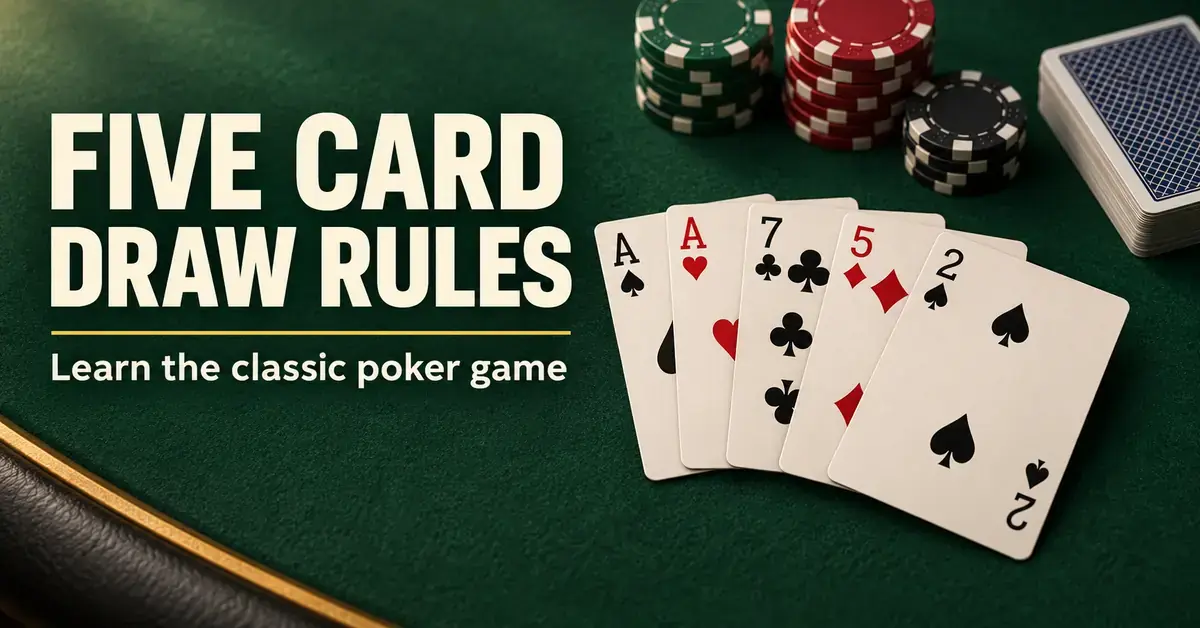
Five card draw is the poker variant most people picture when they imagine a card game around a kitchen table: everyone is dealt five cards, you swap the ones you do not like for fresh ones, and the best five-card hand wins the pot. It is the simplest form of poker to learn, which makes it an ideal first game for absolute beginners before you move on to community-card games like Texas Hold’em. This guide explains the rules of five card draw step by step — the ante, the deal, the single draw, the two betting rounds and the showdown — then covers betting structures, beginner strategy, the real odds of improving your hand, common mistakes and the main draw-poker variants. If you are brand new to the game, it pairs well with our wider beginner’s guide to how to play poker.
Quick Facts
| Players | 2–8 (best with 3–6) |
|---|---|
| Deck | Standard 52-card deck (no jokers in the basic game) |
| Cards per player | 5, dealt face down |
| Betting rounds | 2 — one before the draw, one after |
| The draw | One draw; exchange up to 3 cards (house rules vary) |
| Goal | Make the best five-card poker hand |
| Skill level | Beginner-friendly |
| Also known as | 5 card draw, draw poker |
What is five card draw?
Five card draw is a draw-poker game in which each player holds their own private five-card hand and has one chance to exchange cards to improve it. Unlike Hold’em or Omaha, there are no shared community cards and no cards are dealt face up — every card is hidden from your opponents, so bluffing and reading betting patterns matter more than seeing exposed cards.
The game is often called “draw poker” or simply “5 card draw.” It was the dominant home and saloon game for much of the 20th century and remains the easiest way to teach poker, because a single hand has only two betting rounds and one decision point about which cards to keep.
What you need to play five card draw
You need very little to start a home game. The requirements are deliberately minimal, which is part of why the variant is such a good gateway.
- A standard 52-card deck. No jokers in the basic game, though some home variants add wild cards.
- Two to eight players. It plays best with three to six. With a full table of players each drawing cards, a 52-card deck can run short, which is why larger tables sometimes use a reshuffled discard pile or a stripped deck.
- Chips or a staking method. Players need something to bet with and a shared agreement on stakes before the first hand.
- A dealer button (or an agreed rotation) so everyone knows whose turn it is to deal and act.
How to play five card draw step by step
A hand of five card draw follows the same fixed sequence every time. Agree on the stakes and the house rules first, then run through these stages.
1. Post the ante or blinds
Before any cards are dealt, players put money into the pot as seed money. Home games usually use an ante — every player contributes a small equal amount. Casino and card-room games usually use blinds, where only the one or two players to the dealer’s left post a forced bet. Either way, there is something in the pot worth competing for before the deal.
2. The deal
The dealer gives each player five cards, dealt one at a time and face down, starting with the player on the dealer’s left and moving clockwise. The remaining deck (the “stub”) is set aside, often marked with a chip, because it will supply the replacement cards during the draw. Players look at their own hands but keep them concealed.
3. The first betting round
Action begins to the left of the big blind (in blinds games) or to the dealer’s left (in antes games) and moves clockwise. On this round each player may:
- Fold — give up the hand and any chips already committed.
- Check — pass the action without betting, only allowed if no one has bet yet (and typically not available in blinds games, where the blind counts as the opening bet).
- Bet or raise — put chips in, forcing others to match.
- Call — match the current bet to stay in the hand.
Some home games add a “jacks or better” rule, meaning a player needs at least a pair of jacks to open the betting; this variant is covered below.
4. The draw
Once the first round of betting is settled, each remaining player in turn announces how many cards they want to discard and receives the same number of fresh cards from the top of the stub. You may choose to discard nothing and keep all five — this is called standing pat. The number of cards a player draws is public information and a major clue to the strength of their hand.
5. The second betting round
After everyone has drawn, a second and final betting round takes place, usually beginning with the player who opened the first round (in antes games) or the first active player to the dealer’s left. Checking is normally allowed here even in blinds games. Players bet, call, raise or fold exactly as before.
6. The showdown
If two or more players remain after the final bet is called, there is a showdown: the players reveal their hands and the best five-card hand wins the whole pot. If everyone else folds to a bet at any point, the last player standing wins without showing their cards.
The draw: how many cards can you swap?
You can usually exchange as many of your five cards as you like, but the exact limit depends on the house rules you agree on, so settle this before you deal.
- The common three-card house rule. Many low-stakes social games cap the draw at three cards, with one exception: a player may draw four if they show and keep an ace (or a wild card). This rule is useful at the kitchen table but is generally unnecessary in casinos.
- Drawing four or five. Formal rules often let you draw up to four, and some allow all five. Many casinos will not deal five replacement cards in a row — they deal you four, let the other players draw, then give you the fifth, so one person does not take an unfair run of the deck.
- The bottom card. A common safeguard is that the dealer never gives out the bottom card of the stub as a replacement; a card is burned instead if the deck runs low.
Hand rankings used in five card draw
Five card draw uses the standard poker hand rankings, from a high card at the bottom up to a royal flush at the top. Because you are building the single best five-card hand, knowing the order cold is the foundation of every decision you make. The full order, with example cards and a printable chart, is in our guide to poker hand rankings. In short, from weakest to strongest: high card, one pair, two pair, three of a kind, straight, flush, full house, four of a kind, straight flush and royal flush.
One exception is worth knowing: in a stripped-deck game (using 32 or 36 cards instead of 52), a flush outranks a full house, because flushes become harder to make when low cards are removed.
Betting structures: antes, blinds and limits
How much you can bet is set by the betting structure, agreed before play. The three common formats are:
- Fixed-limit (or limit). Bets and raises come in fixed increments — often a smaller size before the draw and a larger size after. This keeps swings small and is friendly for beginners.
- Pot-limit. The maximum bet is the current size of the pot, so bets can grow quickly on later streets.
- No-limit. A player may bet any amount up to all of their chips at any time.
A structural quirk of limit draw: a player who checks on the second betting round often cannot raise later in that same round, and a player with a strong hand who checks after the draw may forfeit any claim to money bet after the draw. These rules do not apply in pot-limit or no-limit games. Again, confirm the house version before you sit down.
Basic five card draw strategy for beginners
The core skill in five card draw is deciding which cards to keep and which to throw away, then betting in a way that does not give your hand away. These fundamentals get you started; our wider poker strategy guide goes deeper on position, pot odds and bankroll.
Which cards should you keep and discard?
- One pair: keep the pair and draw three. Resist keeping a high “kicker” — drawing three gives you the best chance to improve.
- Two pair: keep all four and draw one, hoping to fill a full house.
- Three of a kind: draw two cards to chase a full house or four of a kind (drawing two improves your odds more than keeping a kicker and drawing one).
- Four to a flush or an open-ended straight: draw the one card you need.
- Nothing (a weak high-card hand): usually fold before the draw rather than draw three or four and hope.
When should you stand pat?
Standing pat — drawing no cards — tells the table you already have a made hand such as a straight, flush or better. Strong players sometimes stand pat on a weak hand as a bluff, representing strength to push opponents off a draw. As a beginner, stand pat only when you genuinely hold a straight or better, and bet it to build the pot.
Why does position matter?
Acting later in the betting order is an advantage because you see how many cards your opponents drew and how they bet before you decide. A player who draws three almost certainly started with one pair; a player who stands pat is representing a straight or better. Use that information — it is one of the few reads available in a game with no face-up cards.
Five card draw odds: your chances on the draw
Knowing roughly how often a draw improves your hand keeps you from chasing hopeless cards. The table below shows the approximate chances of improving the most common holdings, assuming you keep only the useful cards and every unseen card is equally likely.
Draw Odds
| Your hand before the draw | Cards you draw | Chance of improving | Approx. odds against |
|---|---|---|---|
| One pair | 3 | ~29% (to two pair or better) | ~2.5 : 1 |
| Two pair | 1 | ~8.5% (to a full house) | ~10.8 : 1 |
| Three of a kind | 2 | ~10% (to a full house or quads) | ~8.6 : 1 |
| Four to a flush | 1 | ~19% (to complete the flush) | ~4.2 : 1 |
| Open-ended straight draw | 1 | ~17% (to complete the straight) | ~4.9 : 1 |
Figures are rounded and assume you keep only the useful cards and that every unseen card is equally likely.
The practical lesson: a single pair improves to two pair or better only about three times in ten, so you should only pay to chase when the pot is large enough to justify the risk — the heart of pot odds.
Common five card draw mistakes
Most beginner losses come from a handful of repeatable errors rather than bad luck.
- Ignoring how many cards opponents drew. The draw count is free information. Not using it is the biggest leak in the game.
- Keeping a kicker with a pair. Holding a high card alongside your pair and drawing two lowers your chance of making trips or two pair compared with drawing three.
- Chasing weak draws out of position. Drawing to an inside (gutshot) straight or paying big to improve a single pair rarely pays off.
- Playing too many hands. Folding weak holdings before the draw costs you nothing but the ante and saves you from expensive second-round bets.
- Never bluffing — or bluffing too much. Because hands are hidden, a believable pat hand or a confident bet can win pots, but predictable bluffing gets picked off.
Draw poker variants to know
Five card draw sits in the draw family of poker variants. Once you know the basic game, these related versions are easy to pick up:
- Ace-to-five (California) lowball: the lowest hand wins, straights and flushes do not count against you, and the ace is low. The best possible hand is 5-4-3-2-A, known as the “wheel.”
- Deuce-to-seven (Kansas City) lowball: the lowest hand wins, but here straights and flushes count against you and the ace is high. The best hand is 7-5-4-3-2.
- 2-7 Triple Draw: a lowball game with three draws and four betting rounds, common in casino mixed games.
- Jacks or better (jackpots): a high-hand draw game in which a player needs at least a pair of jacks to open the betting.
- Badugi: a four-card draw lowball game where the goal is four low cards of different suits and ranks — related to draw poker but with its own hand rankings.
Who is five card draw for?
Five card draw is for anyone learning poker for the first time and for casual home games that want fast, simple hands. Its two betting rounds and single draw make it far less complex than Hold’em or Omaha, so new players can focus on hand values and basic betting without tracking community cards. It is less common in modern casinos and online rooms — where Hold’em dominates — but it remains the classic way to introduce the game and a staple of friendly home sessions.
Disclaimer
This article is educational and explains the rules of five card draw; it is not gambling advice and does not promise winnings. Poker played for money involves risk, and no strategy or practice removes the element of chance. Play only with money you can afford to lose and within limits you set in advance. If gambling is affecting you or someone you know, support is available — see our responsible gambling resources for Canada.
Sources
- 58 Pa. Code § 637a.13 — Five-card Draw Poker: procedures for dealing the cards and completing each round of play
- California Department of Justice — Approved Oaks Card Club game rules (draw and lowball procedures)
- Wizard of Odds — Poker Probabilities
- University of Hawaii — Probability: 5-Card Poker Hands
- CBS News — Step Two: Learn Five-Card Draw
Frequently Asked Questions (FAQ)
How many cards can you exchange in five card draw?
It depends on the house rules. Many social games cap the draw at three cards (with an exception allowing four if you keep an ace), while formal rules often let you draw up to four or even all five. Agree on the limit before you deal.
How many players can play five card draw?
Two to eight players can play, but the game works best with three to six. With a full table drawing replacement cards, a single 52-card deck can run short, so large games may reshuffle the discards or use a stripped deck.
What beats what in five card draw?
Five card draw uses the standard poker hand rankings, from high card at the bottom up to a royal flush at the top. The one common exception is the stripped-deck game, where a flush outranks a full house.
Is five card draw the same as video poker?
No. Video poker machines borrow the draw mechanic — you are dealt five cards and get one draw — but you play against a paytable alone, not against other players, and there is no betting round against opponents or bluffing.
What is the best strategy in five card draw?
Fold weak hands before the draw, keep your strongest cards (draw three to a pair, one to two pair or a four-card flush or straight), watch how many cards opponents draw, and only chase draws when the pot justifies the cost.
