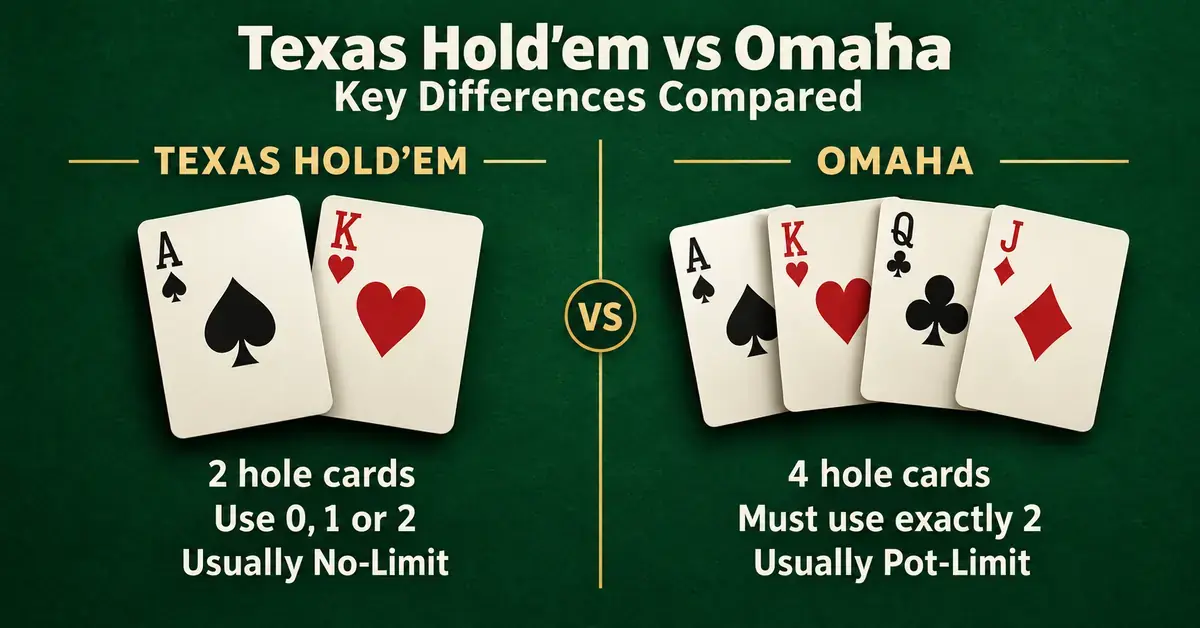
Texas Hold’em and Omaha are the two most widely played community-card poker games in the world, and at the table they look almost identical: the same 52-card deck, the same blinds, the same flop, turn and river. The difference that matters is in your hand. Hold’em deals you two private cards and lets you use them freely; Omaha deals you four and forces you to use exactly two of them. That single rule change cascades into bigger pots, wilder swings and a steeper learning curve. This guide compares the two games side by side so you can see exactly how they differ and decide which one suits you.
Key Points
- Hole cards: Hold’em deals 2; Omaha deals 4.
- Hand rule: In Omaha you must use exactly two hole cards and exactly three board cards; in Hold’em any combination is allowed.
- Betting: Hold’em is usually No-Limit (NLHE); Omaha is usually Pot-Limit (PLO).
- Variance: Omaha swings more because far more hands connect with the board.
- Difficulty: Hold’em is easier to learn; Omaha has a steeper post-flop learning curve and a higher skill ceiling.
- Shared ground: Same 52-card deck, same blinds, same flop-turn-river structure and the same hand rankings.
What the two games have in common
Both Hold’em and Omaha are community-card games, which means part of your hand is shared with every player at the table. In both games the action runs the same way: players post the small and big blinds, everyone is dealt private cards (called hole cards), and then five community cards are revealed in stages — three on the flop, one on the turn and one on the river — with a round of betting after each stage. Both games also use the identical poker hand rankings, from the Royal Flush down to a high card, and both end in a showdown where the best five-card hand wins. If you understand how to play poker in general, you already know most of the Omaha framework. Omaha is best thought of as Hold’em with two extra cards and one strict rule attached.
What is Texas Hold’em?
Texas Hold’em is the community-card game in which each player receives two hole cards and builds the best possible five-card hand from any combination of those two cards and the five shared community cards. You can use both of your hole cards, just one, or even none of them (known as “playing the board”). It is the most common poker game in casinos, online and on television, and it is the format of the World Series of Poker Main Event. Hold’em is usually played No-Limit, meaning there is no cap on how much you can bet at any point.
Because you only hold two cards, Hold’em hands are relatively easy to read and categorise. There are 1,326 possible two-card starting combinations, but since suits have no absolute value before the flop, these collapse into just 169 strategically distinct starting hands. That smaller universe of holdings is a big reason Hold’em is considered easier to learn.
What is Omaha poker?
Omaha is the community-card game in which each player receives four hole cards and must make a five-card hand using exactly two of those hole cards plus exactly three of the five community cards. The “exactly two, exactly three” rule is the heart of the game and the single most common source of misread hands among newcomers. You cannot use one hole card, you cannot use three, and you cannot play the board.
The most popular form is Pot-Limit Omaha, usually abbreviated PLO, where the maximum bet is the current size of the pot. Omaha is also commonly played as a split-pot game called Omaha Hi-Lo (or “eight-or-better”), in which the pot is divided between the best high hand and the best qualifying low hand of eight-or-better. Omaha can be dealt to as many players as a Hold’em table, though six-handed and nine-handed are the usual sizes. Four hole cards produce a far larger universe of starting hands: there are 270,725 possible four-card combinations, which is one reason the game rewards post-flop skill so heavily. You can see where it fits among the other major poker variants on our overview page.
Texas Hold’em vs Omaha at a glance
The table below summarises the structural differences between the two games. Read it top to bottom and the knock-on effects become clear: more hole cards and a stricter construction rule lead to bigger pots and higher variance.
Comparison
| Feature | Texas Hold’em | Omaha |
|---|---|---|
| Hole cards dealt | 2 | 4 |
| Hole cards used at showdown | Any 0, 1 or 2 | Exactly 2 |
| Community cards used | Any of the 5 | Exactly 3 of the 5 |
| Can you play the board? | Yes | No |
| Most common betting format | No-Limit (NLHE) | Pot-Limit (PLO) |
| Possible starting combinations | 1,326 (169 distinct) | 270,725 |
| Typical variance | Lower | Higher |
| Learning curve | Easier to learn | Steeper; more post-flop complexity |
| Typical table size | 2-10 players | Usually 6- or 9-handed |
The biggest difference: how you build a hand
The defining difference between Hold’em and Omaha is the hand-construction rule, not the number of cards. In Hold’em you may freely mix any of your hole cards with any of the board cards. In Omaha you must use precisely two hole cards and precisely three board cards — no more, no fewer.
That rule has concrete consequences that trip up Hold’em players constantly:
- You cannot make a flush with one card. If the board shows three hearts, you need two hearts in your hand to have a flush, not one.
- A pair on the board is not a full house for you unless you hold a matching pair. One matching card is not enough, because you must bring exactly two cards from your hand.
- You cannot “play the board.” If the five community cards make a straight, you still have to combine exactly two of your own cards with exactly three of them, so the board alone never plays in Omaha.
This is why an Omaha board that looks dangerous may be safer than it appears, and why a board that looks safe can hide the “nuts” (the best possible hand). Learning to read what the board allows is the core skill the game demands.
Betting structures: No-Limit Hold’em vs Pot-Limit Omaha
The default betting formats differ, and that shapes how each game feels. Hold’em is most commonly No-Limit (NLHE): at any point you may bet everything in front of you. Omaha is most commonly Pot-Limit (PLO): the most you may bet is the current size of the pot, and the maximum raise is the pot after you have notionally called.
Pot-limit sounds more conservative, but in practice Omaha pots grow quickly because the pot itself is the bet ceiling — each raise enlarges the pot, which enlarges the next legal bet. Combined with four hole cards, this means PLO pots often build into large all-ins by the river even though no single early bet could be enormous. Both games are also spread in fixed-limit formats in some rooms, but NLHE and PLO are the headline versions you will encounter most often.
How starting hands and hand values change
Hand values are closer together in Omaha than in Hold’em, which changes correct strategy. Because every player holds four cards, far more hands connect strongly with the board. A single pair that might win in Hold’em is almost worthless in Omaha, and even top pair with a good kicker is routinely beaten. Winning Omaha hands are usually straights, flushes, full houses and better — the “nuts” or close to it.
The four-card format also multiplies draws. A strong Omaha hand can have a straight draw, a flush draw and a pair all at once, giving it many ways to improve. Strategically this means:
- Nut hands matter more. In Omaha you want to be drawing to the best possible version of a hand, because second-best flushes and straights lose large pots.
- Starting-hand selection favours coordinated cards. Four cards that work together (connected and suited) are worth far more than four scattered high cards.
- Equities run closer pre-flop. Even a big favourite in Omaha is rarely as far ahead as a comparable Hold’em matchup, so more money goes in with thinner edges.
If you want to build the underlying fundamentals that apply to both games, start with our poker strategy guide.
Which game has higher variance?
Omaha has higher variance than Hold’em, meaning your bankroll swings up and down more sharply over a given number of hands. The reason is mechanical: with four hole cards, more players connect with the flop, more hands continue to later streets, and equities run closer together, so big pots are contested more often and more all-ins go in as near coin-flips. Even a strong Omaha favourite can lose frequently because the trailing hand usually has more outs (cards that would complete it) than it would in Hold’em.
The practical takeaway is that Omaha players generally need a larger bankroll cushion to ride out the swings than Hold’em players at the same stakes. Higher variance does not mean more luck over the long run — skill still decides outcomes — but the short-term ride is bumpier.
Is Omaha harder than Texas Hold’em?
Omaha is generally considered harder to play well, while Hold’em is easier to learn at a basic level. The distinction matters, because “harder” depends on what you mean.
- Easier to start: Hold’em, with only two hole cards and 169 distinct starting hands, is simpler to pick up. Beginners reach a competent level faster.
- Harder to master: Omaha’s four cards create a huge number of possible holdings and draws, so reading the board, judging relative hand strength and calculating equity are all more complex. More information must be processed on every street.
- Harder on the nerves: Omaha’s higher variance makes it more demanding emotionally and on your bankroll.
A common view among experienced players is that Omaha has a higher skill ceiling: the gap between a good player and a great one is wider than in Hold’em. If you already play Hold’em, the Omaha framework will feel familiar, but the correct decisions are often very different.
Which game should you play?
Choose based on your experience and what you want from the session, not on which game is “better” — neither is. Use these guidelines:
- Choose Texas Hold’em if you are new to poker, want the widest choice of games and stakes, prefer a lower-variance experience, or want to learn the fundamentals that transfer to every other variant.
- Choose Omaha if you already know Hold’em and want more action, enjoy complex post-flop decisions, like seeing more flops with playable hands, and have a bankroll that can absorb bigger swings.
Many players learn Hold’em first and add Omaha later. Because the two share a deck, blinds and hand rankings, the time you invest in one is never wasted on the other.
Common mistakes when moving from Hold’em to Omaha
Most Omaha errors come from carrying Hold’em habits into a game with different rules. The frequent ones are:
- Forgetting the exactly-two rule. Counting a one-card flush or a one-card straight is the classic misread. You always need two cards from your hand.
- Overvaluing single pairs and two pair. Hands that win in Hold’em are routinely crushed in Omaha, where straights, flushes and full houses are common.
- Playing too many hands. Four coordinated cards are strong; four scattered high cards are not. Dangling cards that don’t connect are a leak.
- Chasing non-nut draws. Drawing to the second-best flush or the low end of a straight loses big pots when someone holds the nuts.
- Using a Hold’em-sized bankroll. Omaha’s variance punishes an under-funded bankroll faster, so bring a larger cushion for the same stakes.
A note on responsible play
This article explains game mechanics only; it is not betting advice, and no strategy, demo or practice guarantees winning money. Poker is a game of both skill and chance, and real-money play can carry financial risk. If you choose to play, set limits in advance and treat any losses as the cost of entertainment. If gambling stops being fun or feels hard to control, free and confidential help is available — see our responsible gambling resources for Canadian support lines and self-exclusion options.
Sources
Frequently Asked Questions (FAQ)
What is the main difference between Texas Hold’em and Omaha?
In Texas Hold’em you get two hole cards and can use any combination of them with the board. In Omaha you get four hole cards and must use exactly two of them plus exactly three community cards. That construction rule is the defining difference between the two games.
Is Omaha harder than Texas Hold’em?
Omaha is generally harder to master because four hole cards create far more possible hands, draws and board situations to read, and the game swings more. Hold’em is easier to learn at a basic level, so most beginners start there and add Omaha later.
Can you use only one hole card in Omaha?
No. Omaha requires you to use exactly two of your four hole cards and exactly three of the five community cards. You can never use one hole card or three, and you cannot play the board as you sometimes can in Hold’em.
Why are the pots bigger in Omaha?
With four hole cards, more players connect strongly with the board and hands run closer in value, so more players stay in and more money goes in. In Pot-Limit Omaha each raise is capped at the pot size, but because every bet enlarges the pot, pots still grow quickly.
Do Texas Hold’em and Omaha use the same hand rankings?
Yes. Both games use the standard poker hand rankings, from a Royal Flush down to a high card, and both share the same betting rounds and showdown. The deck, the blinds and the flop-turn-river structure are identical; only the hole cards and the construction rule differ.
