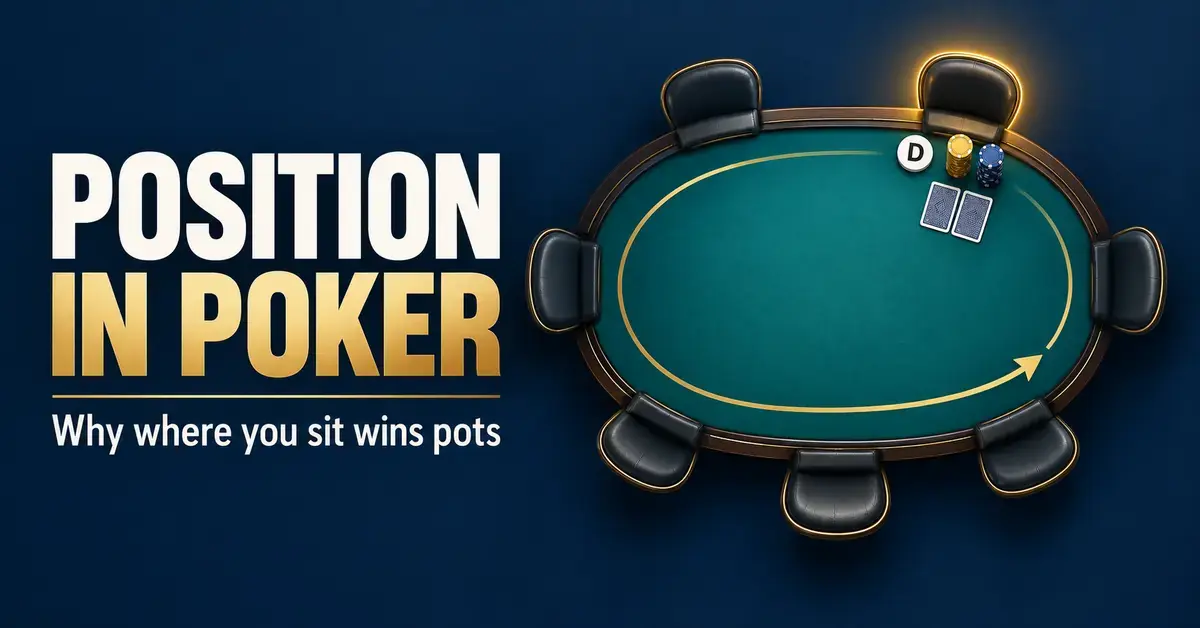
Position in poker is simply where you sit in the betting order relative to the dealer button — and it is one of the few edges a beginner can grab on day one without memorising a single chart. The later you act in a hand, the more you already know about what everyone else is doing, and that information turns into better, cheaper, more confident decisions. Players have a saying for it: position beats cards. A modest hand played from a strong seat will often out-earn a prettier hand played from a weak one. This guide explains the dealer button, the blinds, and the early, middle and late positions, then shows exactly why acting last wins pots.
Key Points
- Position is your seat in the betting order relative to the dealer button — it decides when you act each round.
- The button acts last after the flop and is the most profitable seat at the table.
- The small and big blinds are forced bets that act first after the flop, making them the toughest seats to play.
- Seats group into early (act first, need strong hands), middle, and late (act last, can play more hands).
- Acting last gives you more information, so you can control the pot, bluff and value bet more accurately.
- Position beats cards: a modest hand played in position often out-earns a better hand played out of position.
What is position in poker?
Position is the order in which you act during each betting round, counted from the dealer button. In Texas Hold’em and most community-card games, action moves clockwise, so the player to act after you has seen your decision before making their own. Whoever acts last in a betting round is said to be “in position”; whoever acts first is “out of position.”
That order is not fixed to a chair — it rotates every hand as the button moves. Over a full orbit, everyone spends time in every seat, so position is a shared, fair advantage rather than a permanent one. The skill is recognising which seat you are in before you decide how to play a hand. If you are new to the mechanics of dealing and betting rounds, our complete beginner’s guide to how to play poker covers the deal and the streets that position sits on top of.
How does the dealer button work?
The dealer button is a small disc that marks which player is the nominal dealer for that hand, and it is the reference point for every position at the table. In a casino or licensed online room the house deals the cards, but the button still decides the order of play: the blinds are posted immediately to its left, and the button itself acts last on the flop, turn and river.
After every hand the button moves one seat clockwise. This rotation is what keeps the game fair — the forced bets (the blinds) and the powerful last-to-act seat pass around the whole table over time. Because the button acts last on every postflop street, it is widely regarded as the single most profitable seat in poker.
What are the blinds, and why do they matter for position?
The blinds are two forced bets posted before any cards are dealt, which get the betting started so there is always something to play for. The small blind (SB) sits immediately left of the button and posts roughly half a bet; the big blind (BB) sits left of the small blind and posts the full minimum bet.
The blinds create an awkward relationship with position. Before the flop the big blind acts last, which sounds good — but on every street after the flop the blinds act first. That means for the rest of the hand they are out of position against everyone still involved, having already put money in “blind.” This is why the blinds are statistically the hardest seats to beat: the realistic goal from the blinds is to lose less, not to win big. Understanding how these forced bets drive the action is part of the wider picture of poker strategy fundamentals.
What are the poker table positions?
On a full-ring (9-handed) table the seats are grouped into early, middle and late position, named relative to the button. Preflop, the first player to act is the one directly left of the big blind — “under the gun” — and action runs clockwise until it reaches the big blind. Postflop, the order flips so the blinds act first and the button acts last. The table below maps the standard seats, their abbreviations and when each one acts.
Table Positions
| Seat | Abbr. | Group | When it acts / why it matters |
|---|---|---|---|
| Under the Gun | UTG | Early | First to act preflop; needs the strongest opening hands. |
| UTG+1 | EP | Early | Acts just after UTG; still very little information available. |
| Middle Position | MP | Middle | Some players have acted; can open a slightly wider range. |
| Lojack | LJ | Middle/Late | First of the “stealing” seats; range starts to widen. |
| Hijack | HJ | Late | Can open wide and pressure the blinds. |
| Cutoff | CO | Late | Second-best seat; often raises to isolate the button. |
| Button | BTN | Late | Acts last on every postflop street — the most profitable seat. |
| Small Blind | SB | Blinds | Forced half-bet; acts first on every postflop street. |
| Big Blind | BB | Blinds | Forced full bet; last to act preflop, then acts early postflop. |
Full-ring (9-handed) layout. Preflop, action runs UTG → Button → SB → BB. Postflop, it flips: the blinds act first and the button acts last.
Group names are not perfectly standardised between sources, but the practical logic never changes: the closer you are to acting last, the more hands you can play and the more freedom you have.
Early position (UTG and the seats beside it)
Early position acts first and knows the least, so it is the most demanding place to open a hand. With up to seven or eight players still to act behind you, any hand you play can run into a stronger one. The standard response is to open only premium holdings — big pairs and strong, high cards — and to fold most everything else.
Middle position
Middle position is a transition zone. A few players have folded or acted, so you have slightly more information and can widen your opening range beyond the early-position premiums — but there are still several seats behind you, so caution remains sensible.
Late position (cutoff and button)
Late position acts last or close to it and is where position pays off. The cutoff (one seat right of the button) and the button can open a much wider range of hands, apply pressure to the blinds, and steal pots uncontested when everyone folds to them. The button in particular keeps its last-to-act advantage all the way to the river.
Why does acting last win pots?
Acting last wins pots because position converts information into control. The player who acts first must commit to a check, bet or raise while learning nothing about anyone else’s hand. The player who acts last has watched all of that first and only then decides. That single asymmetry powers almost every positional advantage.
More information means better decisions
When opponents act before you, their choices leak information. A nervous check often signals weakness; a confident bet suggests strength. Acting last lets you fold hopeless hands cheaply, continue with good ones, and avoid the guesswork that traps out-of-position players.
Pot control
In position you can keep the pot the size you want. With a marginal hand you can check behind and take a free card instead of being blown off the pot by a raise. Out of position, a check can be punished with a bet, forcing a tough decision you would rather not face.
Bluffing and value betting
Bluffs are more believable when you bet into an opponent who has already shown weakness by checking to you. Value bets are more accurate too: when a player checks, you can size your bet to what their action suggests they will pay. Both the bluff and the value bet are sharper in position because they are informed decisions, not guesses.
You can profitably play more hands
Because position makes the rest of the hand easier, late-position seats can profitably open a far wider range of starting hands than early seats. The simplest winning habit in poker is a direct consequence of this: play more hands in position and fewer hands out of position.
How does position change which starting hands you play?
Position and starting-hand selection are two sides of the same decision: the worse your position, the stronger your hand needs to be to get involved. From early position you want hands that can stand up to a lot of players acting behind you, so you stick to premiums. From late position you can add suited connectors, smaller pairs and more offsuit broadways, because you will usually get to act last for the rest of the hand.
Judging which hands are actually strong relies on knowing the pecking order of made hands — see our poker hand rankings chart for what beats what. Position tells you when to get involved; hand rankings tell you whether the cards justify it.
How does position work in 6-max and heads-up games?
Shorter tables compress the same ideas into fewer seats. A 6-max table drops the extra middle seats and typically runs UTG, hijack, cutoff, button, small blind and big blind. With fewer players behind you, every seat can play a wider range than its full-ring equivalent, and late-position aggression matters even more.
Heads-up (two players) flips a rule that surprises many beginners: the player on the button also posts the small blind and acts first before the flop, while the big blind acts first on the flop, turn and river. The button still closes the preflop action and holds position on every later street, which is why it remains the stronger seat even while posting a blind. These adjustments are part of adapting to the different poker variants and formats you will meet.
What are the most common position mistakes?
The most common position mistake is playing too many hands from early position and the blinds — exactly the seats where information is scarce and acting first is a burden. A few recurring errors cost beginners the most:
- Opening weak hands under the gun. A hand that looks playable is often a trap when seven players can wake up with something better behind you.
- Over-defending the blinds. Calling raises “because you already have money in” commits you to playing out of position with a mediocre hand. The chips posted are gone; do not chase them with more.
- Ignoring your position before you look at your cards. Strong players note their seat first, then decide. The same two cards are a fold in early position and a raise on the button.
- Playing passively in position. Wasting last-to-act by just calling throws away the advantage. Position rewards selective aggression — betting and raising when the information favours you.
- Treating 6-max and heads-up like full ring. Fewer players means ranges should widen; clinging to tight full-ring habits leaves money on the table.
Who benefits most from understanding position?
Every poker player benefits, but new and recreational players gain the most the fastest. Position is a free, rules-based edge that does not require reading opponents or memorising odds — it only requires discipline about which seat you are in. A beginner who simply plays tighter early and wider late, and who prefers to enter pots in position, will avoid a large share of the mistakes that cost money. More advanced players lean on position to run bluffs, control pot size and squeeze thin value, but the foundation is identical. For a structured path through the rest of the fundamentals, work through the strategy hub and build position into every habit from the start.
A note on responsible play
This article is educational and informational only. Understanding position improves your decisions, but poker still involves chance and short-term variance, and nothing here guarantees a profit. Play only with money you can afford to lose, set limits before you sit down, and if gambling stops being fun, free confidential support is available through our responsible gambling resources.
Sources
Frequently Asked Questions (FAQ)
What does “position” mean in poker?
Position is the order in which you act during a betting round, measured from the dealer button. Acting later is better because you see what your opponents do before you have to decide, which gives you more information for every choice.
Which is the best position in poker?
The button is the best seat because it acts last on the flop, turn and river. Having the final say on every postflop street lets you control the pot size, bluff and value bet more accurately, and play a wider range of hands profitably.
What is the difference between early and late position?
Early position acts first and knows the least, so it should play only strong hands. Late position acts last or close to it and can play many more hands, steal the blinds and apply pressure, because it has far more information when it decides.
Why are the blinds considered a weak position?
The small and big blinds post forced bets before seeing their cards and then act first on every street after the flop. Being out of position for the rest of the hand makes the blinds the hardest seats to beat, so the goal there is usually to lose less rather than to win.
Does position really matter more than your cards?
Position does not beat a much stronger hand outright, but over many hands it is often worth more than small differences in card strength. A decent hand played in position frequently out-earns a slightly better hand played out of position, which is why players say position beats cards.
