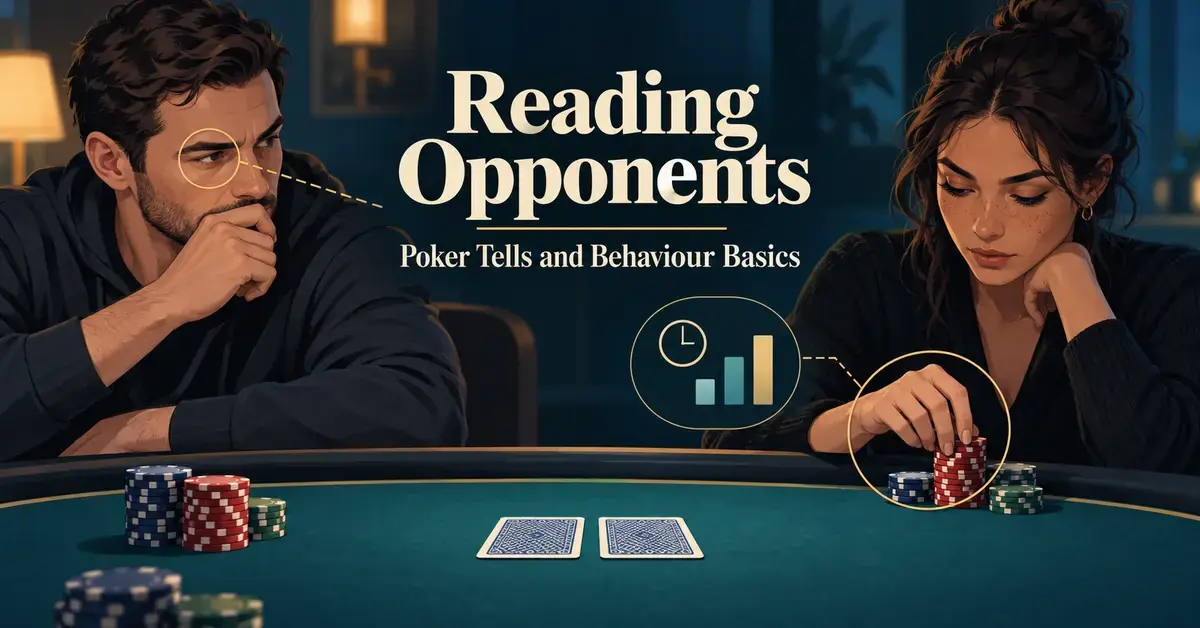
Every poker player eventually asks the same question: can you really work out what an opponent is holding by watching how they act? Poker tells — the small, often unconscious clues players give off about the strength of their hand — are one of the most talked-about parts of the game, and also one of the most misunderstood. This guide explains what tells are, how physical reads at a live table differ from the betting- and timing-based reads you rely on online, and, above all, why even a confident read is a probability rather than a certainty.
Key Points
- A poker tell is any behaviour that hints at the strength of an opponent’s hand — some are involuntary, some are deliberate acting.
- Every read is a probability, never a certainty; base big, hard-to-reverse decisions on the math, not a single tell.
- Live tells are physical (body language, speech, chip handling) and are the least reliable category.
- Online tells are behavioural (bet sizing, timing, session patterns) and are usually more dependable because they can be measured over many hands.
- Everything is read against a player’s own baseline, confirmed over several hands and checked at showdown.
- Reading opponents yourself is legitimate skill; using solvers or other real-time assistance during play is cheating and is banned by major sites.
What is a poker tell?
A poker tell is any observable behaviour that gives away information about the strength of a player’s hand or their likely next action. Tells fall into two broad groups. The first is involuntary: a change in breathing, a shaking hand, or how long someone takes to act — signals the player does not know they are sending. The second is deliberate acting: a player who sighs, shrugs or stares you down is trying to plant a false impression on purpose.
Reading opponents is a layer you add on top of solid fundamentals, not a replacement for them. You still need to know the hand rankings, pot odds and position before a read is worth anything. If you are new to the game, start with the basics of how to play poker and the wider poker strategy fundamentals, then treat tells as a tie-breaker in close spots — the extra information that nudges a marginal call into a fold, or a fold into a call.
Why reads are probabilities, not certainties
No tell is ever 100% reliable, and treating one as proof is the fastest way to lose money. A behaviour that means weakness in one player can mean nothing — or the opposite — in another. Professional player Daniel Negreanu has long warned that most physical tells are notoriously unreliable, because the same gesture can come from a bluffer and from someone holding the best possible hand.
The honest way to think about a read is in terms of likelihood. A strong read might move your estimate from “this player is value-betting maybe half the time” to “probably more like 70% of the time.” That is useful, but it is not a guarantee, and you will still be wrong a meaningful share of the time. Good readers accept that they will be wrong, size their decisions accordingly, and never stake a big, hard-to-reverse call on a single twitch.
How do live physical tells work?
Live physical tells come from body language, speech and table behaviour that you can only observe in person. They are the most famous kind of tell and, paradoxically, the least dependable — so they deserve a calm, sceptical eye.
Establish a baseline first
A tell only means something relative to how a particular player normally behaves. Before you read anyone, watch them in hands that do not involve you and note their default: how fast they usually act, how they stack chips, how chatty they are, how they handle their cards. A sudden departure from that baseline is the signal — the baseline itself is the measuring stick. Without it, you are guessing.
“Strong means weak, weak means strong”
The best-known principle in live reads was popularised by Mike Caro in Caro’s Book of Poker Tells. Caro’s observation is that when players act, they tend to perform the opposite of what they hold: a player who sighs, looks disappointed or shrugs is often strong, while a player who stares you down or acts aggressive is often weak and trying to discourage a bet. The logic is simple — a genuinely strong hand wants you to bet, so it hides its strength, whereas a weak hand wants you to check, so it projects false confidence.
There is an important catch: because the principle is so widely known, skilled opponents reverse it deliberately. That is why Caro’s rule is a starting hypothesis about unsophisticated players, not a universal law. Against a thinking opponent, the act may be a double bluff.
Which physical cues are worth watching?
Some involuntary signals are discussed more than others. Treat the following as cues to investigate, not verdicts:
- Trembling hands while placing a bet — often linked to a genuinely strong hand and the adrenaline of being about to win, though some people simply shake regardless.
- Breathing and chest movement — shallow, held or rapid breathing can accompany a big bluff, as the player tries to stay still.
- Looking away from the action — feigned disinterest can precede a raise, fitting the “weak means strong” pattern.
- Chip-grabbing before you have acted — reaching for chips to suggest they will call can be an attempt to stop you betting a weak-but-live hand.
- Sudden changes in talk — a normally quiet player becoming chatty, or a talkative one going silent, is a baseline break worth noting.
None of these is proof. The classic movie tells — a bead of sweat, a nervous glance — are far less reliable than most players believe, and the real skill is noticing a consistent deviation from one person’s baseline across several hands.
How do you read opponents in online poker?
Online, you lose every physical tell, so your reads come from three measurable things: how someone sizes their bets, how long they take to act, and how their tendencies shift across a session. These behavioural reads are generally more dependable than live body language, because you can observe them precisely and over a large number of hands — which matters a great deal if you play regulated online poker in Canada, where high hand volume makes patterns easier to spot.
Bet-sizing tells
Bet sizing is the single richest source of online information, because many recreational players unconsciously use different sizes for different hand strengths. Common patterns include small bets (around a quarter to a third of the pot) used as cheap blocking bets or thin value; standard bets (roughly half to three-quarters of the pot) that could be almost anything; and overbets that tend to be polarised — usually either a very strong hand or a bluff. Inconsistent sizing is itself a tell, because it exposes a player who has not thought their strategy through.
Timing tells
Timing is the most informative online signal, measured against each player’s normal speed. A long pause before a big bet often signals a strong hand weighing how much to extract; a quick pause before checking can point to weakness; and an instant action in a spot where most players would think usually means the player pre-selected their move and is not really engaged with the hand. Baseline matters even more here than live: four seconds feels slow in person, but online it can simply be a player on eight tables waiting in a queue.
Session and board patterns
Over many hands, each opponent reveals structural habits: some only get aggressive on certain board textures, some only check-raise with genuinely strong hands, some always min-raise before the flop, and some speed up or slow down with hand strength. These tendencies are the foundation of a profile, and they are what turn a one-off guess into a read you can trust.
Comparison
| Aspect | Live (physical tells) | Online (behavioural reads) |
|---|---|---|
| Main signals | Body language, breathing, hand tremor, speech, chip handling | Bet sizing, action timing, board and session patterns |
| Typical reliability | Lowest — easily faked and highly player-dependent | Higher — measurable and observable over many hands |
| Key skill | Spotting a break from one player’s baseline in person | Profiling sizing and timing against each player’s norm |
| Biggest risk | Over-reading a one-off gesture or a deliberate act | Mistaking multi-tabling lag or pre-set clicks for a tell |
| How to verify | Compare with how the player behaves in other hands | Match your read against shown hands at showdown |
How do you build a read you can rely on?
A reliable read is built, not spotted in a single moment. The process is the same live and online:
- Establish the baseline. Learn what normal looks like for each opponent before you act on anything.
- Wait for a second observation. One timing event or odd bet is an anecdote; a repeated pattern across different hands is evidence. Do not change your line on a single data point.
- Use showdowns to check yourself. When cards are turned up, compare what the player’s timing and sizing suggested with what they actually held. Showdowns are what convert a guess into verified information.
- Track signals separately, then combine. A snap-fast big bet is not the same as a slow, thoughtful big bet — keep timing and sizing distinct, then read them together.
- Watch for reverse tells. If a pattern suddenly changes the moment you start acting on it, the opponent may be reading you back and feeding you false information.
Common mistakes when reading opponents
Most tell-reading errors come from over-confidence, not from missing information. The recurring mistakes are:
- Acting on a single observation. The biggest leak is treating one twitch or one fast click as a confirmed read.
- Ignoring the baseline. Reading a behaviour in isolation, without knowing the player’s normal, produces noise, not signal.
- Forcing the “strong means weak” rule. It describes unsophisticated players; applied blindly to good opponents it gets reversed on you.
- Letting a read override the math. A tell should break a close decision, not justify calling a huge bet with a hand that is a clear fold on pot odds alone.
- Reading opponents while leaking your own tells. Many players improve fastest not by reading others but by eliminating the cues — consistent bet timing, steady sizing, neutral body language — they were giving away.
- Tilting after a read goes wrong. Because reads are probabilistic, some will fail; expecting certainty leads to frustration and worse decisions.
What is allowed, and what counts as cheating?
Reading opponents with your own eyes, memory and notes is a legitimate, skilful part of poker. Using external software to make decisions for you is not, and it can get your account closed and your funds confiscated. The line between the two matters, so here is the current picture.
Real-time assistance (RTA) is banned. RTA means consulting any tool that helps your decision while a hand is live — solvers, range calculators, ICM analysers or AI assistants. Major sites prohibit it outright. GGPoker, for example, bans such tools during play and has partnered with GTO Wizard to detect and ban offending accounts, while PokerStars lists real-time assistance among its prohibited tools. Live events go further still: the 2025 World Series of Poker rules bar devices that contain or use artificial intelligence at the table.
HUDs are a grey area that depends on the site. A heads-up display (HUD) overlays statistics about opponents gathered from past hands. Some sites, such as PokerStars, have historically permitted only tools on an approved list; others, such as GGPoker, block third-party HUDs entirely and offer their own post-session analytics instead. Because operator terms change, always read your site’s current rules before installing anything — and note that a HUD shows history, not live advice, which is what separates it from banned RTA.
The takeaway is simple: train your own observation, take notes where the site allows it, and never outsource an in-hand decision to software. Skillful reading is part of the game; prohibited tools are cheating.
Who should focus on tells, and how much do they matter?
Tells matter most at lower and mid stakes, where opponents are least polished and most likely to leak consistent patterns. At that level, bet-sizing and timing reads can be genuinely profitable because many players are not thinking about disguising themselves. As the stakes rise, opponents balance their actions deliberately, reads get noisier, and sound fundamentals — position, hand selection, pot odds and discipline — carry far more of the win rate.
For a beginner, the priority order is clear: learn the rules and the math first, then add reading opponents as a supporting skill. A good read in a close spot is worth having, but it will never rescue a strategy that is unsound to begin with.
A note on responsible play
This article is educational and informational only. Reading opponents is a skill that can give you an edge in close decisions, but no tell, read or system makes poker a guaranteed source of income — poker involves risk, and you can lose money. Play only with money you can afford to lose, set limits before you sit down, and if the game stops being fun, step away. For warning signs, limit-setting tools and confidential, free help across Canada, see our guide to responsible gambling.
Sources
Frequently Asked Questions (FAQ)
Are poker tells real?
Yes, but they are probabilities, not certainties. Players do leak information through body language, bet sizing and timing, and skilled opponents can exploit those patterns. However, any single tell can be misleading or deliberately faked, so a read should shift your estimate of what an opponent holds, not prove it.
What is the most reliable poker tell?
Betting patterns and timing are more reliable than physical body language. Live, bet sizing against a player’s own baseline is the strongest cue; online, timing — how fast or slow someone acts relative to their normal pace — is usually the most informative, because it can be observed precisely over many hands.
Can you read tells in online poker?
Yes, just not physical ones. Online reads come from how opponents size their bets, how long they take to act, and how their habits shift across a session. Because you cannot see faces, these behavioural patterns become your main source of information and are often more dependable than live physical tells.
What does “strong means weak, weak means strong” mean?
It is Mike Caro’s observation that acting players tend to perform the opposite of their hand strength: those with strong hands often fake disinterest or sadness to encourage a bet, while those bluffing act confident or aggressive to discourage one. It describes unsophisticated players well, but good opponents reverse it on purpose.
Are poker HUDs and solvers allowed?
Solvers and other real-time assistance are banned during play on major sites and can lead to account closure and confiscated funds. HUDs, which show statistics from past hands, are permitted on some sites and blocked on others, so you must check the current terms of the specific site you play on before using one.
