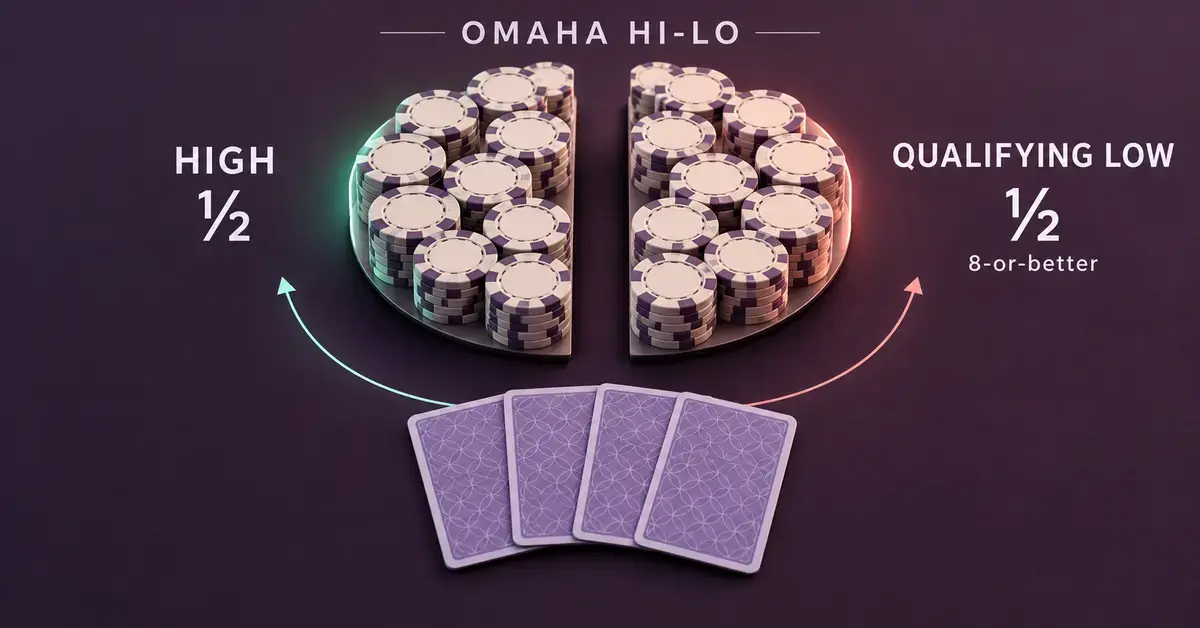
Omaha Hi-Lo, also written Omaha 8-or-Better, Omaha/8 or simply O8, is a split-pot version of Omaha in which the pot is divided between the best high hand and the best qualifying low hand at showdown. You are dealt four hole cards, you still must use exactly two of them with three community cards, and the twist is that you can chase two prizes at once in a single hand. This guide explains every rule in plain English: how the split works, what makes a low hand “qualify”, how to read and rank lows, the betting, a worked example, and the mistakes that cost beginners the most chips.
Key Points
- Split pot: half goes to the best high hand, half to the best qualifying low hand.
- 8-or-better qualifier: a low must be five unpaired cards all ranked eight or lower, or there is no low.
- Two-card rule: use exactly two of your four hole cards plus three board cards — and you may use a different pair for high and for low.
- Aces play low: the best low is 5-4-3-2-A (the “wheel”); the weakest qualifier is 8-7-6-5-4.
- No qualifying low: the best high hand scoops the entire pot.
- Scoop vs quarter: win both halves to scoop; tie for the low and you are “quartered” (a quarter of the pot).
What is Omaha Hi-Lo (8-or-Better)?
Omaha Hi-Lo is a community-card poker game where one pot is shared between two different winning hands. Half of the pot goes to the highest-ranking hand, exactly as in any normal poker game, and the other half goes to the best “low” hand — provided a low hand even exists under the game’s qualifier. The deck, the deal and the board are identical to standard Omaha; only the way the pot is awarded changes.
The “8-or-better” in the name is the low qualifier: to win the low half of the pot, your five low cards must all be ranked eight or lower. If no player can make a qualifying low, the high hand simply takes the entire pot. That single rule shapes the whole game, because roughly a third of hands produce no qualifying low at all, handing the full pot to the best high hand.
If you are completely new to four-card Omaha, it helps to read our guide to Omaha poker rules and Pot-Limit Omaha first — Omaha Hi-Lo uses the same deal and the same card-selection rule, and adds the split pot on top.
How the pot is split between high and low
In Omaha Hi-Lo the pot is split in two at showdown. The high half is awarded to the best five-card poker hand using the standard poker hand rankings — a straight flush beats quads, quads beat a full house, and so on down to high card. The low half goes to the lowest-ranking five-card hand that meets the eight-or-better qualifier.
Three outcomes are possible on any given hand:
- High and low both exist: one player wins the high half and another (or the same) player wins the low half. The pot is cut down the middle.
- No qualifying low: the best high hand wins the whole pot. This is common and is why strong high hands never lose value in O8.
- One player wins both halves: holding the best high hand and the best qualifying low at the same time is called a “scoop”, and it takes 100% of the pot.
When the pot cannot be divided evenly — an odd chip is left over — that odd chip is awarded to the high hand by convention in most card rooms.
The 8-or-better low qualifier explained
The low qualifier is the single rule that separates Omaha Hi-Lo from ordinary Omaha, so it is worth understanding fully. A low hand is a five-card hand made of low cards, and it only competes for the low half if it clears the eight-or-better bar.
What makes a qualifying low
A qualifying low must be five cards of different ranks, every one of them eight or lower. In practice that means:
- You need five cards ranked 8, 7, 6, 5, 4, 3, 2 or Ace — and the ace always counts as the lowest card (a “one”) for the low.
- The five cards must all be different ranks. Any pair kills the low, because a pair is not five distinct low cards.
- Straights and flushes do not count against a low. A hand like 5-4-3-2-A is a straight for high purposes, but for the low it is simply five low cards and the best low possible.
If your best five low cards include a nine, a ten, a face card, or a pair, you have no qualifying low at all. The weakest low that still qualifies is 8-7-6-5-4; anything “higher” than that does not make the eight-or-better cut.
How to read and rank low hands
Lows are compared from the highest card downward, and the hand with the lower top card wins. The simplest way to read a low is to say it from the top down: a low with a top card of a six beats a low with a top card of a seven, regardless of the smaller cards. If the top cards tie, move to the next card down, and so on.
A useful habit is to name a low by its two highest cards. A “seven-five low” (7-5-x-x-x) beats an “eight-anything” low, and loses to a “seven-four low”. When two lows share the same top card, keep comparing downward until one is lower.
The wheel and the nut low
The best possible low is 5-4-3-2-A, known as the “wheel”. Because the ace plays low and straights do not count against you, the wheel is both the strongest low hand and, as a 5-high straight, a handy high hand too. The “nut low” is simply the best low available on a given board; on many boards that is the A-2 combination in your hand filling out the five lowest cards.
The two-card rule: exactly two plus three
Omaha Hi-Lo uses the same card-selection rule as all Omaha: you must play exactly two of your four hole cards together with exactly three of the five community cards. You can never use one hole card or three hole cards — always precisely two.
The key point that trips up new players is that you can use a different pair of hole cards for your high hand than for your low hand. For example, with hole cards A-2-K-Q you might use K-Q for a high flush or straight while using A-2 with three low board cards for the nut low — two separate two-card selections from the same four cards, in the same hand.
Quick Facts
| Also known as | Omaha 8-or-Better, Omaha/8, O8 |
|---|---|
| Family | Community-card poker (Omaha) |
| Deck | Standard 52 cards |
| Hole cards | 4 per player |
| Cards used | Exactly 2 hole cards + 3 board cards |
| Pot | Split between best high and best qualifying low |
| Low qualifier | Five unpaired cards, all 8 or lower |
| Best low | 5-4-3-2-A (the wheel) |
| Betting rounds | Pre-flop, flop, turn, river (4) |
| Betting structures | Fixed-limit (traditional), pot-limit, sometimes no-limit |
How a hand of Omaha Hi-Lo plays out
The flow of betting is identical to Texas Hold’em and standard Omaha, with four betting rounds around a shared board. If you are new to the mechanics, our explainer on how betting works in poker covers blinds, antes and the check/call/raise/fold actions in detail.
- Pre-flop: each player is dealt four hole cards face down. The two players to the left of the dealer post the small and big blinds, and a round of betting follows.
- The flop: three community cards are dealt face up, followed by a betting round.
- The turn: a fourth community card is dealt, followed by a betting round.
- The river: a fifth and final community card is dealt, followed by the last betting round.
- Showdown: remaining players reveal their hands. The best high hand and the best qualifying low are determined, and the pot is split (or scooped).
Betting structures: Limit, Pot-Limit and No-Limit
Omaha Hi-Lo is most often played with a fixed-limit betting structure, where bet and raise sizes are capped at set amounts on each street. Fixed-limit was historically the standard for the game and still features in mixed-game rotations and major series. Pot-limit Omaha Hi-Lo (PLO8), where the maximum bet is the current size of the pot, has become increasingly common, especially online, and some sites also spread no-limit versions. The rules of the hand are the same in every format; only the size of the bets changes.
A worked example hand
Suppose the final board is 8-6-4-K-Q and two players reach showdown.
- Player A holds A-2-10-10. Using A-2 with the 8-6-4 on the board, their low is 8-6-4-2-A — a qualifying eight-low. Using the pair of tens, their high is a pair of tens.
- Player B holds K-K-7-5. Using K-K with the king on the board, their high is three kings. Using 7-5 with 8-6-4, their low is 8-7-6-5-4 — also a qualifying low, but weaker.
Player B wins the high half with three kings. For the low, Player A’s 8-6-4-2-A beats Player B’s 8-7-6-5-4 (reading from the top, both are eight-lows, but A’s second card is a six versus B’s seven), so Player A takes the low half. The pot is split: no one scoops. Had the board paired both low cards or produced no three cards eight-or-lower, there would be no qualifying low and Player B would have scooped the whole pot with three kings.
Scooping, splitting and getting quartered
Scooping — winning both the high and the low halves of the same pot — is the most profitable result in Omaha Hi-Lo, so strong two-way hands (those that can make both a high hand and a low) are prized. Hands built around A-2 with suited or connected high cards are the classic scooping holdings.
The flip side is getting “quartered”. If you tie another player for the best low, you each take only a quarter of the total pot (half of the low half), while a third player with the best high takes the other half. Two players both holding A-2 with no board problems routinely chop the low and win just a quarter each. This is why chasing only the low with a hand that has no high potential — and raising it hard — can quietly lose money: you risk investing heavily to win a fraction of the pot. Understanding exactly which poker hand wins and how split pots are settled is essential before you play O8 for real stakes.
How Omaha Hi-Lo differs from PLO and Texas Hold’em
Omaha Hi-Lo shares its deal and card-selection rule with regular Omaha but plays very differently because of the split pot. Compared with Texas Hold’em versus Omaha, the gap is even wider:
- Versus Pot-Limit Omaha (high only): standard PLO awards the whole pot to the best high hand. Omaha Hi-Lo adds the low half, so half the time you are playing for a prize that does not exist in PLO, and raw high-only hands lose relative value.
- Versus Texas Hold’em: Hold’em gives you two hole cards and lets you use any combination; Omaha Hi-Lo gives you four and forces exactly two. The split pot and the two-way nature of hands make O8 far more about making the nuts and far less about bluffing.
- Pace and swings: because pots are frequently chopped, Omaha Hi-Lo tends to have smaller net swings per hand than high-only big-bet games, rewarding patience and strong starting hands.
Common beginner mistakes in Omaha Hi-Lo
The biggest leaks in Omaha Hi-Lo come from misunderstanding the split, not from the betting:
- Forgetting the two-card rule. You must use exactly two hole cards for the low and exactly two for the high. A single ace in your hand with four low cards on the board is not a low — you still need a second qualifying low card in your hand.
- Chasing non-nut lows. A weak low such as an eight-low is often second-best and a prime candidate for getting quartered. Strong O8 play leans heavily on A-2 and A-3 type holdings that make the nut low.
- Ignoring the “no low” boards. When the board has fewer than three cards eight-or-lower, no low is possible and the hand plays as a high-only game — adjust accordingly.
- Over-valuing one-way hands. Hands that can only win the high or only the low are vulnerable. Two-way hands that can scoop are worth far more.
- Playing too many hands. As in every game, loose play is costly; see our list of common beginner poker mistakes for the fixes.
Who Omaha Hi-Lo suits
Omaha Hi-Lo rewards patient, mathematically minded players who enjoy reading boards and hunting for scoops rather than gambling on big all-in pots. Because so many pots are split, it is often a lower-variance game than no-limit high-only formats, which can make it appealing to recreational players who want a thinking game without the biggest swings. It also forms a core part of mixed-game rotations such as H.O.R.S.E., so learning it opens the door to the wider poker world explored in our guide to poker variants.
Responsible Gambling
This article explains the rules of Omaha Hi-Lo for educational purposes only. It is not betting advice, and no strategy or style of play can guarantee a profit — poker involves risk, and you should only ever play with money you can afford to lose.
In Canada, only provincially licensed operators may legally offer real-money poker, and the legal age is 18 or 19 depending on the province. If gambling stops being fun or starts causing harm, free, confidential help is available 24/7 — see our responsible gambling resources for Canada, or call the 9-8-8 Suicide Crisis Helpline if you are in crisis.
Sources
Frequently Asked Questions (FAQ)
What does “8 or better” mean in Omaha Hi-Lo?
It is the low qualifier. To win the low half of the pot, your five low cards must all be ranked eight or lower, with no pairs. If no player can make a hand of five unpaired cards eight-or-lower, there is no qualifying low and the best high hand wins the whole pot.
Does the ace count high or low in Omaha Hi-Lo?
The ace plays both ways. For high hands it is the highest card (as in A-K-Q-J-10). For low hands it counts as the lowest card, which is why A-2-3-4-5 — the wheel — is the best possible low.
Can I use the same two cards for my high and my low hand?
You can, but you do not have to. You must use exactly two hole cards and three board cards for each hand, and the two cards you pick for your high hand can be different from the two you pick for your low. This is how one holding can make both a strong high and the nut low.
What is getting quartered?
Getting quartered means tying another player for the best low, so the low half of the pot is split again and you each receive only a quarter of the total pot. It usually happens when two players hold the same nut low, such as both having A-2.
Is Omaha Hi-Lo harder than Texas Hold’em?
It is more complex, because you weigh two possible winning hands on every board and must track the low qualifier, but the split pot also makes it more forgiving in some ways. Many players find the rules easy to learn and the strategy — choosing hands that can scoop — the part that takes time to master.
