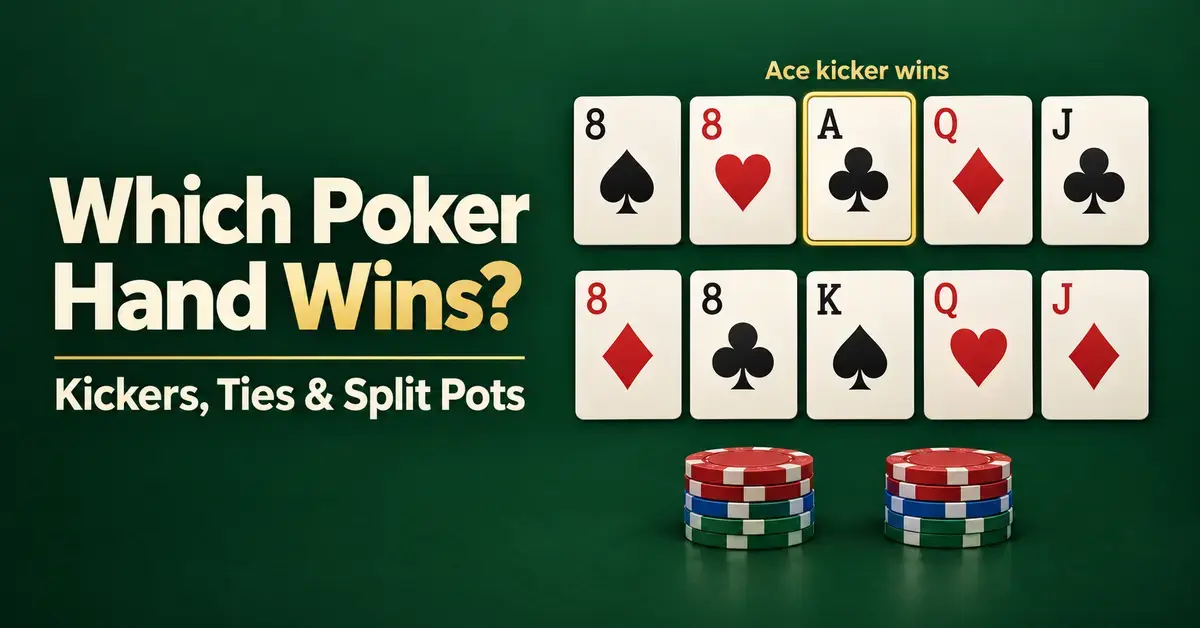
When two poker players reach showdown with hands that look equal, something still has to decide who scoops the pot — and it is almost never the suits. This guide explains exactly how a winner is determined once hands land in the same category: how a single “kicker” card breaks a deadlock, when a pot is genuinely split, whether one suit ever outranks another, and how the leftover chip is handed out. If you first need to know which hand beats which, start with our poker hand rankings guide; this article picks up where that one ends, at the moment two hands tie.
Key Points
- Best five cards decide everything. Only a player’s best five-card hand is ranked; extra cards are ignored.
- Kickers break ties between hands of the same rank — but only when the kicker is part of those best five cards.
- Suits never rank for winning. Identical hands in different suits split the pot; a spade flush does not beat a heart flush of the same values.
- A pot splits only when two or more players hold identical best five-card hands — often when the board plays.
- The odd chip in flop games goes to the first active seat left of the dealer button.
The one rule that decides every poker hand
Every poker hand is decided by each player’s best five cards — nothing more. In Texas Hold’em you choose the best five from the seven available to you (your two hole cards plus the five community cards on the board). In other poker variants the count differs, but the principle is identical: only a five-card hand is ranked, and extra cards are ignored.
This matters because the cards sitting in front of you are not automatically “your hand.” If the five shared board cards already make a stronger combination than anything you can build with your hole cards, then the board is your hand — and so is everyone else’s. That single idea explains most confusing showdowns, as the worked examples below show.
How are tied poker hands broken?
Tied poker hands are broken in a fixed order: hand category first, then the rank of the cards that make the hand, then the kickers from highest to lowest. You compare one level at a time and stop the moment a difference appears.
- Compare the hand category. A flush beats a straight, a full house beats a flush, and so on. If the categories differ, the comparison ends here.
- Compare the cards that define the hand. If both players have one pair, the higher pair wins; if both have a straight, the higher top card wins.
- Compare the kickers. If the defining cards are identical, compare the remaining cards one by one, highest first, until one is higher.
- Split if all five match. If both best five-card hands are identical, the players share the pot.
Crucially, suits are never part of this ladder. Two players who reach the same five-card hand in different suits are tied, full stop.
What is a kicker in poker?
A kicker is an unpaired side card that breaks a tie between hands of the same rank — but only when it is part of your best five cards. The classic case is one pair: the pair decides the category, and a higher kicker alongside it wins the pot when both pairs are equal.
The trap is assuming your highest hole card is always a kicker. It only counts if it makes your five-card hand stronger than the board alone. If a sixth or seventh card is higher than your “kicker” but sits outside the best five, it is irrelevant.
Worked example: one pair with a kicker
Board: A♣ 7♦ 4♠ 2♥ J♠. Player 1 holds A♥ K♣; Player 2 holds A♦ Q♦. Both players pair their ace, so the category (one pair, aces) ties. The comparison moves to kickers: Player 1’s king outranks Player 2’s queen, so Player 1 wins. Notice that both players’ five-card hands are A-A-K-J-7 versus A-A-Q-J-7 — the king versus the queen is the only difference that matters.
Worked example: two pair decided by a kicker
Board: 6♠ 6♦ Q♠ Q♥ K♠. Player 1 holds A♠ Q♦; Player 2 holds J♠ 10♠. Both players use the board’s two pair, queens and sixes. The fifth card decides it: Player 1 plays the ace as a kicker, which beats the king on the board that Player 2 is stuck with. Player 1 wins. Player 2’s J-10 never improves on the board’s king.
Do suits matter in poker?
No — in standard poker, suits do not rank, so they never decide which hand wins. A heart flush does not beat a spade flush of the same card values, and a royal flush in clubs equals a royal flush in diamonds. When two hands are otherwise identical, the pot is split regardless of suit.
Suits matter in only one on-the-table sense: they define whether you have a flush at all. Holding five hearts gives you a flush because they share a suit — but that does not make hearts “worth more” than clubs. It is about which cards combine, not a ranking between suits.
There are narrow procedural exceptions where card rooms assign suits an order (spades highest, then hearts, diamonds and clubs lowest). In seven-card stud this order can decide who posts the forced “bring-in” bet when two players share the lowest up-card, and it can award the odd chip in a split stud pot. In both cases it settles a procedure — it never decides who wins a showdown in Hold’em.
When does a poker pot split?
A pot splits only when two or more players hold identical best five-card hands. A single higher card in the fifth position means there is no split — the player with that higher card takes everything. Because suits do not rank, “identical” means identical in card value, not in suit.
The most common reason a pot splits is that the board plays: the five community cards already make everyone’s best hand, and no one can improve on it with their hole cards. Learning to spot a “playing board” is one of the most useful poker fundamentals at showdown, because it tells you when to expect a chop before the cards are even turned.
Worked example: a straight that splits
Board: 7♠ 8♦ 9♣ 10♥ J♠. Player 1 holds K♦ 3♦; Player 2 holds K♣ 4♣. The board makes a jack-high straight (7-8-9-10-J), and neither player can beat it with their low cards. Both play the same five-card straight, so the pot is split. The differing suits and the differing kickers (3 vs 4) are irrelevant because they fall outside the best five.
Worked example: a flush on the board
Board: Q♦ 8♦ 6♦ K♦ 10♦. Player 1 holds K♠ 4♠; Player 2 holds Q♠ 10♠. All five board cards are diamonds, so the board itself is a K-Q-10-8-6 flush. Neither player holds a diamond higher than the board’s lowest flush card, so both play the board. The pot is split. Had either player held, say, the A♦, that single higher diamond would have won the whole pot.
Who gets the odd chip in a split pot?
The odd chip is the single leftover chip that cannot be divided evenly between tied players, and in community-card games it goes to the first active seat to the left of the dealer button. This is the convention used by the World Series of Poker and the Poker Tournament Directors Association for flop games such as Hold’em and Omaha. No player can receive more than one odd chip, and each side pot is split separately, so a hand with side pots can produce more than one odd chip.
Two situations work differently. In stud and razz, the odd chip goes to the highest card by suit in the best five-card hand rather than by position. In high-low split games, the odd chip goes to the player with the high hand. Online, the software applies these rules automatically, so you rarely need to think about it — but it is worth knowing for live play. When in doubt in a home game, agree the rule before you deal, because house rules can vary.
Which card breaks the tie, hand by hand
The tie-breaker you reach for depends on the hand category. Some categories use all five cards and leave no room for a kicker; others lean heavily on side cards. The cheat sheet below summarises what to compare for each hand, from the top of the ranking down.
Tie-Breaker Cheat Sheet
| Hand | Compared first | Tie-breaker |
|---|---|---|
| Straight flush | Highest card | If top cards match, split (no kicker) |
| Four of a kind | Rank of the quads | Then the single kicker |
| Full house | Rank of the trips | Then the rank of the pair |
| Flush | Highest card | Then each lower card in turn; suit never counts |
| Straight | Highest card | If top cards match, split (no kicker) |
| Three of a kind | Rank of the trips | Then two kickers, highest first |
| Two pair | Higher pair | Then lower pair, then one kicker |
| One pair | Rank of the pair | Then three kickers, highest first |
| High card | Highest card | Then each lower card in turn |
A few points deserve emphasis. Straights and flushes are compared from the top card down, and because a straight uses all five of its cards there is no separate kicker — if the top cards match, the hands are equal and the pot splits. The ace is the one card that plays both high and low in a straight: A-K-Q-J-10 (“Broadway”) is the highest straight, while A-2-3-4-5 (the “wheel”) is the lowest, counting as a five-high hand. The ace cannot wrap around, so K-A-2-3-4 is not a straight at all.
Common mistakes when reading which hand wins
Most showdown errors come from a handful of recurring misreads, not from the rules themselves being complicated.
- Thinking a suit wins it. A spade flush does not beat a heart flush of the same values. Compare the card ranks from the top; if they match, it is a chop.
- Forgetting the board plays. Holding a “big” hole card does not help if the five community cards already make a better five-card hand that you cannot improve on.
- Counting a kicker that is not in your best five. A card only breaks a tie if it is one of your best five; otherwise it is ignored, however high it is.
- Misreading the wheel. A-2-3-4-5 is the lowest straight, not a high one — it loses to 2-3-4-5-6.
- Playing more or fewer than five cards. Every hand is exactly five cards; you cannot combine six to “stretch” a straight or add a sixth kicker.
- Assuming a hole pair beats board two pair. Check whether your pair actually creates a better two pair than the board plus your best kicker — often it does not.
When you are unsure at the table, say “table your cards” and let the dealer or software read the hand; in regulated online games the winner is determined automatically and correctly every time.
Responsible play
The tie-breaking rules here follow standard high-hand conventions used in licensed Canadian card rooms and regulated online poker; some home games and lowball variants use different house rules, so confirm them before you play. This article is educational and is not betting advice — knowing how ties resolve does not change the odds of any hand. If gambling is no longer fun for you or someone you know, free, confidential help is available through our responsible gambling resources.
Sources
- PokerNews — Tied Poker Hands: Split Pots & Tie-Breaker Rules Explained
- PokerNews — What Is a Kicker in Poker?
- CardPlayer — Kicker (Rules of Poker glossary)
- PokerZone — Robert’s Rules of Poker: Ties and Odd Chips
- PokerNews — Five Poker Rules You Didn’t Know Existed
- The Poker Bank — Texas Hold’em Hand Rank FAQ
Frequently Asked Questions (FAQ)
Does a higher suit ever win a poker hand?
No. In standard poker, suits have no rank, so they never decide a showdown. If two players have the same five-card hand in different suits, they split the pot. Suits are used only for procedures such as the stud bring-in or awarding an odd chip in some games.
What exactly is a kicker?
A kicker is an unpaired side card that breaks a tie between hands of the same rank, such as two players who both hold a pair of aces. It only counts when it is part of your best five-card hand; a higher card that sits outside those five is irrelevant.
Can two players both win the same pot?
Yes. If two or more players finish with identical best five-card hands, they split the pot evenly. This is common when the five community cards make the best hand and no one can improve on it with their hole cards.
Is A-K-Q-J-10 a higher straight than 10-9-8-7-6?
Yes. Straights are compared by their highest card, so an ace-high “Broadway” straight is the highest possible straight. The lowest is A-2-3-4-5, the “wheel,” which counts as five-high because the ace plays low.
Who gets the odd chip when a pot is split?
In Hold’em and other community-card games, the odd chip goes to the first active seat to the left of the dealer button. In stud and razz it goes to the highest card by suit, and in high-low games it goes to the high hand. No player receives more than one odd chip.
