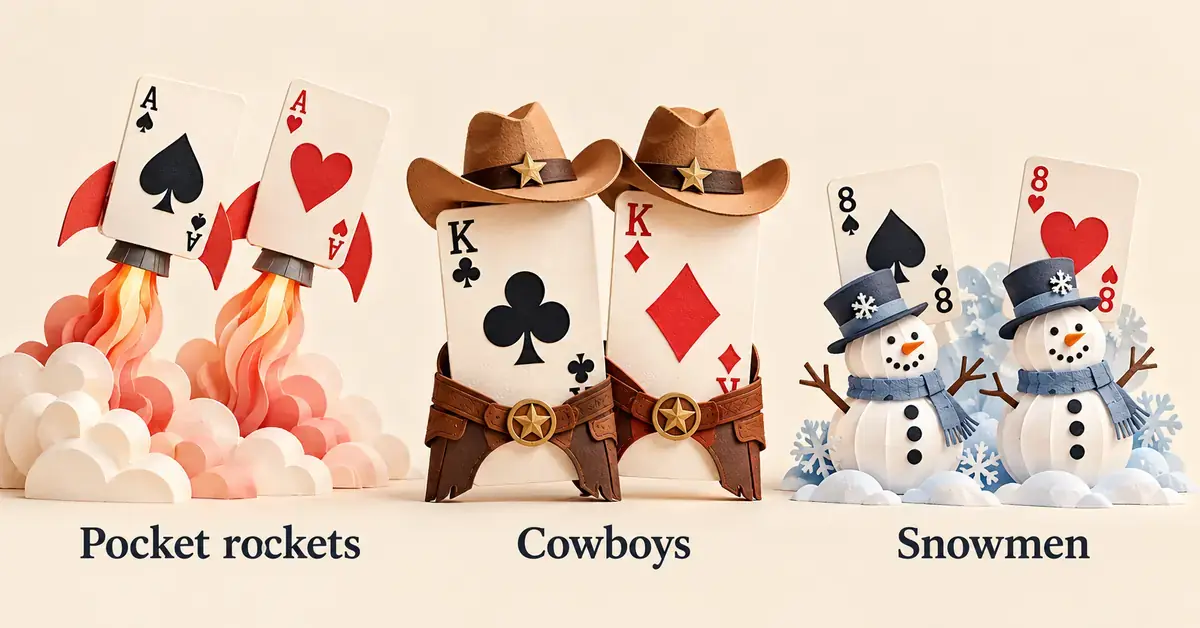
Poker hand nicknames are the slang names players use for the two-card starting hands in Texas Hold’em: pocket aces become “bullets,” ace-king is “Big Slick,” and ten-deuce is “the Doyle Brunson.” The names come from card shapes, pop culture, famous hands and plain wordplay, and while none of them change how a hand plays, they are part of the language you will hear at any card table. This guide decodes the most common nicknames hand by hand, explains where the memorable ones came from, and separates the stories that are true from the ones that are poker folklore.
Key Points
- Poker hand nicknames are slang labels for two-card starting hands, used across Texas Hold’em tables, broadcasts and books.
- They come from four main sources: card shapes, letters and numbers, pop culture and famous hands.
- Classics include pocket rockets (AA), Big Slick (AK), cowboys (KK), ladies (QQ) and snowmen (88).
- Named hands with real stories: the Doyle Brunson (10-2), the dead man’s hand (aces and eights) and the Hammer (7-2 offsuit).
- A nickname says nothing about a hand’s strength — play the cards, position and odds, not the name.
What are poker hand nicknames?
A poker hand nickname is an informal label for a specific starting hand, used instead of naming the two cards. Players reach for them because they are quicker to say, easier to remember and more fun than “jack-ten suited.” Most nicknames attach to the 169 distinct two-card combinations in Texas Hold’em — the game where each player is dealt two private “hole” cards — but a few famous ones describe made hands such as aces and eights.
The names are cultural, not official. No governing body approves them, they vary by country and era, and a single hand can carry a dozen aliases. That is why you will hear pocket kings called “cowboys” in one room and “King Kong” in another. Knowing the common ones helps you follow table talk, poker broadcasts and hand histories without missing the joke.
How poker hand notation works
Before the nicknames make sense, it helps to read the shorthand players write for starting hands. Each card is a rank (A, K, Q, J, T for ten, then 9 down to 2) and the pair of hole cards is written rank-high first.
- Pocket pair: two cards of the same rank, such as AA or 88. No suit note is needed.
- Suited: an “s” means both cards share a suit, as in AKs (ace-king of the same suit).
- Offsuit: an “o” means mixed suits, as in AKo (ace-king of different suits).
Suit matters because suited hands can make a flush, so some nicknames apply only to the suited or the offsuit version. If you are still deciding which starting hands are worth playing, the nicknames are a memory aid rather than a strategy, and the hands themselves are ranked in detail in our guide to poker hand rankings.
Pocket pair nicknames, from aces to deuces
Pocket pairs collect the most nicknames because they are the hands players care about most. Here is what each pair is commonly called, strongest first.
- Aces (AA): “pocket rockets” or just “rockets” (the ace pips look like rocket fins), “bullets,” and “American Airlines” from the AA airline code.
- Kings (KK): “cowboys,” “King Kong,” “gorillas,” and “ace magnets” — a rueful nod to how often an ace spoils them.
- Queens (QQ): “ladies,” “the Hilton sisters,” and “Siegfried & Roy.” In Canada you will also hear “Canadian aces.”
- Jacks (JJ): “fishhooks” or “hooks” (a J looks like a hook), “brothers,” and “jaybirds.”
- Tens (TT): “dimes” and “Audi,” after the Audi TT car.
- Nines (99): “Phil Hellmuth” (his favourite hand), “Wayne Gretzky” for the number 99, and “popeyes.”
- Eights (88): “snowmen” (two round 8s), “doggie balls,” “piano keys,” and “two fat ladies” from bingo.
- Sevens (77): “hockey sticks” or “walking sticks,” “axes,” and “Sunset Strip” after the TV show 77 Sunset Strip.
- Sixes (66): “Route 66” and “kicks,” a pun on Route 66’s “get your kicks.”
- Fives (55): “nickels,” “speed limit” (55 mph), “presto,” and “snakes.”
- Fours (44): “sailboats” (the 4 resembles a sail), “Luke Skywalker” and “magnum.”
- Threes (33): “crabs” (the 3 looks like a sideways crab) and “treys.”
- Deuces (22): “ducks” (the 2 resembles a duck), “quack quack,” and “swans.”
Nicknames for unpaired hands
Unpaired starting hands, especially the big ones built from aces, kings and face cards, carry some of the best-known nicknames in the game. These are the hands you will hear named most often during a session.
- Ace-king (AK): “Big Slick,” “Anna Kournikova” (it looks great but often fails to win), and “walking back to Houston.” The offsuit version is sometimes “Big Ugly.”
- Ace-queen (AQ): “Big Chick,” “little slick,” and “mixed marriage.”
- Ace-jack (AJ): “Ajax” and “Apple Jacks.”
- King-queen (KQ): “marriage” or “royal couple,” and “Othello” when offsuit.
- King-jack (KJ): “Kojak,” after the bald TV detective (K and J).
- Queen-jack (QJ): “Maverick,” after the card-playing TV cowboy, and “Oedipus.”
- Jack-ten (JT): “Justin Timberlake,” “the two Jakes,” and “T.J. Hooker.”
- King-nine (K9): “canine,” “dog,” and “Fido.”
- Jack-five (J5): “Jackson Five” or “Motown.”
- Nine-five (95): “Dolly Parton,” after her 1980 film 9 to 5.
- Two-four (24): “Jack Bauer,” after the TV series 24.
Many of these sit well outside the hands you should actually play, so treat them as vocabulary rather than a licence to call. A full dictionary of table talk lives in our poker terms glossary.
Famous named hands and the stories behind them
A handful of nicknames come with real stories, and these are the ones worth knowing because they turn up constantly in poker broadcasts and books. The accounts below are drawn from documented poker history, with the folklore flagged as folklore.
The Doyle Brunson (10-2)
Ten-deuce is called “the Doyle Brunson” because the late Texas legend won the World Series of Poker Main Event with it in back-to-back years. In 1976 he beat Jesse Alto heads-up — a ten on the river completed a full house — for USD 220,000. In 1977 he did it again against Bones Berland when another river ten filled him up, this time for USD 340,000. Brunson was the underdog on both final hands, which is exactly why the weak-looking ten-deuce bears his name. It is also nicknamed “Texas Dolly” and, playfully, “Terminator 2.”
The computer hand (Q-7)
Queen-seven is known as “the computer hand” because it is often described as the median starting hand — roughly break-even against two random cards. The popular origin story claims an early computer analysis “proved” Q-7 to be the most common or most average hand, but that tale is widely regarded as apocryphal, since any two specific cards are equally likely to appear. The useful takeaway is simpler: Q-7 wins a little over half the time against a random hand, yet is a clear underdog to any specific strong holding such as pocket aces.
Dolly Parton (9-5)
Nine-five is “Dolly Parton” after the singer’s 1980 comedy 9 to 5, whose title song was a number-one hit for her. The name is pure pop-culture wordplay and carries no strategic meaning — nine-five offsuit is a weak, usually fold-worthy hand.
The dead man’s hand (aces and eights)
The dead man’s hand is two pair, aces and eights, named for the cards gunfighter Wild Bill Hickok was reportedly holding when he was shot dead in Deadwood in 1876. Strictly it describes a made two-pair hand rather than a Hold’em starting hand, but by extension the ace-eight starting combination is sometimes given the same nickname. It is a piece of poker lore rather than a guide to the hand’s strength.
The Hammer (7-2 offsuit)
Seven-deuce offsuit is “the Hammer,” and it is widely considered the worst starting hand in Texas Hold’em: the two lowest cards that cannot make a straight together, with mismatched suits. It is also called the “beer hand.” Among friends, winning a pot with 7-2 has become a running joke, but it is a hand to fold, not to brag about hunting with.
Big Slick (A-K)
Ace-king earned “Big Slick” long before Hold’em went mainstream, and the exact origin is uncertain. The name captures the hand’s reputation perfectly: it looks powerful and plays as a strong drawing hand, but because it is unpaired it misses the flop about two-thirds of the time, which is why it also picked up the sardonic alias “Anna Kournikova.”
The Canadian angle: Canadian aces, hockey sticks and Gretzky
Several nicknames land especially well at Canadian tables. Pocket queens are called “Canadian aces” (or “Canadian rockets”), a tongue-in-cheek line about the second-best pair standing in for the best. Hockey shows up all over the deck: sevens are “hockey sticks” for their shape, pocket nines are “Wayne Gretzky” for his 99, and pocket eights are sometimes “Ovechkin” for Alexander Ovechkin’s number 8. These shared references are part of why hand slang travels so well among players, and Canada has produced plenty of its own characters at the felt — our profile of famous Canadian poker players covers the pros behind the game here.
Nickname Cheat Sheet
| Hand | Notation | Common nicknames |
|---|---|---|
| Ace-ace | AA | Pocket rockets, bullets, American Airlines |
| King-king | KK | Cowboys, King Kong, ace magnets |
| Queen-queen | Ladies, Hilton sisters, Canadian aces | |
| Jack-jack | JJ | Fishhooks, hooks, brothers |
| Ten-ten | TT | Dimes, Audi |
| Nine-nine | 99 | Phil Hellmuth, Gretzky, popeyes |
| Eight-eight | 88 | Snowmen, piano keys, Ovechkin |
| Seven-seven | 77 | Hockey sticks, walking sticks, axes |
| Six-six | 66 | Route 66, kicks |
| Five-five | 55 | Nickels, speed limit, presto |
| Deuce-deuce | 22 | Ducks, quack quack, swans |
| Ace-king | AK | Big Slick, Anna Kournikova |
| Ace-queen | AQ | Big Chick, little slick |
| King-jack | KJ | Kojak |
| Queen-jack | QJ | Maverick, Oedipus |
| Nine-five | 95 | Dolly Parton |
| Ten-deuce | T2 | The Doyle Brunson, Texas Dolly |
| Seven-deuce (offsuit) | 72o | The Hammer, beer hand |
Where do poker hand nicknames come from?
Poker hand nicknames come from four recurring sources, and spotting the pattern makes almost any new name easy to decode.
- Card shapes: what the printed rank looks like — deuces as “ducks,” eights as “snowmen,” jacks as “fishhooks,” sevens as “hockey sticks.”
- Letters and numbers: initials or figures that spell something, as in KJ “Kojak,” AJ “Ajax,” 66 “Route 66” and 24 “Jack Bauer.”
- Pop culture: films, TV, music and sport — QJ “Maverick,” 95 “Dolly Parton,” 99 “Gretzky.”
- Famous hands: moments from poker history, above all 10-2 “the Doyle Brunson” and the aces-and-eights “dead man’s hand.”
Because the names are folk culture, origins are often disputed and many hands carry regional variants. Treat colourful backstories with healthy skepticism unless a reliable poker source confirms them.
Common mistakes and misconceptions about hand nicknames
The biggest misconception is that a nickname tells you how to play the hand — it does not. A memorable name has no bearing on a hand’s strength, and a few specific errors trip up newer players.
- Thinking a nickname implies value. “The Doyle Brunson” and “the Hammer” are both famous, yet 10-2 and 7-2 are among the weakest hands you can hold. Name recognition is not a reason to play them.
- Confusing the dead man’s hand with a starting hand. Aces and eights is a made two-pair from history, not a premium Hold’em opener; A-8 offsuit is a marginal hand at best.
- Believing the computer-hand legend. No computer “proved” Q-7 is special; it is simply a roughly median hand, and still an underdog to any real holding.
- Assuming every name is universal. Nicknames vary by region, room and generation, so the alias you learned may draw blank looks elsewhere.
- Using slang to show off at the table. Announcing your hand’s nickname mid-pot can reveal information or breach etiquette; save the vocabulary for after the hand.
In short, enjoy the slang as culture, but base your decisions on position, odds and the fundamentals — the same fundamentals that apply across every form of Texas Hold’em.
A quick responsible-gambling note
This article explains poker vocabulary for informational purposes only; it is not betting advice, and a hand’s nickname never improves your chances of winning. Poker is a game that involves risk, and you should only ever play with money you can afford to lose. In Canada the legal gambling age is 18 or 19 depending on the province, and licensed play is regulated provincially. If gambling is no longer fun, free and confidential help is available — ConnexOntario can be reached 24/7 at 1-866-531-2600, and the national 9-8-8 line offers mental-health crisis support. For warning signs, limit-setting and self-exclusion, see our guide to responsible gambling.
Sources
Frequently Asked Questions (FAQ)
Why is ace-king called Big Slick?
Ace-king is called Big Slick because the hand looks strong and “slippery” — impressive on paper but tricky to win with, since it is unpaired and misses the flop roughly two-thirds of the time. The nickname predates the modern poker boom and its exact origin is uncertain. The offsuit version is sometimes called “Big Ugly.”
What is the Doyle Brunson hand?
The Doyle Brunson is ten-deuce (10-2). It is named after Doyle Brunson, who won the World Series of Poker Main Event in both 1976 and 1977 holding that hand, completing a full house on the river each time despite being the underdog.
What is the worst starting hand in poker?
Seven-deuce offsuit is generally considered the worst starting hand in Texas Hold’em, which is why it is nicknamed “the Hammer” or the “beer hand.” The two cards are low, cannot combine for a straight and are of different suits, giving the hand very little potential.
Why are pocket queens called the ladies?
Pocket queens are called “ladies” simply because the queen is the female face card, so a pair of them is a pair of ladies. They also go by “the Hilton sisters” and, at Canadian tables, “Canadian aces.”
Do poker hand nicknames affect how a hand plays?
No. Nicknames are cultural shorthand and have no effect on a hand’s strength or the correct way to play it. A colourful name like “the Doyle Brunson” belongs to a weak hand, so decisions should always be based on the cards, your position and the odds.
