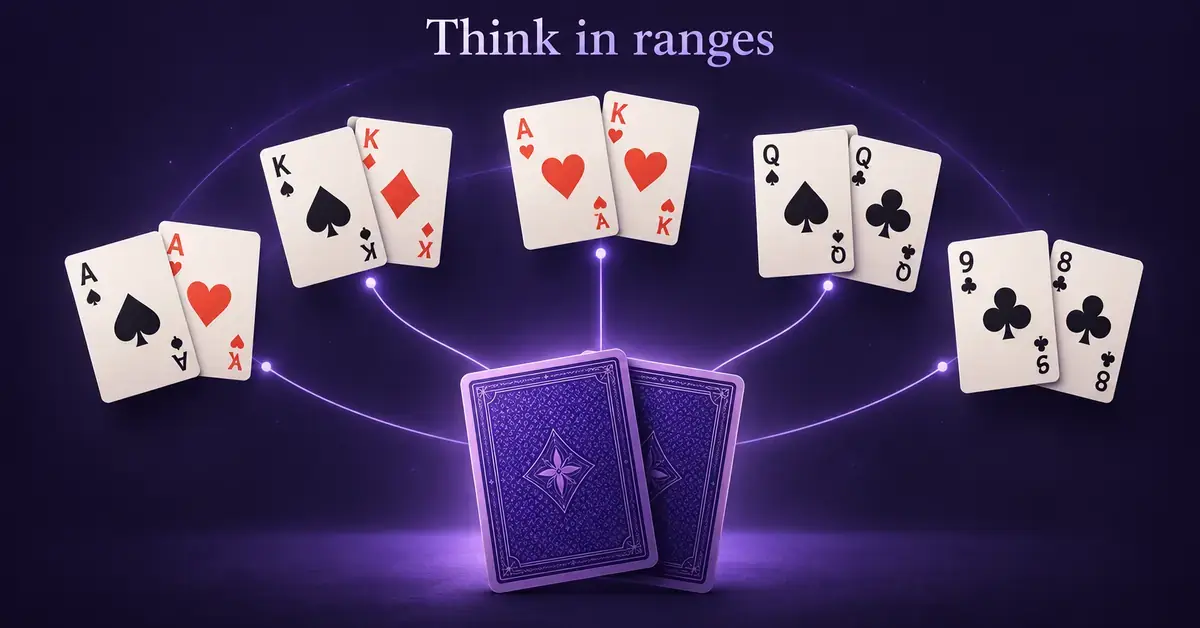
A poker hand range is the full set of hands an opponent could be holding in a given spot, rather than the single hand you imagine they have. Strong players rarely say “he has ace-king.” They ask, “which hands would he play exactly this way?” and then weigh their decision against that whole group. This guide explains what a range is, how to read range notation, the combinatorics that make the idea work, and how to put an opponent on a range street by street — in plain English for players who already know the basic rules.
Key Points
- A hand range is every hand an opponent could hold in a spot, not one specific hand.
- Thinking in ranges beats guessing a single hand, because you will usually guess wrong.
- Range notation is shorthand: s = suited, o = offsuit, + = this hand and better (so 22+ means every pair from 22 to AA).
- There are 1,326 two-card combinations and 169 distinct starting hands; each pair = 6 combos, each suited hand = 4, each offsuit hand = 12.
- Offsuit hands are three times as common as their suited versions, so combinatorics decide how “heavy” each part of a range is.
- You narrow a range street by street using position, the preflop action, bet sizing and board texture.
- Blockers are cards you hold that remove combinations from an opponent’s range.
What is a poker hand range?
A hand range is the collection of every two-card holding a player could have that is consistent with how they have acted so far. Because you almost never see an opponent’s cards before showdown, the honest answer to “what does he have?” is “one of many hands.” A range captures that uncertainty instead of pretending it away.
Early in a hand a range is wide. A player who just calls from the big blind could hold a huge spread of cards. Every action after that — a raise, a call, a check, a bet, a fold decision avoided — trims the range down. By the river, a well-read opponent’s range may be only a handful of specific combinations.
It helps to separate two ideas. Your own range is shaped by which starting hands you choose to play. An opponent’s range is what you are trying to estimate from the outside. This article is about the second task: reading and narrowing the range on the other side of the table.
Why think in ranges instead of a single hand?
Putting an opponent on one exact hand is one of the most common and most expensive mistakes in poker. The moment you decide “he has AK,” you stop reacting to reality and start reacting to a story in your head.
Three reasons range thinking wins:
- You will usually guess wrong. A player who raises with AK almost always raises AQ, AJ, KQ and various pairs the same way. Singling out one hand ignores the rest of that group.
- Decisions are made against the whole range. You are not trying to beat one hand; you are trying to make the most profitable play against the mix of hands your opponent can hold, weighted by how likely each is.
- It lets you use math. Once a spot is a range rather than a guess, you can calculate how your hand performs against that range and compare it to the price you are being offered.
Picture the cost of guessing. You decide an opponent “has top pair” and give up on the river, but their range here is actually full of missed draws — you fold the best hand. Or you are sure they are bluffing and call, when their betting range is almost all value. A range keeps both possibilities on the table and forces you to size them honestly.
How do you read poker range notation?
Range notation is simple shorthand for describing groups of hands. Three symbols do most of the work:
- s means suited — both cards the same suit. AKs is ace-king suited.
- o means offsuit — two different suits. AKo is ace-king offsuit.
- + means “this hand and everything better.” 22+ is every pocket pair from 22 up to AA. ATs+ is ATs, AJs, AQs and AKs.
Pocket pairs have no suited or offsuit label because the two cards are the same rank. So a typical button opening range might be written as something like “22+, A2s+, K9s+, suited connectors, A2o+, K9o+.” Each entry is a compact way of naming a block of hands.
How many hand combinations are there?
There are 1,326 different two-card combinations in a 52-card deck, which group into 169 distinct starting hands (13 pairs, 78 suited hands and 78 offsuit hands). The split between combinations matters more than most beginners expect:
- Each specific pocket pair can be made 6 ways (for example AA can be any 2 of the 4 aces).
- Each specific suited hand can be made 4 ways — one per suit.
- Each specific offsuit hand can be made 12 ways.
That last point is the key insight: an offsuit hand is three times as common as its suited twin. So when an opponent’s range contains “AK,” the offsuit AKo (12 combos) carries three times the weight of AKs (4 combos). Counting combinations is how you turn a vague range into a number you can reason about.
Combination Cheat Sheet
| Hand type | Example | Combinations |
|---|---|---|
| One specific pocket pair | AA, 99 | 6 |
| One specific suited hand | AKs, T9s | 4 |
| One specific offsuit hand | AKo, QJo | 12 |
| All 13 pocket pairs | 22–AA | 78 |
| All 78 suited hands | — | 312 |
| All 78 offsuit hands | — | 936 |
| Every possible starting hand | 169 distinct hands | 1,326 |
How do you put an opponent on a range?
Putting an opponent on a range is a process of starting wide and narrowing with every piece of information. You never need to name a single hand — you only need a set of hands and a rough sense of how likely each is.
Start with position and the preflop action
The first filter is your opponent’s position at the table and what they did before the flop. A raise from early position is a tight, strong range; a raise from the button is far wider. A limp or a cold call tells a different story again. Give the player a plausible opening or calling range for their seat and the action, and you have your starting point.
Narrow the range on every street
Each new street removes hands that no longer fit the action. If a player raises preflop, bets the flop, bets the turn and bets the river on a dry board, most weak hands have left the range — they would usually give up along the way. If they check somewhere, draws and marginal hands flow back in. This continuous narrowing, combined with reading your opponents for timing and sizing patterns, is the heart of hand reading.
Use bet sizing and board texture
Bet sizing splits a range into pieces. A small bet on a dangerous board often means a thin value hand or a cheap bluff; a large overbet usually means polarization — very strong hands and pure bluffs, with little in between. Board texture matters too: a connected, coordinated board interacts with more of a calling range than a dry, disconnected one, so the same bet means different things on different boards.
A worked example: reading a range hand by hand
Suppose a tight player opens from under the gun. A reasonable range for that seat might be AA through 99, ATs+, AJo+ and KQs. Count the combinations:
- Six pairs (AA–99): 6 pairs × 6 = 36 combos
- ATs, AJs, AQs, AKs: 4 hands × 4 = 16 combos
- AJo, AQo, AKo: 3 hands × 12 = 36 combos
- KQs: 4 combos
That totals 92 combinations out of 1,326 — a shade under 7% of all possible hands. Now the flop comes A-7-2 rainbow (three different suits) and the player bets. That board smashes the top of this range: every ace makes top pair, and the pairs above sevens are still strong. Very few hands in the range missed. Against a betting range this value-heavy, a weak ace or a bluff-catch is in trouble, while a flopped set is thrilled. You never guessed one hand — you measured your holding against the shape of the whole range.
What do typical opening ranges look like by position?
Opening ranges widen as you move closer to the button, because later position means acting last and facing fewer players still to come. The table below is illustrative — exact ranges vary by game format, stakes, table and strategy source — but it shows the shape every player should recognise.
| Position | Typical opening range (illustrative) | Approx. % of hands |
|---|---|---|
| Under the gun (early) | 77+, ATs+, KQs, AQo+ | ~10–15% |
| Middle position | 55+, A9s+, KTs+, QTs+, AJo+, KQo | ~15–20% |
| Cutoff | 22+, A2s+, K9s+, Q9s+, ATo+, KJo+ | ~25–30% |
| Button | 22+, A2s+, K5s+, suited connectors, A2o+, K9o+ | ~40–50% |
Memorising exact charts is less important than internalising the pattern: early position is tight and strong, late position is wide. When you assign an opponent a range, start from where they are sitting.
What are blockers and card removal?
Blockers are cards you hold that remove combinations from an opponent’s range. If you hold the ace of spades, your opponent can never hold a hand that needs that specific card — so every combo containing it drops out of their range. This is also called card removal, and it works both ways: the cards on the board remove combinations too.
A classic use is in bluffing. If three spades are on the board and you hold the ace of spades, your opponent can never have the nut flush — so a bluff representing it is harder for them to call. Removal matters most late in a hand, when betting has already narrowed a range: cutting even a few combos from a small, polarized range changes the math noticeably. Keep it in perspective, though — blocker effects are usually modest, and clear exploitative reads often outweigh them.
How does your hand perform against a range?
Once you have a range, you can estimate your equity — the share of the pot you would win on average if the hand were played out against that entire range. A hand that beats most of an opponent’s range has high equity; a bluff-catcher that only beats the bluffs has low equity. You then compare that equity to the pot odds and equity you are being offered to decide whether a call shows a profit.
This is why range thinking and poker math are the same skill. “Guessing his hand” gives you nothing to calculate. “He has roughly these 40 combinations, I beat 25 of them” gives you a number you can act on.
What are the common mistakes when thinking in ranges?
Range-based thinking fails in predictable ways. Watch for these:
- Collapsing the range to one hand. The original sin — deciding what they have and then only playing against that. Keep the whole set alive until the action rules hands out.
- Ignoring combinatorics. Treating “AK” as one thing when AKo is three times as likely as AKs, or forgetting that a single pair is only 6 combos.
- Never narrowing — or narrowing too fast. Some players keep an opponent’s range as wide as it was preflop; others slam it down to the nuts after one bet. Narrow at the pace the action justifies.
- Forgetting your own range. Your opponent is reading you too. If you only ever bet big with the nuts, your range is an open book.
- Over-trusting percentages. A “20% range” is rarely the literal top 20% of hands by raw strength — it is a specific set of combinations. Think in hands, not just headline numbers.
- Treating a range as certainty. A range is a probability estimate, not a readout of their cards. Stay willing to update.
How do you practise range-based thinking?
Range thinking is a trainable skill, and you do not have to do all the combinatorics at the table. Away from the felt, free and paid tools such as Equilab and Flopzilla let you build ranges, count combos and run equity calculations, while modern solver-based trainers show how balanced ranges are constructed. The goal is not to memorise outputs but to develop an instinct for how wide or narrow a range should be in a given spot.
At the table, build one simple habit: before you act, say to yourself what hands your opponent would play this way, not what single hand they have. Pair that with the broader poker strategy fundamentals — position, starting hands, pot odds and discipline — and range thinking becomes the thread that ties them together.
Responsible Play Disclaimer
This article is educational information about poker strategy, not betting advice or a promise of results. Poker involves risk, and no amount of range analysis guarantees a win on any given hand or session — skill reduces long-run variance, it does not remove it. Only ever play with money you can afford to lose, and if gambling stops being fun or starts causing harm, step away and seek support. For warning signs, limit-setting, self-exclusion and confidential help lines across Canada, see our responsible gambling resource. You must be of legal age in your province to play.
Sources
Frequently Asked Questions (FAQ)
What does “putting someone on a range” mean in poker?
It means estimating the full set of hands a player could hold based on how they have acted, instead of guessing one exact hand. You start with a wide range and narrow it street by street as their actions rule hands out.
How many starting hand combinations are there in Hold’em?
There are 1,326 two-card combinations, which group into 169 distinct starting hands. Each pocket pair is 6 combos, each suited hand is 4 combos, and each offsuit hand is 12 combos.
What is the difference between a suited and an offsuit hand in a range?
A suited hand (marked “s”, like AKs) has both cards in one suit and can be made 4 ways. An offsuit hand (marked “o”, like AKo) has two suits and can be made 12 ways, so it appears three times as often in a range.
What does the plus sign mean in range notation?
The plus sign means “this hand and everything stronger in that group.” So 22+ is every pair from 22 to AA, and ATs+ covers ATs, AJs, AQs and AKs.
Are blockers worth thinking about as a beginner?
Blockers (cards you hold that remove combinations from an opponent’s range) are useful but usually have a small effect, and they matter most on late streets with narrow, polarized ranges. Beginners should master position, preflop ranges and narrowing first, then add blockers.
