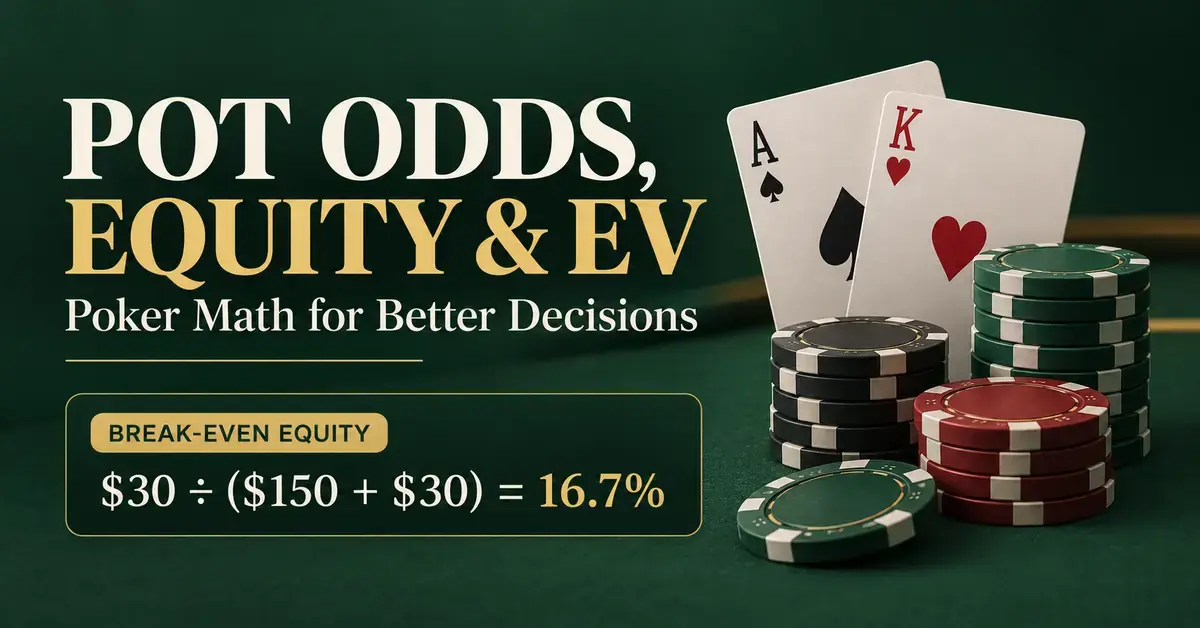
Pot odds are the single most useful piece of math in poker: they tell you whether calling a bet is worth it by comparing the price of the call to the size of the pot you could win. Master this one idea — plus the related concepts of equity, expected value (EV) and implied odds — and most of your tricky calling and folding decisions stop being guesses. This guide explains each term from scratch, shows the two ways to calculate pot odds, and walks through a worked $30-into-$150 example so you can see the numbers line up. No prior maths background is needed; if you can handle simple fractions and percentages, you can do this at the table.
Key Points
- Pot odds compare the cost of your call to the pot you can win — the price of continuing.
- Break-even equity = call ÷ (pot + call). Example: $30 ÷ ($150 + $30) = 16.7%.
- Equity is how often your hand wins. Call when equity is higher than the break-even percentage; otherwise fold.
- Estimate equity fast with the Rule of 2 and 4: outs × 2 (one card to come) or × 4 (two cards).
- EV turns the decision into a dollar figure: (win% × amount won) − (lose% × amount lost).
- Implied odds add the chips you expect to win later; be strict about counting them.
What are pot odds in poker?
Pot odds are the ratio between the amount you must call and the total amount you stand to win. They answer one question: “Is the price I’m being offered good enough to continue?” Pot odds do not tell you whether you will win this particular hand — they tell you whether calling makes money on average if you faced the same situation many times.
The logic is the same as any value decision in daily life. If someone offers you a bet where you risk $1 to win $5, you only need to be right a little more than one time in six for the bet to pay off in the long run. Poker is identical: a small call into a big pot is a cheap shot at a large reward, while a large call into a small pot needs your hand to be strong far more often to be worth it.
Because poker rewards long-term decisions rather than single results, pot odds are most powerful when you combine them with an estimate of how often your hand will win — your equity. We will build up to that step by step.
How to calculate pot odds (call ÷ final pot)
There are two ways to express pot odds. Both give the same answer; use whichever you find faster at the table.
The ratio method
Compare what you must call to what is already in the pot, written as a ratio of reward to risk. Suppose the pot holds $150 (your opponent’s bet is already included in that figure) and it costs you $30 to call. You are risking $30 to win $150, so your pot odds are:
$150 : $30 = 5 : 1
Read aloud, that is “five to one.” The pot is paying you five dollars for every one dollar you put at risk. As a rule of thumb, the bigger the first number, the better the price — and the more often a call can be justified.
The percentage (break-even) method
Most modern players prefer a percentage, because equity is also measured in percent and the two numbers can then be compared directly. The formula is:
Break-even equity = call ÷ (pot + call)
The denominator, pot + call, is simply the size of the pot after your chips go in — the final pot. Using the same example:
$30 ÷ ($150 + $30) = $30 ÷ $180 = 0.167 = 16.7%
This is the crucial number. It means your hand must win at least 16.7% of the time for calling to break even. Win more often than that and the call is profitable; win less often and it loses money over time. A 5:1 ratio and a 16.7% break-even point are two ways of saying exactly the same thing.
If you prefer to convert a ratio straight into a percentage, use: break-even % = 1 ÷ (ratio + 1). For 5:1 that is 1 ÷ 6 = 16.7%, which matches.
What is equity in poker?
Equity is your share of the pot right now, expressed as the percentage of the time your hand will end up winning if all remaining cards were dealt out. If you hold a draw that will become the best hand 20% of the time, you have 20% equity in that pot. Equity is the number you compare against the break-even percentage from pot odds.
The call/fold rule follows directly: if your equity is higher than the pot-odds break-even percentage, calling is profitable; if it is lower, folding is correct (unless implied odds, covered below, tip the balance). In the example above you need more than 16.7% equity. A standard flush draw after the turn card has roughly 19.6% equity, which clears the bar — so against a bet offering 16.7%, calling with that draw makes money.
Turning outs into equity (the Rule of 2 and 4)
“Outs” are the unseen cards that complete your hand. Counting them precisely is a topic in its own right, but you can convert a known out-count into an approximate equity percentage instantly with the Rule of 2 and 4:
- One card to come (you are on the turn, waiting for the river): outs × 2 ≈ your equity %.
- Two cards to come (you are on the flop, with both turn and river to see): outs × 4 ≈ your equity %.
A flush draw has 9 outs. On the turn that is 9 × 2 = 18% (the exact figure is about 19.6%). On the flop it is 9 × 4 = 36% (exact: about 35%). An open-ended straight draw has 8 outs — about 31.5% by the river from the flop, and about 17% on a single card. The shortcut drifts a little when you have many outs, so with more than eight outs, trim roughly one point per extra out for a closer estimate.
Comparing pot odds to equity: a worked decision
Put the two halves together. You hold a flush draw on the turn, the pot is $150, and your opponent bets — leaving it $30 to call into that $150 pot.
- Pot odds (price): $30 ÷ $180 = 16.7% break-even equity needed.
- Your equity (chance): 9 outs × 2 ≈ 18% (about 19.6% exactly).
- Decision: 19.6% is greater than 16.7%, so calling is +EV. Call.
Change one number and the answer can flip. If the bet were instead $90 into that $150 pot, the price becomes $90 ÷ ($150 + $90) = 37.5% — now your 19.6% flush draw falls well short, and the correct play (on pot odds alone) is to fold. The maths does the arguing for you.
Quick Reference
Break-even equity by bet size (how much equity you need to call):
| Opponent’s bet (vs pot) | Pot odds offered | Equity needed to call |
|---|---|---|
| Quarter pot | 9 : 2 | ~17% |
| Half pot | 3 : 1 | 25% |
| Two-thirds pot | 2.5 : 1 | ~28.5% |
| Three-quarters pot | 2.33 : 1 | ~30% |
| Full pot | 2 : 1 | ~33% |
| Double-pot overbet | 1.5 : 1 | 40% |
Common draws and their equity (approximate):
| Draw | Outs | One card to come | Two cards (flop to river) |
|---|---|---|---|
| Gutshot straight draw | 4 | ~8.5% | ~16.5% |
| Flush draw | 9 | ~19.6% | ~35% |
| Open-ended straight draw | 8 | ~17% | ~31.5% |
| Flush + open-ended draw | 15 | ~32.6% | ~54% |
Expected value (EV): putting a dollar figure on the decision
Expected value is the average profit or loss of a decision if you could repeat it endlessly. Pot odds tell you whether a call is profitable; EV tells you how much it is worth in dollars, which is handy for comparing options and for understanding why a losing hand can still be a winning call.
The EV formula
For a simple call with two outcomes — you win the pot or you lose your call — the formula is:
EV = (chance of winning × amount won) − (chance of losing × amount lost)
A worked EV example
Using the same flush draw calling $30 to win the $150 pot, with 19.6% equity:
- Win: 0.196 × $150 = +$29.40
- Lose: 0.804 × $30 = −$24.12
- EV = $29.40 − $24.12 = +$5.28 per call
A positive result means that, averaged over many identical spots, this call earns about $5.28 each time — even though you will miss the draw and lose the $30 roughly four times out of five. That is the heart of poker maths: you are not trying to win every hand, you are trying to make profitable decisions repeatedly. A negative EV figure signals the opposite — a call that bleeds money over time, however satisfying it might feel to make it once.
Implied odds: counting the money you’ll win later
Pot odds only count the chips already in the middle. Implied odds extend the idea to the chips you expect to win on later streets if your draw completes. This matters because many calls look slightly unprofitable on raw pot odds yet become clearly profitable once you add the extra bets a beaten opponent is likely to pay you.
Suppose your flush draw is a touch too expensive on pot odds alone, but you are confident that when the flush comes in, your opponent will call another $60 bet on the river. Mentally add that $60 to the pot you could win, and the price you are really being offered improves. A rough way to include it is:
Required equity = call ÷ (pot + call + expected future winnings)
Implied odds are an estimate, not a certainty, so stay honest about them. Good implied odds need deep stacks still behind, a hand that stays well hidden (a flush or straight that an opponent won’t see coming), and an opponent willing to pay off. A rule many players use: only count implied odds when you can name the future street, the future bet size, and the specific opponent who will pay it.
Reverse implied odds
The mirror image is reverse implied odds — the money you stand to lose on later streets when you make your hand but it is still second best. Drawing to the low end of a straight, or to a flush that could be beaten by a higher flush, carries reverse implied odds: you hit, you bet or call, and you pay off a stronger holding. These hidden costs are a good reason to discount marginal draws rather than talk yourself into every call.
Common mistakes with poker math
Knowing the formulas is only half the job; most errors come from applying them carelessly. Watch for these:
- Using the wrong denominator. Break-even equity is call ÷ (pot + call). Forgetting to add your own call to the pot, or double-counting the opponent’s bet, throws the percentage off every time.
- Counting “dirty” outs. Only count cards that actually give you the winning hand. A card that pairs your draw but completes a bigger hand for your opponent is not a real out.
- Over-trusting implied odds. Imagining a big payoff that never arrives turns a fold into a leak. Be strict: no concrete future bet, no implied-odds credit.
- Treating a close call as a win. A +EV call is correct over the long run; it will still lose this hand most of the time with a draw. Judge the decision, not the single outcome.
- Ignoring position and board texture. The maths assumes you realise your equity. Out of position, or on a board that may pair and reverse your hand, you will realise less than the raw percentage suggests.
- Chasing with no odds at all. Calling a pot-sized or larger bet with a weak draw (needing roughly 33%+ equity) is usually a fold. The price, not the hope, decides.
Who should use pot odds — and when
Pot odds are for every player, but they earn their keep in specific spots. They are most valuable when you are facing a bet with a drawing hand — a flush or straight draw deciding whether to continue — because the call-versus-win comparison is exactly what pot odds measure. They matter less when you already hold a strong made hand (where the question is how much to bet, not whether to call) or when stacks are so shallow that future betting is irrelevant.
For new players, the practical path is: learn to count outs, convert them to equity with the Rule of 2 and 4, calculate the break-even percentage from the bet, and compare the two. That four-step habit covers the large majority of marginal decisions. From there you can layer on EV to size up the dollar impact and implied odds for deep-stacked draws. For the wider framework these numbers fit into — position, hand selection and discipline — see our guide to poker strategy fundamentals, and if you are still learning the flow of a hand, start with how to play poker. It also helps to know the poker hand rankings cold, so you can tell a clean out from a dirty one at a glance.
A note on responsible play
Pot odds, equity and EV describe long-run averages across many hands; they do not predict the result of any single hand, and no formula removes the risk from gambling or guarantees a profit. Variance means you can play every decision perfectly and still lose over a session or longer. Treat poker as entertainment, set money and time limits before you sit down, and never wager more than you can comfortably afford to lose. If gambling stops being fun, free and confidential help is available — see our responsible gambling resources for Canadian support lines and self-exclusion options.
Sources
Frequently Asked Questions (FAQ)
What is the simplest way to calculate pot odds?
Divide the amount you must call by the size of the pot after your call. If it is $30 to call into a $150 pot, that is $30 ÷ ($150 + $30) = 16.7%. Your hand needs to win more than 16.7% of the time for the call to be profitable.
What is the difference between pot odds and equity?
Pot odds are the price you are offered — the break-even percentage set by the bet size. Equity is how often your hand actually wins. You compare the two: if your equity is higher than the pot-odds percentage, you call; if it is lower, you fold.
How do I turn my outs into a percentage?
Use the Rule of 2 and 4. With one card to come, multiply your outs by 2; with two cards to come, multiply by 4. A 9-out flush draw is about 18% on the turn and about 36% on the flop. The estimate is slightly high above eight outs.
What does +EV mean?
+EV, or positive expected value, means a decision earns money on average if repeated many times. A call can be +EV even though it loses this particular hand most of the time — what matters is the average result over the long run, not any single outcome.
When should I use implied odds?
Use implied odds when a call is marginal on pot odds alone but you expect to win extra chips on later streets if your draw hits. They require deep stacks, a well-hidden hand and an opponent likely to pay you off. If you cannot name the future bet and who pays it, do not count them.
