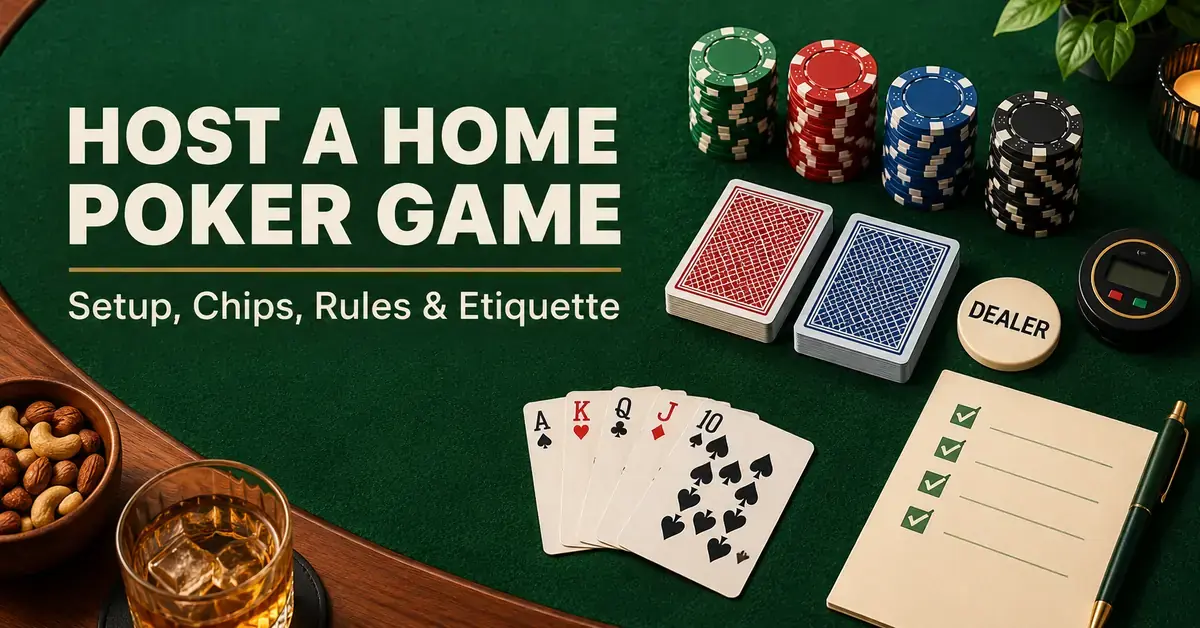
Hosting a poker night at home is one of the friendliest and cheapest ways to enjoy the game: no travel, no entry fee, and you decide the stakes and the pace. A night runs smoothly, though, only when the equipment, the chips, the blinds and the house rules are sorted before the first hand is dealt. This guide walks a Canadian host through every practical decision — what to buy, how many chips each player needs, how to set the blinds, which rules to agree on out loud, and the etiquette that keeps everyone coming back. If you are brand new to the game itself, read our complete beginner’s guide to playing poker first, then come back here to run the table.
Key Points
- Keep it legal and friendly: a private home game with no rake and no profit to the host is generally fine in Canada, but gaming is regulated province by province.
- Core gear: two decks, a 300–500 chip set in 3–4 colours, a table, a dealer button and a blinds timer.
- Chips: give each player 25–30 chips, weighted toward the smallest denomination; never change a colour’s value mid-game.
- Format: tournaments cap each player’s cost and are easiest for beginners; cash games are flexible but open-ended.
- Blinds: for tournaments, start ~100 big blinds deep, use 15–20 minute levels and raise 40–50% per level.
- House rules to state up front: verbal bets are binding, no string bets, a single big chip is a call, show one show all, one player to a hand.
- Etiquette: act in turn, protect your cards, no angle-shooting, no slow-rolling.
Is it legal to host a home poker game in Canada?
A private, friends-only home game with no rake is generally treated as legal in Canada — but the detail matters, and rules vary by province. Under the Criminal Code, section 201 targets “common gaming or betting houses,” while section 204(1)(b) exempts a “private bet between individuals not engaged in any way in the business of betting.” In plain terms, the host must not profit from running the game.
The accepted reading of those sections is that a game played in a private dwelling is fine as long as:
- No rake. The host does not take a cut of the pots.
- No house profit. There is no entry fee, membership charge or other way the host earns money from the game. Players chipping in to cover genuine food and drink costs is a different thing from the host making money.
- It is a true private game. It is among friends in a home, not an advertised, for-profit or club-style operation.
Games run for profit, with a rake, or in bars, clubs and businesses sit on much weaker legal ground, and gaming is regulated province by province. None of this is legal advice — if you have any doubt about your specific setup, check the current law for your province or speak to a Canadian lawyer. For the wider picture of how the game is regulated across the country, see our overview of poker laws in Canada.
What equipment do you need for a poker night?
You can host a solid game with surprisingly little gear. The essentials are a deck, chips, a surface and a way to mark the dealer. Everything else is comfort.
- Playing cards. Two decks with different-coloured backs so one can be shuffled while the other is dealt. Plastic or plastic-coated cards last far longer and are harder to mark than cheap paper cards.
- Poker chips. A 300–500 chip set in three or four colours covers most home games of up to 8–10 players. More on how many each player needs below.
- A table and seating. Any table that seats everyone comfortably works; a felt layout or a fold-out tabletop is a nice touch but optional. Leave enough elbow room that players can protect their cards.
- A dealer button. A marker that shows whose turn it is to “deal” (act as the dealer position). It moves one seat clockwise after every hand.
- A blinds timer. For a tournament, a phone or tablet app that counts down each level and shows the current blinds. It removes arguments about when the blinds go up.
- Small blind and big blind markers (optional) and a cut card to cover the bottom of the deck.
Keep a printed copy of the hand rankings on the table for newer players. Our poker hand rankings chart shows all ten hands in order and settles the inevitable “does a flush beat a straight?” question instantly.
How many poker chips do you need per player?
For a home tournament, give each player a starting stack of 25–30 chips spread across three or four colours. That is enough to make clean bets without constant “colouring up” (trading small chips for larger ones), and few enough that the stacks stay easy to count.
The core principles of chip distribution are the same whether you play a tournament or a cash game:
- Give everyone more small chips than large ones. The lowest denominations pay the blinds and most small bets, so they get used constantly.
- Keep the colour system consistent. A typical home set runs white, red, green and black from lowest to highest value. Agree on what each colour is worth and never change it mid-game.
- Make the smallest chip match your smallest bet. In a tournament, that is the small blind; in a cash game, it is the small blind too. You should never need to make change for a single bet.
The table below shows a clean, representative starting stack for a home tournament. Adjust the quantities to fit the chips you actually own — the exact split matters less than keeping plenty of low chips in each stack.
Chip Distribution
| Chip colour | Value | Chips per player | Total value |
|---|---|---|---|
| White | 25 | 8 | 200 |
| Red | 100 | 8 | 800 |
| Green | 500 | 8 | 4,000 |
| Black | 1,000 | 5 | 5,000 |
| Total | — | 29 | 10,000 |
Cash game or tournament: which format suits your night?
The first big decision is the format, because it changes how long the night runs and how players join and leave.
- Tournament. Everyone pays the same buy-in for the same starting stack, blinds rise on a timer, and you play until one person has all the chips. It has a clear start and finish, a known maximum cost, and it is easy for beginners because you cannot lose more than the buy-in. Best for a fixed group and a set evening.
- Cash game (also called a ring game). Chips equal real money at a fixed rate, blinds stay the same all night, and players can sit down, top up (“rebuy”) and cash out whenever they like. It is more flexible but open-ended, and players can lose more than one buy-in. Best when people drift in and out.
For a first-time host, a tournament is usually the easier choice: the cost is capped, the structure is self-explanatory, and the timer does the pacing for you. Whichever you pick, agree on the buy-in and the stakes before anyone sits down.
How do you set the blinds and a blind structure?
Blinds are the forced bets that start the betting each hand — the “small blind” and the larger “big blind” posted by the two players left of the dealer button. Setting them well is the difference between a three-hour night and one that drags past midnight.
For a cash game, blinds stay fixed. A common home level is a small blind and big blind of, say, $0.25/$0.50 or $0.50/$1.00, with a buy-in of around 100 big blinds. Keep the stakes low enough that losing a buy-in stings a little but ruins no one’s evening.
For a tournament, blinds rise on a timer so the game speeds up and reaches a winner. A reliable home recipe:
- Start about 100 big blinds deep — a 10,000-chip stack opens at 25/50.
- Use 15–20 minute levels. Shorter levels turn the night into a coin-flip; longer ones stretch it out.
- Raise the blinds roughly 40–50% each level.
- Add a 10-minute break every three or four levels, and “colour up” the smallest chips at those breaks.
Here is a sample structure for a 10,000-chip starting stack that lands around three to four hours with 8–10 players:
| Level | Small blind / Big blind |
|---|---|
| 1 | 25 / 50 |
| 2 | 50 / 100 |
| 3 | 75 / 150 |
| Break & colour up | — |
| 4 | 100 / 200 |
| 5 | 150 / 300 |
| 6 | 200 / 400 |
| Break | — |
| 7 | 300 / 600 |
| 8 | 500 / 1,000 |
| 9 | 700 / 1,400 |
| 10 | 1,000 / 2,000 |
Run the timer strictly: blinds go up when it says so, not “after this orbit.” Decide with the group in advance whether a level that ends mid-hand takes effect immediately or at the next deal.
Which house rules should every home game agree on?
House rules prevent the arguments that kill the mood. Read these out loud before the first hand and, ideally, keep a printed copy on the table. Casinos enforce them automatically; at home, the host does.
Verbal declarations are binding
If you say your action in turn — “fold,” “check,” “call,” “bet” or “raise” — you are held to it, even before any chips move. A player who says “call” and then tries to turn it into a raise is only calling. This rule speeds the game up and stops people from testing reactions before committing.
No string bets
A “string bet” is reaching back to your stack for more chips after you have already pushed some forward, without having announced the full amount. It is banned because it lets a player gauge an opponent’s reaction before deciding how much to bet. The remedy: only the first motion counts. To raise, either state the amount first (“raise to 400”) or move all the chips in one clean motion.
A single chip is a call
If a player drops one oversized chip into the pot without saying “raise,” it counts as a call, and they get change back. Announcing a raise — or putting multiple chips forward in one motion — is the only way to raise with a big chip.
Show one, show all
At showdown, if you show your cards to one player, every player at the table is entitled to see them. Flashing a bluff to a neighbour while hiding it from everyone else is unfair, so the whole table gets the same information.
One player to a hand
Only the player holding the cards may look at them or make decisions about the hand while it is live. No coaching, no showing your hole cards to a friend, no discussing a live hand with railbirds. Exposing your cards during play can get your hand declared dead.
What is good poker etiquette at a home game?
Etiquette is what makes people want to come back. Most of it is simple courtesy, but a few points are worth stating plainly.
- Act in turn. Acting out of turn gives away information and can change how players behind you decide. Wait for the action to reach you.
- Protect your cards and keep your chips tidy. Keep your highest-value chips visible so opponents can see roughly how much you have (your “stack”).
- No angle-shooting. An “angle shoot” is a sneaky move that exploits the letter of the rules to mislead opponents — pretending to fold to induce a bet, mis-stating your bet, hiding big chips behind small ones. It is not cheating in the card-marking sense, but it is unwelcome and sours a friendly game fast.
- Don’t slow-roll. If you have the winning hand at showdown, turn it over promptly rather than pausing to let a loser think they won.
- Keep the talk clean. Don’t discuss cards you’ve folded while a hand is still live, and don’t berate players for how they played — it drives recreational players away.
- Tip the host with cleanup, not cash. Since the host takes no rake, help tidy up, bring snacks or host the next one.
If you want to actually win more of those pots once the night is running smoothly, our poker strategy fundamentals cover position, starting hands and discipline for new players.
What are the most common mistakes new hosts make?
Even a well-stocked game can go sideways. These are the errors that trip up first-time hosts most often.
- Not enough small chips. Running out of low denominations means constant change-making and stalls the game. Weight every stack toward the smallest chips.
- Blinds that rise too fast. Steep tournament levels turn skill into luck and bust players before the fun starts. Keep early levels low and the increases gentle.
- No agreed rules. Deciding the string-bet or verbal-bet rule in the middle of a disputed pot guarantees an argument. Settle them before the deal.
- Stakes set too high. A buy-in that hurts turns a social night tense. Pick an amount everyone can comfortably treat as entertainment.
- Mixing up chip values. Changing what a colour is worth mid-game, or using two chip sets with overlapping colours, causes expensive confusion. Lock the colour system in at the start.
- Taking a rake “for the pizza.” Skimming pots can cross the legal line and breeds resentment. If you want to cover costs, ask everyone to chip in openly and equally instead.
Keeping the night fun and responsible
The best home games feel like a social evening that happens to involve cards, not a high-stakes battle. Set stakes everyone can afford to lose, agree on a finish time, and keep food, water and non-alcoholic options on hand. Watch for anyone chasing losses or playing with money they cannot spare, and never lend players money to stay in the game.
Note on responsible play
Play for fun, not profit. Poker played for money carries financial risk and the outcome of any individual session is largely down to chance. Only wager amounts you can comfortably afford to lose, agree on stakes and a finish time in advance, and never chase losses or lend money to keep a player in the game. A home host should take no rake or fee. If gambling is causing stress for you or someone at your table, free, confidential help is available 24/7 — see our guide to responsible gambling in Canada. This article is general information, not legal or financial advice.
Sources
- Criminal Code (R.S.C., 1985, c. C-46), Section 204 — Justice Laws Website, Government of Canada
- Criminal Code (R.S.C., 1985, c. C-46), Section 201 — Justice Laws Website, Government of Canada
- How to Set Up a Poker Blinds Schedule — HomePokerTourney
- Poker String Bets — HomePokerTourney
- Poker Chip Distribution: Ideal Stack — esports.gg
- Poker Power Home Game Guide (PDF)
Vanliga frågor (FAQ)
How many players do you need for a home poker game?
Two players is the minimum (called “heads-up”), but most home games are best with 5–9 players at one table. Six to eight is a sweet spot: enough action to stay lively, few enough that everyone gets regular hands and the night finishes at a reasonable hour.
How much money should each player bring?
Set one fixed buy-in for a tournament, or a buy-in range (often around 100 big blinds) for a cash game, and tell everyone in advance. Choose an amount every player can treat as entertainment and comfortably lose. For low-stakes friendly games, a $20–$40 buy-in is common.
Is it legal to host a poker game at my house in Canada?
A private, friends-only game with no rake and no profit to the host is generally treated as legal, but gaming is regulated province by province and the law draws the line at the host making money. Charging to play, taking a cut of the pots, or running it as a business carries real legal risk. This is general information, not legal advice.
What is the difference between a cash game and a tournament?
In a tournament everyone pays the same buy-in, blinds rise on a timer, and play continues until one player has all the chips. In a cash game chips equal real money at a fixed rate, blinds stay constant, and players can join, top up and cash out whenever they want. Tournaments cap your cost; cash games are more flexible but open-ended.
What is a string bet and why isn’t it allowed?
A string bet is pushing some chips forward and then reaching back for more without first announcing the full amount. It is banned because it lets a player watch opponents react before committing. To raise cleanly, state the amount out loud first, or move all your chips in a single forward motion.
