Texas Hold’em is the most widely played form of poker in the world, and its rules are simpler than they look. Each player is dealt two private cards, five shared cards are turned face up in the middle of the table over four betting rounds, and the goal is to make the best five-card poker hand from the seven cards available to you. This guide explains how to play Texas Hold’em from the first deal to the showdown, with a step-by-step walkthrough of a sample hand so the sequence makes sense.
Key Points
- Each player gets two hole cards; five community cards are shared on the board.
- Every hand starts with two forced bets: the small blind and the big blind.
- There are four betting rounds — preflop, flop, turn and river.
- You make the best five-card hand from the seven cards available (two hole cards plus five community cards).
- In no-limit Hold’em you can bet any amount up to your whole stack.
- The best hand wins at the showdown, or the last player left when everyone else folds.
What is Texas Hold’em?
Texas Hold’em is a community-card poker game in which each player combines two private cards with five shared cards to form the strongest possible five-card hand. It is played with a standard 52-card deck and suits one to ten players at a single table, with nine or ten being a common full ring and two players (“heads-up”) being the smallest game.
The “community-card” label matters. Unlike draw or stud games, most of the cards you use are visible to everyone, which is why Hold’em rewards reading the board and your opponents as much as the strength of your own two cards. If you want to see how it sits alongside Omaha, Seven-Card Stud and other games, our overview of poker variants groups them into families. For the shared basics that apply to every poker game, start with our guide on how to play poker.
Quick Facts
| Deck | Standard 52 cards, no jokers |
|---|---|
| Players | 2 to 10 at one table |
| Cards dealt to each player | 2 (hole cards, face down) |
| Community cards | 5 (flop 3, turn 1, river 1) |
| Betting rounds | 4 (preflop, flop, turn, river) |
| Hand you make | Best 5 cards out of 7 |
| Most common format | No-limit Hold’em |
| How a hand ends | Showdown, or all but one player folds |
What you need to play
You need a 52-card deck, a dealer button and chips (or a way to track bets). The button is a small marker that shows which seat is the nominal dealer for the hand; in a home game the deal rotates with it, while a casino uses a permanent dealer and only the button moves.
- Deck: one standard 52-card deck, no jokers.
- Players: 2 to 10 at one table.
- Button: marks the nominal dealer; moves one seat clockwise after every hand.
- Chips: used to post blinds, bet, call and raise.
The dealer button and the blinds
Every hand starts with two forced bets called blinds, posted before any cards are dealt so there is always something to play for. The player immediately clockwise (left) of the button posts the small blind, and the next player posts the big blind. The small blind is normally half the big blind: in a “$1/$2” game the small blind is $1 and the big blind is $2.
The button, and therefore the blinds, moves one seat clockwise after each hand, so every player posts both blinds in turn over a full round of the table. The big blind also sets the minimum amount other players must match to stay in the hand before the flop.
The four betting rounds: preflop, flop, turn, river
A hand of Texas Hold’em has exactly four betting rounds, each separated by new cards appearing on the table. Understanding this sequence is the core of the holdem rules.
Preflop
After the blinds are posted, each player is dealt two cards face down, known as the hole cards. The first betting round, called preflop, begins with the player to the left of the big blind — the “under the gun” seat. Because the big blind is already a live bet, players here can only call, raise or fold. Action moves clockwise, and the big blind acts last and keeps the option to raise even if everyone before only called.
The flop
Once the preflop betting is settled, the dealer burns the top card (sets it aside face down) and turns three community cards face up together. This is the flop. A new betting round follows. From the flop onward, action starts with the first active player to the left of the button, and the button acts last — a built-in advantage of seeing everyone else act first.
The turn
The dealer burns another card and adds a single fourth community card, called the turn. A third betting round follows, using the same order as the flop. In fixed-limit games the bet size typically doubles on the turn.
The river
The dealer burns one more card and reveals the fifth and final community card, the river. The fourth and last betting round takes place. If two or more players remain after this round, the hand goes to a showdown.
The actions you can take
On your turn you always have a defined set of choices, and which ones are available depends on whether anyone has bet before you in the current round.
- Check: pass the action without betting — only allowed if no one has bet yet this round.
- Bet: put the first chips into the pot this round.
- Call: match the current highest bet to stay in.
- Raise: increase the current bet, forcing others to match more or fold.
- Fold: give up the hand and any chips already committed.
A betting round ends once every remaining player has put in the same amount and has had a chance to act.
No-limit, pot-limit and fixed-limit Hold’em
The betting structure decides how much you can wager, and it is the single biggest difference between Hold’em games. The rules of the hand are identical; only the size of the bets changes.
- No-limit Hold’em: you can bet any amount from the minimum up to your entire stack at any time. The opening raise must be at least double the big blind, and any later raise must be at least the size of the previous bet or raise in that round. This is the format used in most televised games and major tournaments, including the World Series of Poker Main Event.
- Pot-limit Hold’em: the maximum bet is the current size of the pot. Less common for Hold’em than for Omaha.
- Fixed-limit Hold’em: bets and raises are set amounts, and the number of raises per round is capped (commonly one bet and three raises).
When you put your last chips in, you are all-in. You stay in the hand but cannot win more from any opponent than you matched; any extra betting goes into a separate side pot that the all-in player cannot win.
How you make your best five-card hand
At showdown you use the best five cards out of the seven available to you — your two hole cards plus the five community cards. You may use both hole cards, just one, or, occasionally, neither.
That last case is called playing the board: if the five community cards make a better hand than anything you can build with your hole cards, the board plays and tied players split the pot. The exact ranking of hands — from a royal flush down to high card — is the same across every poker game; keep our chart of poker hand rankings open while you learn.
When two players hold the same rank of hand, the kicker breaks the tie. A kicker is the highest side card that is not part of the main combination. For example, if you hold A-K and your opponent holds A-Q and the board pairs the ace, you both have a pair of aces, but your king outkicks their queen and you win. Suits never break ties under standard rules; if the full five-card hands are identical, the pot is split.
The showdown: who wins the pot
A hand ends in one of two ways. If every opponent folds, the last remaining player wins the pot without showing their cards. If two or more players are still in after the river, they reveal their hole cards in a showdown and the best five-card hand takes the pot. Equal hands divide it evenly, with any odd chip going to the player closest to the left of the button.
A hand of Texas Hold’em, step by step
Here is a full hand at a six-player $1/$2 no-limit table to show how the pieces fit together.
- Blinds: the player left of the button posts $1 (small blind); the next player posts $2 (big blind).
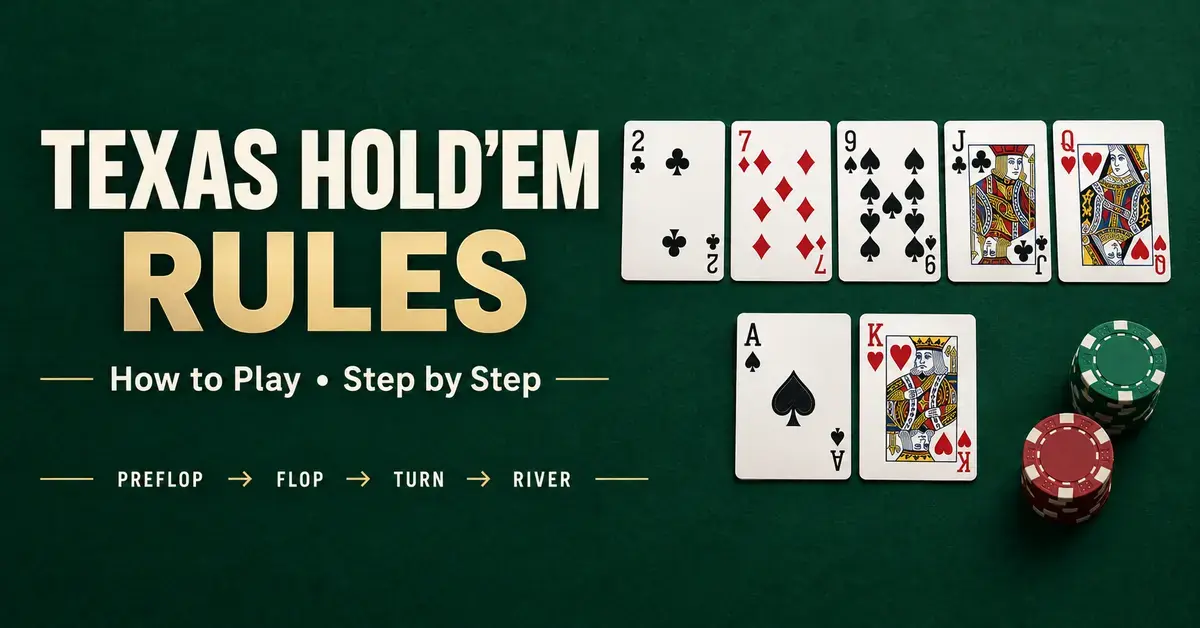
- Deal: everyone gets two hole cards. You are under the gun with the A♦ K♦ (ace-king of diamonds).
- Preflop: you raise to $6. One player calls; the blinds fold. The pot is $15.
- Flop: the dealer burns a card and turns Q♦ 7♦ 2♣. You have two diamonds and need one more for a flush. You bet $8; your opponent calls. Pot: $31.
- Turn: the 9♦ appears. You now have the ace-high flush. You bet $20; your opponent calls. Pot: $71.
- River: the 2♦ pairs the board. Your best five cards are still your ace-high flush. You bet $40; your opponent calls.
- Showdown: your opponent shows Q♠ J♠ for a pair of queens. Your flush is the stronger hand, so you win the pot.
Common beginner mistakes
Most early losses come from a handful of avoidable errors, not from bad luck. Watching for these will save you more than any single tactic.
- Playing too many hands. Entering pots with weak hole cards is the most expensive beginner habit. Folding often is normal and correct.
- Ignoring position. Acting last (on or near the button) lets you see what everyone does first, which is a real edge. Play tighter from early seats.
- Misreading the board. Always build your actual best five cards from the seven available — beginners often miss that the board can pair, complete a straight or a flush for an opponent.
- Calling to “see one more card.” Chasing a draw without the right pot odds slowly drains a stack.
- Chasing losses. Betting bigger to win back lost chips is how a small loss becomes a large one.
For a structured way to improve beyond the rules, see our fundamentals of poker strategy.
Texas Hold’em odds worth knowing
A few probabilities give useful context for how often strong situations actually come up. These are verified, standard figures.
- You will be dealt a pocket pair (two cards of the same rank) about 1 in 17 hands (5.9%).
- You will be dealt pocket aces specifically about 1 in 221 hands (0.45%).
- Holding a pocket pair, you will flop three of a kind (a “set”) roughly 1 in 8 to 9 times (about 11–12%).
- Pocket aces win about 85% of the time against a single random hand before the flop — strong, but far from a guarantee.
Sources
A note on playing responsibly
Texas Hold’em is a game of both skill and chance, and when it is played for money it is a form of gambling. Nothing on this page is a strategy that guarantees winning, and no system removes the element of luck or the house’s edge in commercial games. Set a budget you can afford to lose, treat any losses as the cost of entertainment, and never play to win money back. If gambling is causing you harm, free and confidential help is available through our guide to responsible gambling resources in Canada.
Frequently Asked Questions (FAQ)
How many cards does each player get in Texas Hold’em?
Each player is dealt two private cards face down, called hole cards. Everyone then shares five community cards turned face up in the middle. You make your best five-card hand from those seven cards combined.
What is the order of the betting rounds?
There are four: preflop (after the hole cards are dealt), the flop (three community cards), the turn (a fourth card) and the river (a fifth card). A round of betting follows each stage.
What does “no limit” mean in Hold’em?
In no-limit Hold’em you can bet any amount up to your entire stack at any point in a betting round. Fixed-limit games instead use set bet sizes with a capped number of raises, and pot-limit games cap each bet at the current size of the pot.
Do I have to use both of my hole cards?
No. Your best five-card hand can use both hole cards, one, or neither. If the five community cards are the strongest hand you can make, you “play the board” and the pot is usually split among the remaining players.
What happens if two players have the same hand?
The pot is split equally between them. If both have the same hand rank but different side cards, the higher kicker (the best unused card) wins. Suits do not break ties in standard Texas Hold’em.
