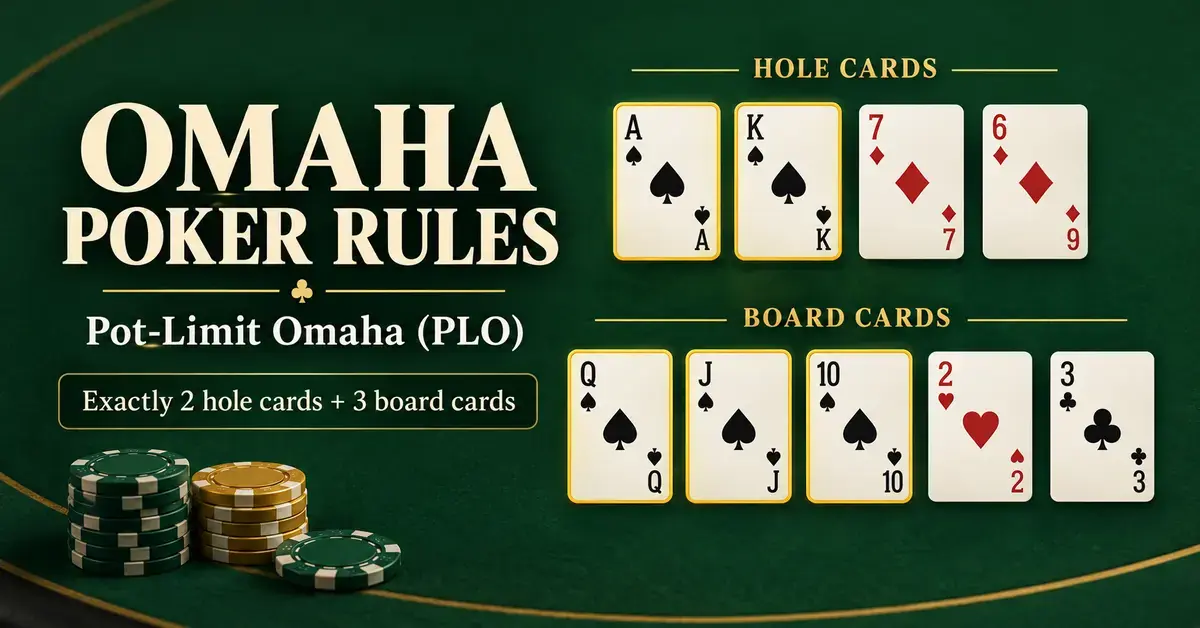
Omaha poker is a community-card game in which each player is dealt four private cards instead of the two used in Texas Hold’em, yet must build every hand from exactly two of those cards plus exactly three of the five shared board cards. It is most commonly played as Pot-Limit Omaha (PLO), where the biggest bet allowed is the current size of the pot. This guide explains the full rules from the deal to the showdown, breaks down the two-card rule that trips up almost every newcomer, shows how pot-limit betting is calculated, and sets out how Omaha differs from Hold’em.
Key Points
- Four hole cards: each player is dealt four private cards instead of Hold’em’s two.
- The two-card rule: your hand must use exactly two hole cards plus exactly three board cards.
- Pot-limit betting: the maximum bet or raise is the current size of the pot (PLO).
- Same shape as Hold’em: blinds, four betting rounds (pre-flop, flop, turn, river) and standard hand rankings all carry over.
- Higher variance: more combinations mean bigger pots and closer equities than Texas Hold’em.
What is Omaha poker?
Omaha is a community-card poker variant played with a standard 52-card deck, usually by two to ten players at a table. Like Texas Hold’em, it uses blinds, four betting rounds and five face-up community cards dealt in the middle of the table. The headline difference is the number of cards in your hand: you receive four hole cards, and you combine them with the board to make the best five-card poker hand.
The standard hand values are identical to every other form of poker, running from a Royal Flush down to a High Card. If you are unsure which hand beats which, our guide to poker hand rankings lists all ten in order. Omaha is widely described as the second most popular poker variant after Texas Hold’em, and “Omaha” on its own almost always means the pot-limit high version, PLO.
How Omaha differs from Texas Hold’em
The quickest way to understand Omaha is by contrast with Hold’em, because the board layout and betting rounds are the same in both games. Three things change: you hold four cards instead of two, you must use precisely two of them at showdown, and the standard betting structure is pot-limit rather than no-limit.
Those small-sounding changes have large effects. With four hole cards you can form six different two-card combinations, so starting hands and draws are far richer, hand values run much closer together, and strong made hands such as straights, flushes and full houses appear more often. Pots tend to be bigger and the game is generally higher-variance than Hold’em. Because of that, most coaches suggest learning the basics of how to play poker and Hold’em first, then moving to Omaha once the fundamentals feel natural.
Omaha vs Hold'em
| Feature | Omaha (PLO) | Texas Hold’em |
|---|---|---|
| Hole cards dealt | 4 | 2 |
| Cards used at showdown | Exactly 2 hole + 3 board | Any combination of hole and board |
| Two-card combinations in hand | 6 | 1 |
| Typical betting structure | Pot-limit | No-limit |
| Strong made hands | More frequent | Less frequent |
| Hand equities | Run closer together | More spread out |
| Variance | Higher | Lower |
The ‘exactly two plus three’ rule explained
The single most important Omaha rule is that your final hand must use exactly two of your four hole cards and exactly three of the five board cards — no more and no fewer. In Hold’em you can use both, one or none of your hole cards; in Omaha the two-and-three split is compulsory, and getting it wrong is the classic beginner error.
Why four hearts in your hand is not a flush
Suppose you hold four hearts and two more hearts land on the board. It looks like a six-card flush, but it is not a flush at all: only two of your cards can play, so you can contribute at most two hearts, and two plus two board hearts is just four — one short. To make a flush in Omaha you need exactly two cards of the suit in your hand and exactly three of that suit on the board.
Reading the board for straights
The same logic applies to straights. If the board shows four cards to a straight, a Hold’em player instinctively reads it as a made straight, but in Omaha you still have to supply two hole cards that complete it. A single connecting card in your hand is never enough. Always ask: which two of my cards, plus which three on the board, actually make this hand?
High and low use two cards each
In split-pot versions such as Omaha Hi-Lo, the rule holds for each half of the pot independently. You use two hole cards and three board cards for your high hand, and two hole cards and three board cards for your low hand — but they do not have to be the same two or the same three cards.
How to play a hand of Omaha, step by step
A hand of pot-limit Omaha follows the same shape as a hand of Hold’em. Here is the full sequence from the deal to the showdown.
Blinds and the deal
Two players post forced bets called the small blind and the big blind to start the action. The dealer then gives each player four hole cards face down, dealt one at a time clockwise.
The four betting rounds
- Pre-flop: Players act on their four hole cards. Starting with the player to the left of the big blind, each can fold, call or raise.
- The flop: Three community cards are dealt face up. A second betting round follows, beginning with the first active player to the dealer’s left.
- The turn: A fourth community card is dealt, followed by another betting round.
- The river: The fifth and final community card is dealt, followed by the last betting round.
If you want a refresher on how check, bet, call, raise and fold work across these streets, the general betting-round basics are the same in every community-card game.
The showdown
If two or more players remain after the river betting, there is a showdown. Each player makes their best five-card hand using exactly two hole cards and exactly three board cards, and the highest-ranking hand wins the pot. If everyone else folds before the showdown, the last player standing wins without showing their cards.
Pot-limit betting explained
In Pot-Limit Omaha, the maximum you can bet or raise at any point is the current size of the pot; the minimum is the big blind (or, for a raise, at least the size of the previous bet or raise). This is the structure that gives PLO its name, and it is the second thing Hold’em players have to relearn after the two-card rule.
How to calculate the maximum bet
When no one has bet yet on the current street, the maximum bet is simply whatever is already in the pot. The tricky case is when you are facing a bet, because the pot you are allowed to match includes that bet and your own call. The method is always the same:
- First, mentally call the bet in front of you.
- Add that call to the pot to get the new pot total.
- Your maximum raise is that new total, on top of your call.
A handy shortcut when facing a single bet: your maximum raise-to amount equals three times the bet plus whatever was in the pot before the bet.
A worked example
Say there is $100 in the pot and an opponent bets $50. To find your maximum raise: you first call the $50, which makes the pot $200, so you may then raise by $200 more. Your maximum total bet is therefore $250 ($50 call + $200 raise). The shortcut gives the same answer: (3 x $50) + $100 = $250.
Pre-flop the logic is identical. In a $1/$2 game the blinds make a $3 pot, so the first player to raise calls the $2 big blind (pot becomes $5) and may raise $5 on top, for a maximum opening raise of $7. In a live game you are always allowed to ask the dealer for the current pot size or the maximum legal raise, so you never have to do this maths under pressure.
Pot-limit versus no-limit
The practical consequence is that you cannot move all-in whenever you like, as you can in no-limit Hold’em. Stacks go in over several streets through repeated pot-sized bets rather than in one shove, which rewards patience and makes position and pot control even more valuable. For broader guidance on applying pressure wisely, see our poker strategy fundamentals.
Omaha variants you may meet
Omaha is a family of games built on the same two-card rule. These are the versions you are most likely to encounter.
Pot-Limit Omaha (PLO)
The high-only, pot-limit version described throughout this guide. It is by far the most widely played form of Omaha, both live and online, and features in major festival schedules.
Omaha Hi-Lo (Eight-or-Better)
Here the pot is split between the best high hand and the best qualifying low hand. To qualify, a low must be five unpaired cards all ranked eight or lower (using the Ace-to-Five method, where the Ace counts as low). If no hand qualifies for the low, the high hand scoops the entire pot. One player can win both halves — called scooping — with the same four cards.
Five-Card Omaha and Big O
Five-Card Omaha is identical to the standard game except that each player receives five hole cards instead of four (you still use exactly two at showdown). Big O is the hi-lo, eight-or-better version of five-card Omaha, almost always played pot-limit. Naming varies between cardrooms, so always read the posted game description before you sit down.
Common mistakes beginners make
- Playing it like Hold’em. Forgetting the two-card rule and misreading flushes and straights is the number-one leak. Count your two cards and three board cards every time.
- Overvaluing single pairs and small two-pair. With everyone holding four cards, made hands and big draws are common, so marginal holdings win far less often than in Hold’em.
- Chasing non-nut draws. Because strong hands appear so frequently, drawing to anything less than the best possible hand (“the nuts”) is expensive.
- Miscounting the pot bet. Players routinely forget to include their call when sizing a pot-sized raise. When in doubt, ask the dealer.
- Loose starting hands. Four coordinated cards that work together are worth far more than four random ones; dangling, disconnected cards add little.
Who Omaha poker suits
Omaha rewards players who enjoy post-flop complexity, big multi-way pots and swingy, action-heavy sessions. It suits people who already understand poker basics and want more decisions per hand. Players who prefer a lower-variance game or are still learning the fundamentals are usually better served by starting with Hold’em and treating PLO as a second step. Whichever you choose, Omaha sits alongside the other games covered in our overview of poker variants.
Disclaimer
This article is educational information about the rules of Omaha poker, not betting advice or encouragement to gamble. No guide, strategy or practice play can change the fact that poker involves risk, and outcomes over any short period are heavily influenced by chance. If you choose to play for money, set limits you can afford and treat it as entertainment. For warning signs, limit-setting tools and free, confidential help in Canada, see our responsible gambling resources.
Sources
Frequently Asked Questions (FAQ)
How many cards do you get in Omaha poker?
Each player is dealt four private hole cards in standard Omaha. At showdown you must use exactly two of them, combined with exactly three of the five community cards, to make your five-card hand.
What is the main difference between Omaha and Texas Hold’em?
Omaha deals four hole cards instead of two and forces you to use exactly two of them plus three board cards, whereas Hold’em lets you use any combination. Omaha is also usually played pot-limit rather than no-limit.
What does pot-limit mean in PLO?
Pot-limit means the largest bet or raise allowed is the current size of the pot. When you face a bet, the pot you can match includes that bet plus your call, so you cannot simply move all-in at any moment as in no-limit.
Can you use only one hole card in Omaha?
No. Omaha requires exactly two hole cards in every hand, no more and no fewer. This is why four cards of one suit in your hand do not make a flush — only two of your cards can ever play.
Is Omaha harder than Texas Hold’em?
Most players find Omaha more complex because four hole cards create more combinations, closer hand values and bigger, higher-variance pots. The rules themselves are simple, but strong reads and disciplined hand selection matter more.
