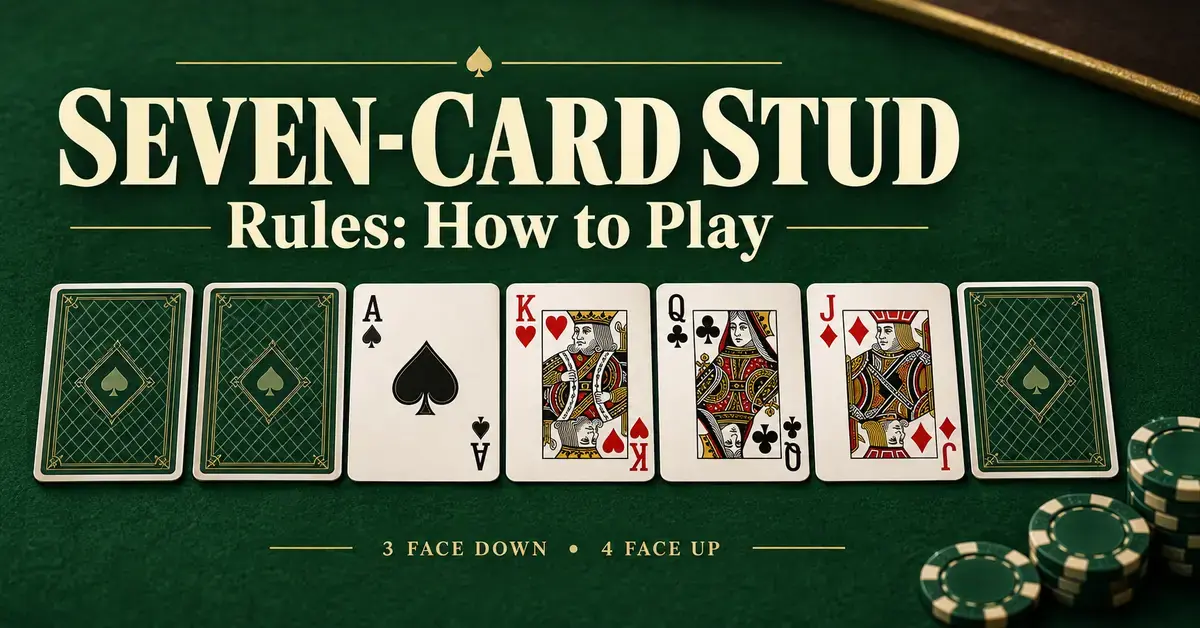
Seven-Card Stud is the classic poker game people played for decades before Texas Hold’em took over televised tables in the 2000s. There are no shared community cards: each player is dealt their own mix of face-down and face-up cards across five betting rounds, and the winner makes the best five-card hand from the seven cards they personally hold. This guide explains the full Seven-Card Stud rules from the ante and bring-in through third-to-seventh street betting and the showdown, so you can sit down and play with confidence.
Quick Facts
| Players | 2–8 (5–7 is best) |
|---|---|
| Deck | Standard 52 cards, no jokers |
| Family | Stud poker (no community cards) |
| Cards per player | 7 total — 3 face down, 4 face up |
| Forced bets | Ante from all players + a bring-in |
| Betting rounds | 5 (third through seventh street) |
| Usual betting format | Fixed-limit (small bet / big bet) |
| Object | Make the best five-card hand from your seven cards |
| Close relatives | Razz (lowball), Seven-Card Stud Hi-Lo |
What is Seven-Card Stud?
Seven-Card Stud is a stud-poker variant in which players build a hand from cards dealt only to them, with no community cards shared by the table. It is played with a standard 52-card deck and uses the standard poker hand rankings, from a Royal Flush down to a High Card. Over the course of a hand each player receives seven cards — some face down (called hole cards, seen only by you) and some face up (called up cards or door cards, visible to everyone) — and at the end makes the best possible five-card hand out of those seven.
The game suits 2 to 8 players, with 5 to 7 generally considered the best table size. Because every player can end up with seven cards, an eight-handed table can run short of cards late in the deal; the rules handle that with a single community card, explained further down.
How is Seven-Card Stud different from Texas Hold’em?
The biggest difference is that Seven-Card Stud has no community cards and no flop, turn or river shared by the table. In Texas Hold’em everyone shares five face-up community cards; in Stud, your cards are your own, and much of your information comes from the up cards your opponents are showing. A few other key contrasts:
- Forced bets: Hold’em uses a small blind and big blind. Stud uses an ante from every player plus a bring-in posted by one player.
- Betting rounds: Hold’em has four betting rounds; Stud has five (third through seventh street).
- Hand size: Hold’em gives you two hole cards; Stud deals you seven cards in total, and you pick your best five.
- Memory and reading: Stud rewards remembering the up cards that have been shown and folded, because those cards affect what is still live. For the shared foundations that apply to both games, see our guide on how to play poker.
What do you need to play?
You need a single 52-card deck, a table of 2 to 8 players, and chips. Seven-Card Stud is traditionally played as a fixed-limit game, which means bet sizes are set in advance rather than chosen freely. A limit game is written as two numbers, such as $5/$10: the first is the small bet and the second is the big bet, which is double the small bet. The table also sets an ante and a bring-in amount. Before you play for money anywhere in Canada, read our note on responsible gambling.
How does a hand of Seven-Card Stud work?
A hand plays out in a fixed sequence of deals and betting rounds known as streets. Every player antes, then receives two down cards and one up card to start. The player showing the lowest up card posts the bring-in, and betting begins. From there, one more card is dealt before each of the next four betting rounds — face up on fourth, fifth and sixth street, and face down on seventh street. The table below summarises the whole hand at a glance.
Betting Round by Round
| Street | Card dealt | Bet size | Who acts first |
|---|---|---|---|
| Third street | 3rd card (face up); 2 down + 1 up total | Small bet | Lowest up card (posts bring-in) |
| Fourth street | 4th card (face up) | Small bet* | Highest showing hand |
| Fifth street | 5th card (face up) | Big bet | Highest showing hand |
| Sixth street | 6th card (face up) | Big bet | Highest showing hand |
| Seventh street | 7th card (face down) | Big bet | Highest showing hand |
*On fourth street, if a player shows an open pair, the table may switch to the big bet. This open-pair rule varies by card room.
The ante and the bring-in
Every player posts an ante before any cards are dealt, which seeds the pot. In games with a bring-in, the ante is usually much smaller than the small bet — for example around $0.50 to $1 in a $5/$10 game, though exact amounts vary by table. The ante is not a bet you can call or raise; it is simply the cost of being dealt in.
After the first three cards are dealt, the player with the lowest-ranking up card must post the bring-in, a small forced bet that starts the action. The bring-in is typically about half the small bet and always less than a full small bet but more than the ante. The player posting it has a choice: pay the small bring-in amount, or “complete” the bet by putting in a full small bet instead.
When two or more players tie for the lowest up card, suit breaks the tie, ranked from lowest to highest as clubs, diamonds, hearts, spades. The lowest card by that order pays the bring-in. (This is the opposite of Razz, the lowball cousin of Stud, where the highest card brings in instead.)
The betting streets explained
Seven-Card Stud has five betting rounds, named after the number of cards each player holds when that round begins. Knowing who acts first on each street is as important as the cards themselves.
Third street
Third street is the first betting round, played after everyone has two down cards and one up card. The lowest up card posts the bring-in, and action moves clockwise. Players in turn may fold, call the bring-in, complete to a full small bet, or raise once someone has completed. Bets on third street use the small bet size.
Fourth street
Fourth street adds a second up card to each remaining player, then a betting round. From fourth street onward, the player showing the highest-ranking poker hand among the up cards acts first — not the lowest card as on third street. Fourth street normally uses the small bet. One common wrinkle: if any player shows an open pair (a visible pair) on fourth street, players may choose to bet the big bet instead of the small bet. This open-pair rule varies between card rooms, so check the house rules at your table.
Fifth and sixth streets
Fifth and sixth streets each deal one more up card followed by a betting round, and both use the big bet size. By sixth street each remaining player is showing four up cards and holding two hole cards, so the table can read a great deal about who is drawing to a flush or straight and who has likely paired.
Seventh street (the river)
Seventh street deals a seventh and final card face down to each remaining player, followed by the last betting round at the big bet size. This card is hidden, so it is the one piece of fresh information your opponents cannot see. After the betting on seventh street closes, any hand with two or more players still in goes to a showdown.
The showdown: best five of seven
At the showdown, each remaining player makes the best five-card poker hand from their seven cards, and the highest hand wins the pot. You are free to choose any five of your seven cards; the other two simply do not count. There are no community cards to share (except in the eight-player case below), so two players can never use the same card. If everyone else folds before the showdown, the last player standing wins without showing their cards.
What happens with eight players?
With a full table of eight, the deck can run out before everyone gets a seventh card: eight players each needing seven cards would require 56 cards from a 52-card deck. If every player stays all the way to seventh street, the dealer places a single card face up in the middle as a community card that counts as the seventh card for everyone still in the hand. Betting on that street starts with the player whose visible hand is highest, ignoring straights and flushes for that purpose, with suit breaking any tie. This situation is rare, because players usually fold along the way and free up cards.
Fixed-limit betting at a glance
Seven-Card Stud is almost always played fixed-limit, which keeps bet sizes predictable. In a $5/$10 game the small bet is $5 and the big bet is $10. Small bets apply on third and fourth street; big bets apply on fifth, sixth and seventh street. Each betting round allows one bet and typically up to three raises while more than two players remain, after which the cap is often lifted when the action is heads-up (two players). Because sizes are fixed, Stud is a game of accumulating small edges over many streets rather than one big all-in moment — a good fit for the patient, position-aware approach described in our poker strategy fundamentals.
Basic Seven-Card Stud strategy
Winning Stud play starts with paying attention to up cards, because they are the main source of information in a game with no community cards. A few fundamentals to build on:
- Count live cards. A pair of jacks is far weaker if another player is already showing two jacks, since fewer of your outs remain in the deck. The same logic applies to flush and straight draws: cards that are visible or already folded are “dead” and cannot help you.
- Remember folded up cards. Cards that other players showed and then mucked are gone for good. Tracking them tells you which hands are still possible for your remaining opponents.
- Start selectively on third street. Strong starting holdings — a high pair, three to a flush, or three to a straight with live cards — are worth continuing with; marginal hands against several opponents usually are not.
- Watch your own board. Your up cards tell opponents a story too. A scary-looking board can let you represent a strong hand, while an obviously busted board invites others to push back.
Common mistakes to avoid
The most common Seven-Card Stud mistake is playing too many third-street hands and ignoring the up cards. Beginners often chase draws without checking whether their outs are still live, call all the way to seventh street out of curiosity, or forget that the betting leader changes to the highest showing hand from fourth street onward. Other frequent errors include confusing the bring-in (lowest card) with Razz (highest card brings in), misremembering that big bets begin on fifth street, and overvaluing a hidden pair when a dangerous board is staring them down. Slowing down, folding weak starts, and counting live cards fixes most of these.
Where Seven-Card Stud fits among poker variants
Seven-Card Stud is the best-known member of the stud family, which deals a mix of face-up and face-down cards with no community board. Its direct lowball cousin is Razz, where the goal is the worst (lowest) hand rather than the best, and Seven-Card Stud Hi-Lo splits the pot between the best high hand and the best qualifying low. Stud is also the “S” in H.O.R.S.E., a mixed-game rotation that cycles through Hold’em, Omaha Hi-Lo, Razz, Stud and Stud Eight-or-better. To see how all these games relate, browse our overview of poker variants.
A note on responsible play
This article explains the rules of Seven-Card Stud for educational purposes only. It is not betting advice, and no knowledge of the rules or strategy changes the fact that poker played for money carries financial risk. Set a budget before you play, treat any losses as the cost of entertainment, and never chase them. In Canada, free and confidential support is available through the resources listed on our responsible gambling page.
Sources
Frequently Asked Questions (FAQ)
Is Seven-Card Stud still played today?
Yes, though it is no longer the dominant game it once was. Before the Texas Hold’em television boom of the 2000s, Seven-Card Stud was one of the most widely played poker variants in the United States. Today it is most often found as part of mixed-game rotations such as H.O.R.S.E. and still features on the World Series of Poker schedule.
How many cards do you use to make your hand?
You make the best possible five-card hand from the seven cards dealt to you — three face down and four face up. The remaining two cards simply do not count. Because there are no shared community cards, no two players use the same card.
What is the bring-in in Seven-Card Stud?
The bring-in is a small forced bet posted on third street by the player showing the lowest up card. It is usually about half the small bet. That player may instead “complete” to a full small bet. When players tie for the lowest card, suit order (clubs lowest, then diamonds, hearts, spades) decides who pays.
Can you play Seven-Card Stud no-limit?
It is possible but uncommon. Seven-Card Stud is almost always played fixed-limit, with a small bet on third and fourth street and a big bet (double the small bet) on fifth, sixth and seventh street. The fixed structure is part of what defines the game as most people know it.
Is Seven-Card Stud harder than Texas Hold’em?
Many players find it more memory-intensive, because you must track the up cards that have been shown and folded rather than reading a shared board. The rules themselves are straightforward, but strong play rewards attention to which cards are still live, so it can feel more demanding than Hold’em for beginners.
