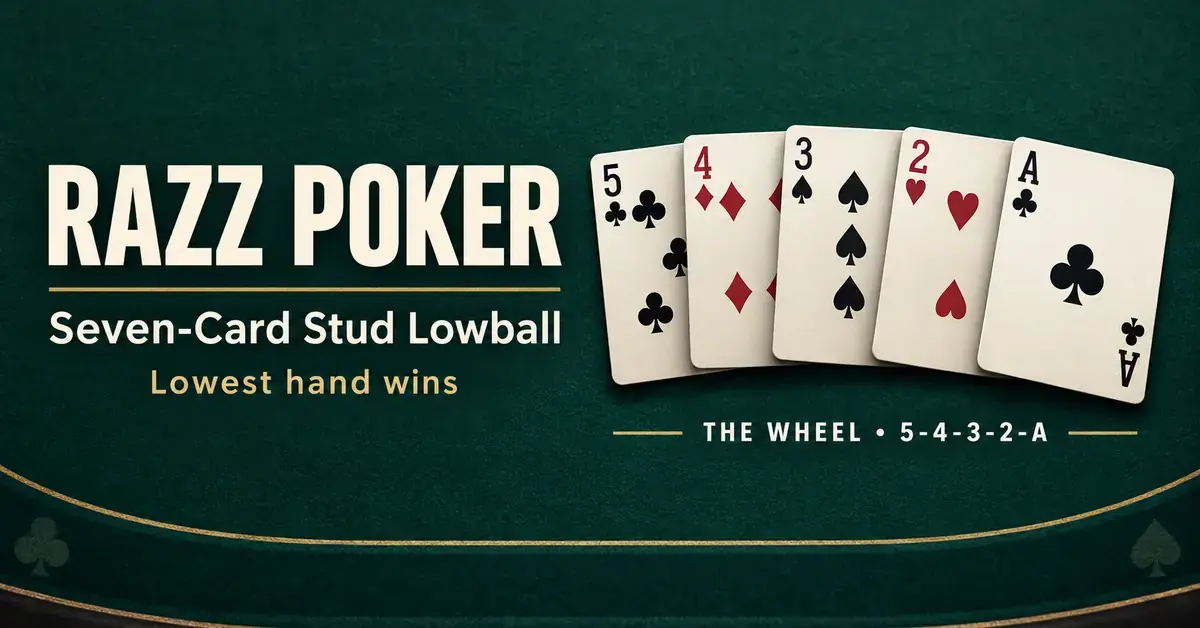
Razz is seven-card stud played in reverse: instead of the best high hand, the lowest five-card hand wins the pot. It uses ace-to-five low ranking, which means aces always count as the lowest card and straights and flushes do not count against you. The perfect Razz hand is 5-4-3-2-A, nicknamed the “wheel.” This guide explains how to play Razz step by step — the deal, the bring-in, the betting rounds and the showdown — along with the common variants, the mistakes beginners make and where the game fits in modern poker.
Key Points
- Lowest hand wins. Razz is Seven-Card Stud played for low — the worst normal hand takes the pot.
- Ace-to-five ranking. Aces are always the lowest card; hands are compared from the highest card down.
- Straights and flushes don’t count, and pairs count against you.
- The wheel 5-4-3-2-A is the best possible hand.
- The highest door card posts the bring-in — the opposite of standard stud.
- No qualifier: the single best low hand wins the whole pot.
What is Razz poker?
Razz is a lowball form of Seven-Card Stud, a stud game in which each player receives their own cards rather than sharing community cards. “Lowball” means the goal is reversed: the worst-looking hand by normal poker standards is the winner. Where Seven-Card Stud rewards the highest hand, Razz rewards the lowest.
There are no blinds and no shared board. Every player is dealt seven cards over the course of the hand — some face down (hidden) and some face up (visible to everyone) — and makes the best five-card low hand from those seven. Because so many cards are exposed, Razz is a game of reading opponents’ visible cards as much as your own. It is one of the classic major poker variants and sits in the “stud” family alongside Seven-Card Stud.
What is the goal in Razz?
The goal in Razz is to make the lowest possible five-card hand. You are dealt seven cards but only your five best (lowest) cards count; the other two are discarded for scoring purposes.
A few rules make Razz hands rank differently from a standard high game:
- Aces are always low. An ace is the best card you can hold, not the highest.
- Straights and flushes do not count. Having five cards in sequence or five of the same suit does not hurt your low hand at all.
- Pairs are bad. Any pair raises the value of your hand, which is the opposite of what you want. Unpaired hands almost always beat paired hands.
- There is no qualifier. Unlike split hi-lo games, Razz has no “eight or better” rule — the single lowest hand at the table wins the whole pot, however high it is.
How ace-to-five low ranking works
Ace-to-five (also written “A-5”) is the ranking system Razz uses to decide which low hand wins. The name tells you the two things that matter most: the ace is the lowest card, and because straights and flushes are ignored, the lowest five distinct card ranks make the best hand.
Why straights and flushes don’t count
In ace-to-five low, suits are irrelevant and runs of cards are irrelevant. A hand like 6-5-4-3-2, which would be a straight in a high game, is simply read as “six-low” in Razz and is an excellent holding. This is the single biggest mental switch for players coming from Texas Hold’em: the sequences and suited cards you normally chase mean nothing here.
How to read and compare two low hands
To compare low hands, ignore suits, then compare the highest card in each hand first; the hand with the lower top card wins. If those are equal, compare the next card down, and so on. Players name a hand by its two highest cards — “an eight-six” means a hand topped by an eight and a six.
For example, 8-6-5-4-2 beats 8-7-3-2-A. Both are “eight-lows,” so you look at the second card: the six beats the seven, so 8-6 wins. A lower second card breaks the tie even when the top card matches.
The wheel: the best hand in Razz
The best possible hand in Razz is 5-4-3-2-A, known as the wheel or the “bicycle.” Nothing beats it. The second-best hand is 6-4-3-2-A (a “six-four”), followed by 6-5-3-2-A, and so on. Reading the rankings is the mirror image of standard poker hand rankings: the hands you would normally throw away are the ones you are trying to build.
How to play Razz step by step
Razz follows the same dealing and betting rhythm as Seven-Card Stud. A hand is dealt over five “streets” (betting rounds), and is almost always played with a fixed-limit betting structure. Here is the full sequence.
The ante and the deal (third street)
Every player posts a small forced bet called an ante before the cards come out. Each player is then dealt three cards: two face down (the “hole” cards, seen only by that player) and one face up. The face-up card is called the door card. This opening round is known as third street, because each player now has three cards.
The bring-in: why the highest card pays
On third street the player showing the highest door card must post a forced bet called the bring-in. This is the opposite of Seven-Card Stud, where the lowest card brings it in — and it makes sense, because in Razz a high card is the worst card to be showing.
If two players show the same rank, suit breaks the tie in the order spades, hearts, diamonds, clubs (highest to lowest), so the king of spades is the worst possible door card and a guaranteed bring-in. The bring-in is usually between one-third and one-half of the small bet; the player may instead “complete” to a full small bet. Action then moves clockwise.
The betting rounds and streets
After third street, each remaining player is dealt more cards with a betting round after each:
- Fourth street: one more face-up card.
- Fifth street: one more face-up card.
- Sixth street: one more face-up card.
- Seventh street (“the river”): the final card, dealt face down.
From fourth street onward, the player showing the lowest hand on the board acts first — again the reverse of high-hand stud. That player may check or bet, and the action continues around the table.
Quick Facts
| Game type | Seven-card stud lowball |
|---|---|
| Goal | Make the lowest five-card hand |
| Ranking | Ace-to-five low (aces low; straights & flushes ignored) |
| Best hand | 5-4-3-2-A (the “wheel”) |
| Players | 2 to 8 |
| Cards dealt | 7 per player (3 face down, 4 face up over 5 streets) |
| Betting | Usually fixed-limit; small bet on 3rd/4th street, big bet on 5th–7th |
| Bring-in | Posted by the highest face-up card |
| Community cards | None (one is used only if the deck runs short with 8 players) |
Betting limits: small bet and big bet
Razz is normally a fixed-limit game, meaning bets and raises come in set amounts rather than any size you choose. In a $10/$20 game, for example, the small bet ($10) is used on third and fourth street, and the big bet ($20) is used on fifth, sixth and seventh street. There is usually a cap of one bet and three raises per round.
The showdown
After the final betting round on seventh street, remaining players reveal their hands and the lowest five-card hand wins the pot. If two players hold identical low hands, the pot is split evenly — suits never break ties at showdown, only for the bring-in. There is no qualifier, so even a relatively high low hand scoops the pot if it is the best one left.
What happens if the deck runs out?
Razz is dealt to a maximum of eight players. With eight players still in the hand at seventh street, the deck would need 56 cards but only has 52. When that rare situation occurs, the dealer places a single card face up in the middle as a community card that every remaining player uses as their seventh card. It is the only time Razz uses a shared card.
Razz vs. Seven-Card Stud: the key differences
Razz and Seven-Card Stud share the same structure, so the easiest way to learn Razz is to note where it flips the stud rules you may already know.
| Feature | Seven-Card Stud | Razz |
|---|---|---|
| Who wins | Highest hand | Lowest hand |
| Ace value | High (or low in a straight) | Always low |
| Straights & flushes | Count (strong hands) | Do not count |
| Pairs | Good | Bad |
| Bring-in posted by | Lowest door card | Highest door card |
| Acts first (4th street on) | Highest board | Lowest board |
| Best starting card | Ace or high pair | Ace (and other low cards) |
Razz variants and where it appears
Standard Razz is ace-to-five, but a few close relatives change the ranking or the betting.
Deuce-to-seven Razz
In deuce-to-seven (“2-7”) Razz, the ace plays high and straights and flushes do count against you. That makes the best hand 7-5-4-3-2 of mixed suits. It is far less common than the ace-to-five version and is sometimes called seven-card stud deuce-to-seven lowball.
London lowball
London lowball is a European pot-limit version of Razz in which straights and flushes count against the player and the ace stays low. Its best hand is 6-4-3-2-A. Because it is pot-limit rather than fixed-limit, the pots can grow much larger.
HORSE and mixed games
Razz is the “R” in H.O.R.S.E., the mixed-game rotation that cycles through Hold’em, Omaha hi-lo, Razz, Stud and Stud hi-lo. It has also been a World Series of Poker event since 1971, when Jimmy Casella won the first WSOP Razz title for a $10,000 prize. Today Razz appears most often inside mixed-game formats rather than as a standalone cash game, which is why learning it widens the range of games you can sit in.
Common mistakes beginners make in Razz
Most Razz errors come from high-poker instincts that do not transfer. Watch for these:
- Playing high cards. Starting with three low cards (ideally three cards below eight) matters far more than any single pretty card. Three babies beat almost anything.
- Chasing straights and flushes. They are worthless in ace-to-five, so never pay to “complete” one.
- Ignoring opponents’ door cards. Because up-cards are visible, you can see when a rival catches a bad (high) card or pairs up. Folding and card-reading off the exposed boards is central to the game.
- Staying in after “bricking.” Catching a high card or a pair on a later street — called a “brick” — badly damages your hand. If your board turns ugly and an opponent’s stays low, let it go.
- Treating a made low as a lock. An eight-low that is best on fifth street can easily be overtaken by a player who catches two more low cards. Re-evaluate every street.
Sound hand selection and discipline are the same muscles used everywhere else in the game; if you are newer to the mindset, the poker strategy fundamentals guide covers position, patience and reading opponents in more depth.
Who is Razz for?
Razz suits players who enjoy slower, more deductive games and who want to broaden beyond Texas Hold’em into stud and mixed formats. It has a small learning curve — the rules are simple, but the reversed logic takes a few sessions to feel natural. Because there is no community board, the skill is in tracking exposed cards and folding bad starts.
If you are brand new to the game, it helps to understand antes, betting rounds and showdowns first; the how to play poker beginner’s guide walks through those shared basics before you add Razz’s lowball twist. Regulated real-money poker in Canada is offered province by province, so check what is available where you live through the poker in Canada overview.
Ansvarsfriskrivning
This article explains the rules of Razz for educational purposes only. It is not betting advice and does not promise winnings — poker always involves risk, and no strategy or practice guarantees a profit. Only ever play with money you can afford to lose, set time and spending limits, and treat the game as entertainment. If gambling stops being fun or starts causing harm, free, confidential help is available; see our responsible gambling resources for Canadian support lines and self-exclusion tools. You must be of legal gambling age in your province to play for real money.
Vanliga frågor (FAQ)
Does the lowest hand really win in Razz?
Yes. Razz is a lowball game, so the player with the lowest five-card hand at showdown wins the pot. Aces count as low, and straights and flushes do not count against you, so the best possible hand is 5-4-3-2-A.
What is the best hand in Razz?
The best hand is 5-4-3-2-A, called the wheel or bicycle. The second-best is 6-4-3-2-A. Because suits and sequences are ignored, a hand is ranked purely by its five lowest unpaired card values, compared from the top card down.
Who posts the bring-in in Razz?
The player showing the highest face-up card (door card) on third street posts the bring-in. This is the reverse of Seven-Card Stud. If two players tie, suit order — spades, hearts, diamonds, clubs — decides it, making the king of spades the automatic bring-in.
How is Razz different from Seven-Card Stud?
Razz uses the same dealing structure as Seven-Card Stud but reverses the goal: the lowest hand wins, aces are low, straights and flushes do not count, pairs are bad, the highest card brings in the betting, and the lowest board acts first from fourth street onward.
Do straights and flushes count in Razz?
No. In standard ace-to-five Razz, straights and flushes have no effect on your hand. A holding like 6-5-4-3-2 is simply a strong “six-low,” not a straight. (The exception is the rarer deuce-to-seven and London lowball variants, where they do count against you.)
