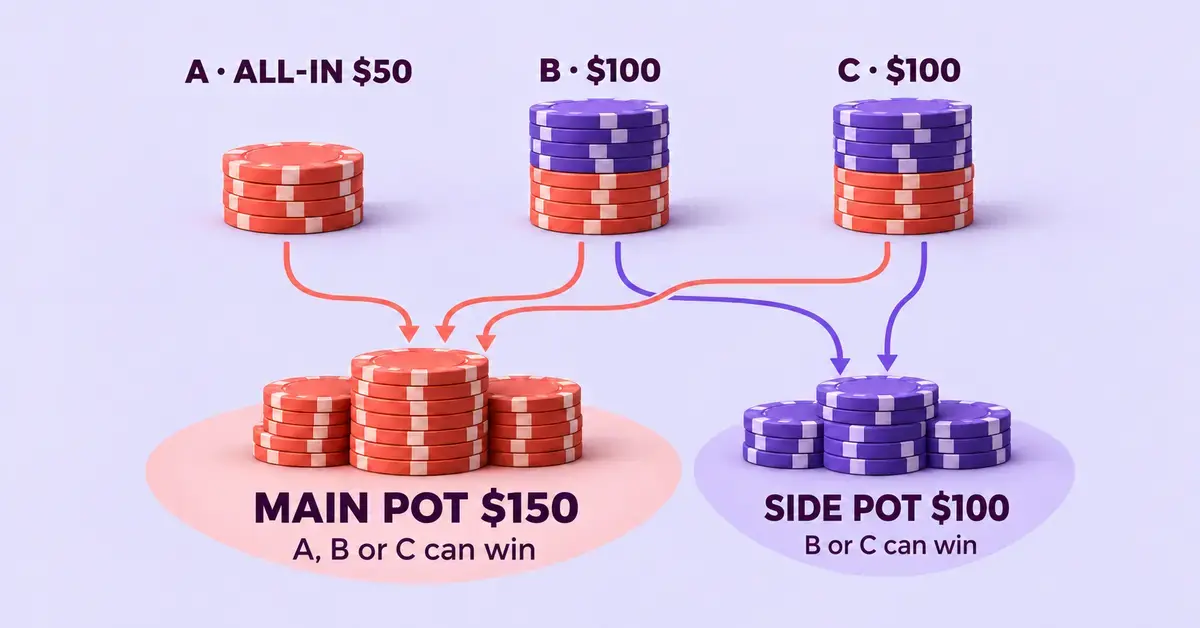
A side pot is a separate pile of chips that forms when one player goes all-in for fewer chips than the others are still willing to bet. Because poker is played under table stakes — you can only win from each opponent the amount you yourself have in front of you — the extra chips the deeper-stacked players keep betting cannot be won by the short stack. Those extra chips are set aside into a side pot that only the remaining players can win, while the all-in player competes for the smaller main pot. This guide explains exactly how side pots are created, calculated and awarded, with worked numbers you can follow at your own table.
Key Points
- A side pot forms whenever a player is all-in for less than the full bet and others keep betting.
- The main pot is capped at the smallest all-in amount multiplied by the number of contributors.
- An all-in player can only win chips they contributed — never a side pot above their all-in amount.
- Side pots are calculated in layers, one layer per all-in amount.
- At showdown, pots are awarded from the highest side pot down to the main pot.
- Any uncalled chips are returned to the bettor and never form a pot.
What is a side pot in poker?
A side pot is any pot created in addition to the main pot when at least one player is all-in for less than the full bet. The main pot holds the chips every active player could match; each side pot holds the surplus that only the deeper stacks contributed. The all-in player is eligible to win the main pot only. Everyone who put money into a side pot can win that side pot as well.
The idea follows directly from the way a bet is called. If you move all-in for 60 chips and two opponents want to bet 100, they can only “call” your 60 against you. The remaining 40 each is a wager between the two of them, settled in a pot you have no claim to. Side pots simply formalise that logic so the chips are counted correctly at showdown.
Why side pots exist: the table-stakes and all-in rule
Side pots exist because of the table-stakes rule, which is standard in virtually all modern poker. Under table stakes you may only wager the chips you have on the table at the start of a hand, and you can only win from any opponent an amount equal to what you have put at risk. You cannot be forced out of a hand just because you have run low on chips, and you cannot win more from an opponent than you could have lost to them.
When a player cannot cover a full bet, they are allowed to go all-in for whatever they have left. Their all-in amount becomes a cap: it is the maximum they can win from each opponent on that street and on earlier ones. Any chips bet beyond that cap have to go somewhere, and that somewhere is a side pot contested only by the players who can still match each other. Without side pots, a short stack could win money they never risked — which table stakes does not allow.
How a side pot is created when a player goes all-in
A side pot is created the moment a bet exceeds what an all-in player can match. The dealer first builds the main pot by taking the all-in player’s amount from every player who is in the hand, then collects the overflow into a side pot that only the still-betting players share.
Here is the simplest case, with three players — A, B and C:
- Player A moves all-in for 60 chips.
- Player B and Player C each put in 100 chips.
- Main pot: 60 from each of the three players = 180. All three can win this.
- Side pot: the extra 40 from B and C = 80. Only B and C can win this.
At showdown, if Player A has the best hand, A wins the 180 main pot and the 80 side pot is awarded to the better of B and C. If B or C beats A, that player can scoop both pots. Player A can never touch the 80 side pot, because A never had the chips to match it.
How to calculate side pots step by step
Side pots are calculated in layers, working from the smallest all-in amount upward. Each layer is a pot in its own right. The method is the same whether there is one all-in or five.
The layer method
- Find the smallest all-in amount. Multiply it by the number of players who contributed at least that much. That product is the main pot.
- Move up to the next all-in amount. Take the difference between it and the previous cap, and multiply by the number of players still in above that lower cap. That is the first side pot.
- Repeat for each higher cap until you reach the deepest contribution.
- Return any uncalled chips. If the deepest bettor wagered more than anyone could match, the unmatched surplus is handed straight back — it never forms a pot.
- Check the total. The layers added together must equal the chips actually put in.
A worked example with multiple all-ins
Imagine four players reach a showdown with these totals in the pot: Player A is all-in for 50, Player B is all-in for 150, Player C is all-in for 400, and Player D calls the 400. The pot divides into three layers:
- Main pot: 50 (A’s cap) × 4 players = 200.
- First side pot: (150 − 50) × 3 players (B, C, D) = 300.
- Second side pot: (400 − 150) × 2 players (C, D) = 500.
The three layers total 1,000, which matches the contributions of 50 + 150 + 400 + 400. The table below shows who can win each pot.
Side Pot Example
| Pot | Chips | Funded by (each) | Who can win it |
|---|---|---|---|
| Main pot | 200 | A, B, C, D (50) | A, B, C or D |
| First side pot | 300 | B, C, D (100) | B, C or D |
| Second side pot | 500 | C, D (250) | C or D |
| Total | 1,000 | 50 + 150 + 400 + 400 | — |
Who is eligible to win each pot
Each player can only win a pot they put chips into, and only up to the point where they ran out of chips. Eligibility stacks upward: the first all-in player competes for the main pot alone, the next player up competes for the main pot plus the first side pot, and so on. In the four-handed example above, Player A can win only the 200 main pot, Player B can win the main pot plus the 300 first side pot, and Players C and D are eligible for all three layers.
This is why a short stack who wins a huge multi-way all-in sometimes takes far less than the total chips on the table: they are paid only from the layers they funded. The deeper players settle the richer side pots between themselves.
How side pots are awarded at showdown
Side pots are awarded from the top down — the highest side pot is settled first, then each lower layer, with the main pot paid last. Settling in this order keeps eligibility straightforward, because the players contesting the biggest side pot are always a subset of those contesting the pots beneath it.
When at least one player is all-in and betting is complete, the hands are turned face up without delay so the pots can be read. Under the Texas Hold’em procedures used in regulated rooms and major tournaments, all hands in the main pot and in every side pot are shown and treated as live. A common dealer practice is to award the side pot first, then let its winner contest the main pot against the all-in player. Each pot is read as its own showdown: the best eligible hand for that specific pot wins it, and a player can win one pot while losing another.
Side pots, split pots and odd chips
A side pot can be split just like any other pot when two or more eligible players tie for the best hand. The all-in player’s tie only affects the pot they are eligible for; any side pot above it is still decided among the deeper stacks. For the full rules on ties, kickers and chopped pots, see our guide to which poker hand wins.
When a pot does not divide evenly, there is an odd chip left over. The standard rule in flop games is that the odd chip goes to the player in the earliest seating position — the first active seat to the left of the dealer button. Each pot that splits is handled separately, so the odd chip is resolved pot by pot rather than across the whole table.
Side pots in cash games versus tournaments
The mechanics of a side pot are identical in cash games and tournaments, but the stakes differ. In a cash game, losing an all-in means reaching for your wallet to rebuy; the chips simply change hands. In a tournament, chips cannot be replaced, so an all-in that you lose can end your event. That is why side pots appear constantly in the late stages of a tournament, where short stacks are forced all-in against several deeper players at once and the pot splits into layers. If you want a fuller comparison of the two formats, read our breakdown of cash games versus tournaments.
One tournament-specific note: when multiple players are all-in on the same hand, the one with the largest starting stack among them cannot be eliminated by that hand even if they lose, because they will always have the deepest side pot to fall back on if they win part of it. Dealers and tournament staff count these multi-way all-ins carefully for exactly that reason.
Common mistakes with side pots
Side pots are where casual players lose track of the chips most often. Watching for these errors protects your stack and keeps the table honest.
- Assuming the all-in player can win everything. A short stack who wins is paid only from the main pot, never from side pots they did not fund.
- Forgetting the main pot is capped. The main pot is limited to the smallest all-in amount times the number of contributors, not the total chips in the middle.
- Mucking a live hand in a side pot. If you are still eligible for a side pot, show your cards — throwing them away hands the pot to someone else by default.
- Not tracking eligibility in multi-way pots. When three or more players are all-in for different amounts, each is eligible for a different set of layers; misreading this can cost a pot you were owed.
- Overlooking the returned uncalled bet. If you move all-in for more than anyone can match, the unmatched portion comes back to you and never goes into any pot.
Disclaimer
This article is for educational purposes only and explains the rules of poker; it is not betting advice and does not promise winnings. Poker involves real financial risk, and no rule or technique changes the chance element of the game. Only ever play with money you can afford to lose, and know the legal gambling age and licensing rules in your province. If gambling is affecting you or someone you know, free, confidential help is available in Canada — see our responsible gambling resources for provincial help lines and self-exclusion options.
Sources
Frequently Asked Questions (FAQ)
What is the difference between the main pot and a side pot?
The main pot holds the chips every player still in the hand could match, capped at the smallest all-in amount. A side pot holds the extra chips that only the deeper-stacked players contributed. An all-in player can win the main pot but not any side pot above their all-in amount.
Can an all-in player win a side pot?
No. An all-in player can only win pots they put chips into. Because a side pot is built from chips wagered beyond their all-in amount, they have no claim to it. The side pot is decided among the players who were able to keep betting.
How do you calculate a side pot?
Work in layers from the smallest all-in upward. Multiply the smallest all-in amount by the number of contributors for the main pot, then take the gap up to the next all-in amount times the players still in above it for each side pot. The layers should add up to the chips actually bet.
Which pot is paid first at showdown?
The highest side pot is settled first, then each lower side pot, and the main pot is paid last. Each pot is read as its own showdown, so a player can win one pot and lose another on the same hand.
What happens if a bet is bigger than everyone can call?
The portion no one can match is returned to the bettor and never forms a pot. Only the chips that other players could actually call go into the main pot and side pots; uncalled chips come straight back to the person who bet them.
