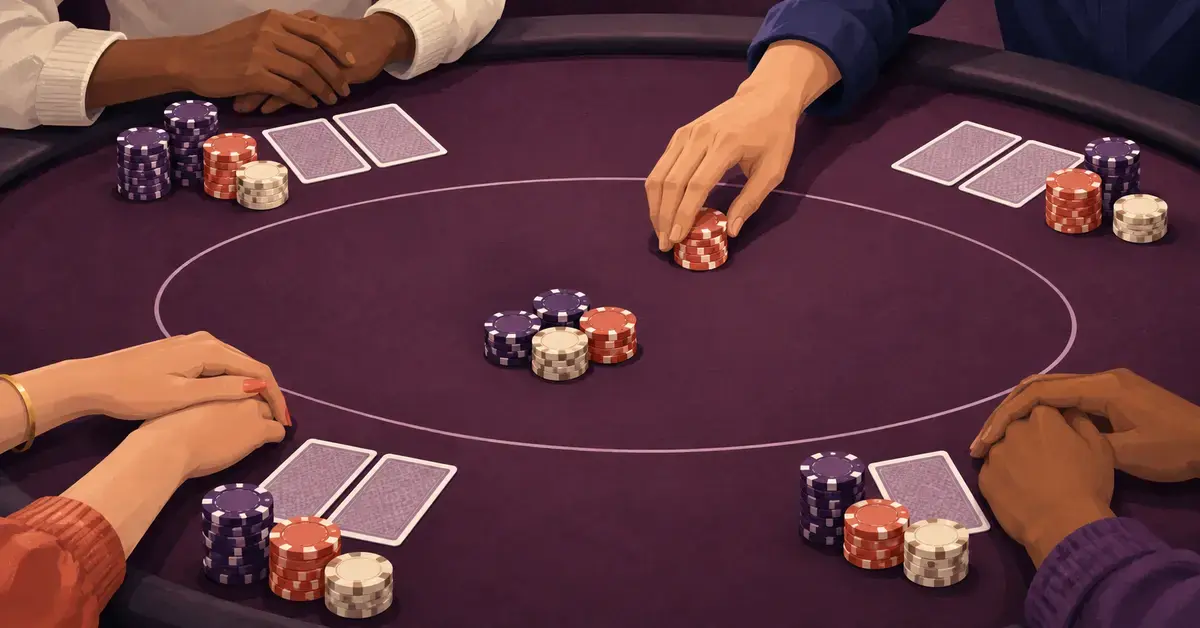
Poker etiquette is the set of unwritten rules and table manners that keep a game fair, friendly and moving — the courtesies the dealer will not always penalise, but that every regular expects you to honour. Learning them matters as much as learning the hand rankings: a player who acts in turn, bets cleanly and treats opponents with respect is welcome anywhere, while one who ignores the social code quickly earns a reputation, even when no formal rule is broken. This guide explains the core table manners for live card rooms, home games and online play, plus the grey areas (such as angle shooting) that cause the most friction.
Key Points
- Poker etiquette is the unwritten code of conduct that sits alongside the formal rules; breaking it rarely draws a penalty but quickly earns a bad reputation.
- Golden rule: always act in turn, and never reveal information that could help players still in the hand.
- Make clear, single-motion bets and announce amounts out loud to avoid string-bet rulings; never splash the pot.
- Never slow roll a winning hand, and keep table talk civil — no berating or gloating.
- Angle shooting (deceptive but technically legal moves) is widely condemned; if it happens, call the floor rather than confront the player.
- Tipping the dealer is customary in live card rooms (commonly about a dollar per pot won), but there is no dealer to tip online.
- Online: act within your timer, keep the chat respectful, and never discuss a live hand.
What is poker etiquette?
Poker etiquette is the code of conduct that governs how players behave at the table, separate from the formal rules of the game. A live game effectively runs on two rulebooks: the written rules the dealer and floor staff enforce, and the unwritten rules that players police among themselves. Breaking the written rules can cost you the pot or draw a penalty; breaking the unwritten rules usually just costs you goodwill — but at a game you return to week after week, goodwill is worth protecting.
The etiquette covered here applies across formats, but the social stakes are highest in live settings where you share a physical space with the dealer and up to nine other players. If you are new to a card room, it also helps to understand how betting works and the common vocabulary in a poker terms glossary before you sit down, because many etiquette slips come from simply not knowing the mechanics yet.
Why do the unwritten rules matter?
The unwritten rules matter because they keep the game fast, fair and enjoyable for everyone, not just for you. Three practical reasons stand out:
- They protect information. Poker is a game of incomplete information, so acting or speaking out of turn can leak details that unfairly help — or hurt — players still in the hand.
- They keep the game moving. A single player who dawdles on every decision, splashes chips or argues with the dealer slows the table and reduces how many hands everyone plays.
- They keep the mood civil. Money changes hands every few minutes, so tension is built in. Courtesy is what stops a long session from turning hostile.
Most etiquette breaches by beginners are accidental. Nobody expects a first-timer to be perfect, and dealers will quietly correct you. What the regulars will not forgive is behaviour that looks deliberately rude or deceptive.
What are the core poker table manners?
The core table manners boil down to acting clearly, acting in turn and never giving away information you should not. The points below are the ones that come up most often in live games.
Act only when it is your turn
Wait for the action to reach you before you do anything — fold, check, bet, call or raise. Acting out of turn is the most common etiquette mistake and it directly damages the game: folding early tells the players behind you that there is one fewer caller to worry about, and reaching for chips signals interest in the pot. Even a visible flinch toward your cards can be a tell. Decide what you will do only when it is genuinely your turn.
Make clear, single-motion bets and avoid string bets
State your action or move your chips in one clean motion so there is no ambiguity about what you are doing. A string bet is a raise made by putting chips in, going back to your stack and adding more without having announced the total first. Under widely used card-room rules, a raise must be made either with a verbal statement of the amount or by placing the chips in a single motion; otherwise it is ruled a string bet and only the first portion counts. The rule exists to stop a player from pushing out a call, watching for a reaction, and then changing it to a raise. When in doubt, say the amount out loud — verbal declarations made in turn are binding and remove any argument.
Do not splash the pot
Place your chips in a neat stack in front of you rather than tossing them into the middle. Throwing chips directly into the pot — “splashing the pot” — makes it impossible for the dealer to confirm you bet the right amount, and it slows the hand while everything is recounted. The dealer will gather your chips into the pot once the betting round is complete.
Protect your hand and keep your cards on the table
Keep your hole cards on the felt and in full view, and place a chip or a card protector on top so the dealer never mistakes a live hand for a fold. Lifting cards off the table, or holding them below the edge, looks suspicious and can get your hand killed. You may look at your own cards, but shield them with cupped hands rather than lifting them into the air.
One player to a hand
Each hand belongs to one player, and only that player may make its decisions. Do not ask a neighbour for advice on a live hand, do not discuss what you folded while a hand is still in progress, and do not comment on the board in a way that could influence the players still involved. Even well-meaning chatter can hand someone an edge.
Show one, show all
If you voluntarily show your cards to one player, every player has the right to see them. Known as the “show one, show all” rule, it prevents collusion and private signalling. If you do not have to table your hand at showdown — for example, you folded to a river bet — the courteous move is simply to muck without flashing your cards to a friend.
Never slow roll
Reveal a winning hand promptly at showdown instead of pausing for effect. A slow roll is when a player who knows (or clearly should know) they hold the winner delays turning it over after an opponent has committed, especially after an all-in call. It breaks no written rule, yet it is one of the most disliked moves in poker because it reads as gloating. If you have the nuts, just show it.
Keep table talk fair and civil
Friendly conversation is part of what makes live poker fun, but there are limits. Do not berate opponents for how they played, do not celebrate at a losing player’s expense, and never reveal cards or comment on a hand you are no longer part of. Reading opponents is a legitimate skill — our guide to poker tells explains where observation ends and rudeness or rule-breaking begins.
What is angle shooting, and why is it frowned upon?
Angle shooting is making a move that stays technically within the rules while deliberately exploiting or misleading an opponent, and it is considered one of the worst breaches of poker etiquette. Because the actions are not outright cheating, the floor cannot always penalise them — which is exactly why the community polices them so firmly. Common examples include:
- Hiding high-value chips behind lower ones so opponents misjudge the size of your stack.
- Fake folding or fake betting motions to provoke a reaction out of turn.
- Ambiguous verbal declarations, such as announcing “I raise… four” and gauging the reaction before clarifying whether that means four hundred or four thousand.
- Pretending to misunderstand the action to induce a check or a fold.
If you believe someone is angle shooting, do not confront them directly. Call the floor supervisor calmly and let staff rule on it. Escalating at the table rarely helps and can get you penalised.
Do you tip the dealer in poker?
In live card rooms, tipping the dealer is customary but not mandatory, and it is a normal part of the cost of playing. The usual practice in North American rooms is a small tip — commonly around one dollar — from the winner of each pot, with larger tips for big pots or after a long, well-run session. Tipping norms vary by venue and region, so watch what the table does and ask the dealer or floor if you are unsure. In tournaments, a staff gratuity is often already built into the buy-in. Online, there is no dealer to tip, since the software deals every hand.
How is poker etiquette different online?
Online poker replaces physical tells and chip handling with a timer and a chat box, so the etiquette shifts accordingly. The spirit is identical — act fairly and keep the game pleasant — but the specifics change:
- Act within your time bank. Each player gets a set window to act. Use only the time a decision needs; letting the clock run on routine spots frustrates the whole table. Avoid habitually using the full timer or the disconnect-protection window to stall.
- Keep the chat civil. The chat box is for light conversation, not for berating opponents, bragging, or coaching. Most sites will mute or suspend accounts for abuse.
- Never discuss a live hand. Do not reveal your folded cards or speculate about what others hold while a hand is still playing, even in chat — it can pass information to active players.
- Play one account, by yourself. Multi-accounting, letting someone else play your account, and using prohibited real-time assistance all break site rules as well as etiquette.
Does home game etiquette differ?
Home games follow the same principles, but the host — not a professional dealer — sets and enforces the house rules, so clarity up front matters even more. Agree before the first hand on whether verbal declarations are binding, whether string bets are called, and how to handle misdeals, so nobody feels singled out mid-session. Rotating the deal fairly, keeping stakes within what everyone can comfortably afford, and settling up honestly are the social glue of a good home game. Our guide to hosting a home poker game covers the practical setup, and if you want to graduate to a public room, the overview of live poker rooms across Canada explains what to expect from card-room procedure.
What are the most common poker etiquette mistakes?
The most common mistakes are the small, repeatable habits that annoy a table over a full session rather than any single dramatic breach. Watch for these:
- Acting out of turn, or reaching for chips before the action reaches you.
- String betting or splashing the pot instead of announcing clean amounts.
- Talking about a hand — yours or the board — while you are no longer in it.
- Slow rolling a clear winner at showdown.
- Playing too slowly, whether at a live table or by running the online timer down every street.
- Letting frustration (“tilt”) spill into rudeness toward the dealer or other players.
- Forgetting to tip in a live room where it is customary.
Etiquette Checklist
Do
- Wait for the action to reach you before folding, betting or reaching for chips.
- Announce bet and raise amounts clearly, or move chips in one motion.
- Keep your cards on the table, protected and in view.
- Show a winning hand promptly at showdown.
- Tip the dealer where it is customary, and thank them.
- Call the floor calmly if there is a dispute.
Don’t
- Act or talk out of turn, or react to cards before it is your turn.
- String bet, splash the pot, or hide high-value chips.
- Discuss or reveal a hand you have folded while it is still live.
- Slow roll, berate opponents, or celebrate at a loser’s expense.
- Stall by running the timer down online or dawdling live.
- Confront a suspected angle shooter directly at the table.
A note on responsible play
Poker etiquette keeps the game pleasant, but it is still a form of gambling played for real money in most settings. Only ever play with money you can afford to lose, set limits before you sit down, and treat any winnings as uncertain. If gambling stops being fun or starts to feel out of control, free, confidential help is available — see our responsible gambling resources for Canadian support lines and self-exclusion options. This article is general information about table conduct, not financial, legal or gambling advice.
Sources
- PokerNews — Unwritten Rules of Poker Every Player Should Follow
- Home Poker Tourney — String Bets (Robert’s Rules of Poker)
- PokerNews Poker Terms — String Bet
- Poker Tournament Directors Association — TDA Rules
- CardPlayer — First Time Visit to a Brick-and-Mortar Card Room
- The Poker Bank — Online Poker Etiquette
Frequently Asked Questions (FAQ)
What is the single most important rule of poker etiquette?
Act in turn and never give away information that could help the players still in the hand. Almost every other etiquette rule — not splashing the pot, not discussing folded cards, making clear bets — flows from those two ideas: keep the action orderly and keep the information fair.
Is slow rolling against the rules?
No. Slow rolling — delaying the reveal of a hand you know is winning — breaks no written rule, which is exactly why it is governed by etiquette instead. It is widely seen as disrespectful because it reads as gloating, so the courteous move is to show a winning hand promptly at showdown.
Do I have to tip the poker dealer?
Tipping is customary in live card rooms but not mandatory. The usual practice is a small tip, often around a dollar, from the winner of each pot, with more for large pots. Watch the table or ask the floor if you are unsure. There is no dealer to tip in online poker.
What exactly is a string bet?
A string bet is a raise made by putting chips in and then going back for more without first announcing the total amount. Only the first motion counts. To avoid it, state the full amount out loud, or move all your chips in a single motion.
What should I do if I think someone is angle shooting?
Stay calm and call the floor supervisor rather than confronting the player yourself. Angle shooting lives in the grey area between legal moves and cheating, so it is up to staff to rule on it. Arguing at the table rarely resolves anything and can get you penalised.
