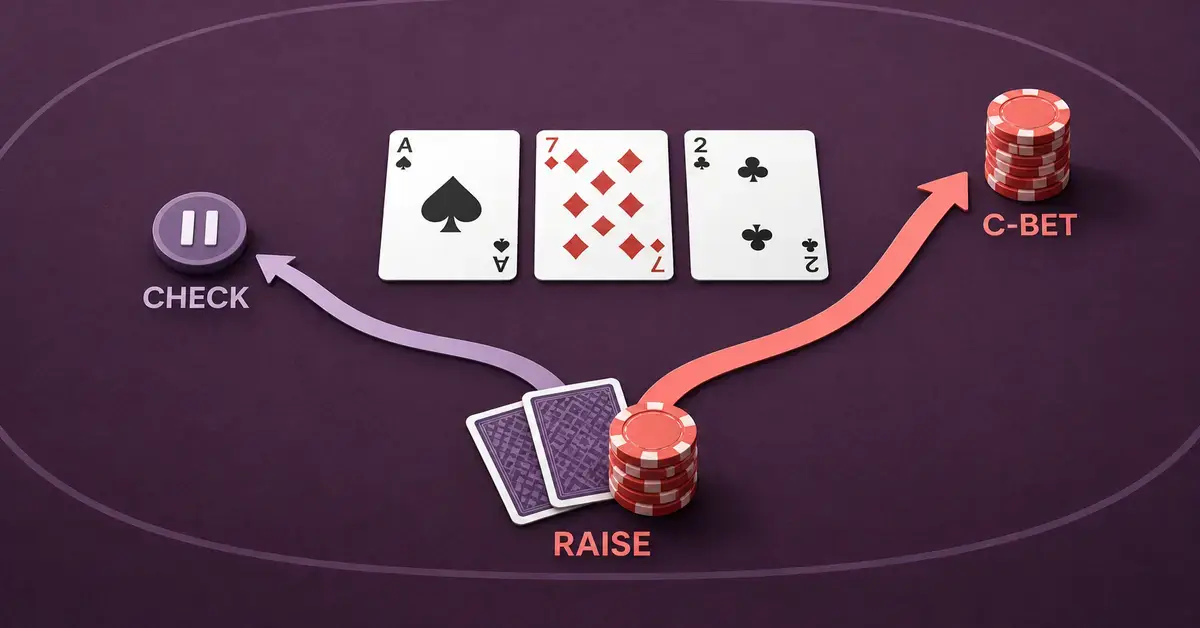
A continuation bet — almost always shortened to c-bet — is the bet you make on the flop when you were the player who raised before the flop. You took the lead before the community cards appeared, and you “continue” that aggression on the flop whether or not those first three cards actually improved your hand. It is one of the most common moves in no-limit Texas Hold’em, and also one of the most overused: firing a c-bet on autopilot every single time quietly leaks chips. This guide explains what a c-bet is, why it works, when to fire it, how big to bet, and when checking is the stronger play.
Key Points
- A continuation bet (c-bet) is a flop bet by the player who raised before the flop — made whether or not the flop helped them.
- It works because most hands miss the flop, so you often win the pot through fold equity (opponents folding).
- C-bet more on dry boards that favour your range, heads-up, and in position; check more on wet boards, multiway, and out of position.
- Size to the board, not your hand: ~1/3 pot on dry boards, 2/3 pot or more on wet, draw-heavy boards.
- The biggest mistake is c-betting every flop — a predictable pattern is easy to exploit.
- Always have a plan for the turn before you fire the flop.
What is a continuation bet in poker?
A continuation bet is a flop bet made by the preflop raiser — the player who made the last aggressive action before the flop. The name describes the story: you showed strength before the flop, and the c-bet continues that story on the next street. Crucially, a c-bet is defined by who makes it and when, not by hand strength. You can c-bet with top pair for value, with a flush draw as a semi-bluff, or with complete air as a pure bluff.
The term was popularised by Dan Harrington in his Harrington on Hold’em books in the mid-2000s. The books spread the label widely, though the underlying idea — betting again after raising — is older than the name itself. Today “c-bet” is standard vocabulary at every level of the game. If you are still learning the betting rounds, our guide to Texas Hold’em rules covers how preflop, flop, turn and river fit together.
Why does the continuation bet work?
The continuation bet works because most hands miss most flops. A flop contains only three cards, so both players usually flop nothing more than high cards. When you were the preflop raiser, you have already told the table a believable story of strength — and the flop rarely helps your opponent either. Betting lets you claim the pot before anyone has to show down a hand.
The engine behind it is fold equity: the share of the pot you expect to win simply because your opponent folds. Every time an opponent folds a hand that would have beaten yours at showdown, your c-bet has earned its money without a single card being revealed. A c-bet also does three useful jobs at once:
- It wins the pot immediately when the opponent folds.
- It charges draws and worse hands when you actually have the best hand (value).
- It protects your checking range — if you only ever bet strong hands, observant opponents will punish every time you check.
Because the c-bet can represent so many hands, a balanced betting pattern is hard for opponents to read. That link between pressure and information is a core idea in poker strategy fundamentals.
When should you fire a continuation bet?
Fire a c-bet when the board, the number of opponents and your position all point in your favour. A good c-bet is not a reflex — it is a decision based on how well the flop fits the range of hands you would have raised with before the flop, compared with how well it fits your opponent’s range. The four questions below decide most spots.
Does the board favour your range?
C-bet more often on boards that connect with the hands a raiser is likely to hold. Because you raised preflop, your range is weighted toward big cards and pairs. A dry, high-card flop such as K-7-2 with three different suits hits that range far more often than it hits a player who merely called, so a small c-bet pressures the whole field cheaply. By contrast, a coordinated flop such as 9-8-7 with two cards of the same suit connects strongly with the caller’s range of suited and connected hands — here you should bet less often and think before firing.
Two linked ideas describe this edge. Range advantage is having the stronger overall collection of hands on a given board. Nut advantage is the narrower edge of holding more of the very best possible hands — for example, on an ace-high board after you raised, you hold far more strong aces than a caller does. When you have both, you can bet often and sometimes large; when the caller’s range catches up, you check more.
How many opponents are left?
C-bet far more freely heads-up than in a multiway pot. Against one opponent, a single fold wins the pot and your bluffs carry real fold equity. Against two or more callers, the chance that someone connected with the flop rises sharply, so c-bet bluffs lose value fast. The standard adjustment in multiway pots is to bet mainly for value with genuinely strong hands and to check most marginal holdings and air.
Are you in or out of position?
C-bet more when you act last. Acting after your opponent — being in position — lets you see their action before you decide and makes every street easier to control. Out of position, you commit chips without that information, and strong opponents can float (call with weak hands) planning to take the pot away later. A more selective, defensive c-betting plan is correct out of position. Our guide to position in poker explains why acting last is such a persistent edge.
Do you have a reason beyond “I raised”?
Fire when you have a plan for later streets. Ask what you are representing, which turn cards let you keep betting, and what you will do if you are called or raised. A c-bet with a flush or straight draw (a semi-bluff) is strong because you can win now by a fold or later by hitting. A c-bet with no equity and no follow-up plan is the one that leaks chips.
How much should you c-bet?
Size your c-bet to the board, not to your hand — using the same size with strong and weak hands keeps you unreadable. As a rule of thumb, dry and static boards reward small bets, while wet and dynamic boards call for larger ones. The cheat sheet below summarises the common guidelines; treat the percentages as starting points, not fixed targets, because real solver outputs mix sizes.
C-Bet Cheat Sheet
| Board type | Example flop | How often to bet | Suggested size | Why |
|---|---|---|---|---|
| Dry / static | K-7-2 rainbow | Very often | ~25-33% pot | Favours the raiser’s big cards; cheap pressure folds out misses |
| Semi-coordinated | Q-J-4 two-tone | Selectively | ~50-66% pot | Some draws present; bet value and strong semi-bluffs |
| Wet / dynamic | 9-8-7 two-tone | Less often | ~66-100%+ pot | Hits the caller’s range; charge draws and protect value |
| Multiway (2+ callers) | Any board | Mostly for value | Larger | Someone likely connected; check marginal hands and bluffs |
The logic is straightforward. On a dry board where little can change, a small bet of around a third of the pot is cheap, hard to raise profitably, and still folds out the many hands that completely missed. On a wet board full of draws, a larger bet of two-thirds pot or more charges those draws a fair price and protects the hands you are betting for value. Understanding the price you are laying is the same math covered in pot odds and equity.
When should you check instead of c-betting?
Check when the board favours your opponent, when you are out of position with a medium hand, or when a bet accomplishes nothing. Checking is not weakness — it is a deliberate part of a balanced strategy. Good spots to check include:
- Low, connected boards that miss your range — such as 6-5-4 when you raised with big cards.
- Multiway pots with a marginal hand, where someone is likely to have connected.
- Medium-strength hands out of position, where betting turns your hand into a bluff and folds out worse while getting called by better.
- Boards where you have no equity and no believable story, so a bet only builds a pot you expect to lose.
Checking a strong hand occasionally — a tactic sometimes called a delayed c-bet — also disguises your range, because opponents learn they cannot assume you are weak just because you checked the flop.
Second barrels and delayed c-bets
A continuation bet is only the first shot; the turn and river are where many pots are actually decided. A second barrel is a follow-up bet on the turn after your flop c-bet was called. The best turn cards to barrel are those that improve your range or scare your opponent — an overcard to the board, or a card that completes a draw you could credibly hold. A delayed c-bet is when you check the flop as the preflop raiser and then bet the turn instead, which is useful for pot control, for catching a hand that would have folded to a flop bet, and for balancing your checking range. Both are extensions of the same principle: keep telling a story your opponent finds believable.
Common continuation-betting mistakes
The biggest c-bet mistake is firing too often. Betting every flop out of habit is the most reliable way to turn a good tool into a losing one, because attentive opponents simply wait and raise. Watch for these leaks:
- C-betting 100% of the time. A predictable bettor is exploitable; mix in checks based on the board, not on your mood.
- Bluffing into multiway pots. With two or more callers, lean toward value and check your air.
- Ignoring board texture. Blasting a c-bet into 9-8-7 two-tone with two overcards invites raises and tough spots.
- Betting into calling stations. Against players who rarely fold, a bluff c-bet has little fold equity; bet for value and give up more bluffs.
- No turn plan. Firing the flop without knowing which turn cards you will barrel leaves you guessing for real money.
- Same size, readable pattern. Using one size for value and another for bluffs lets opponents read you instantly.
If you are working through leaks in your overall game, our list of common beginner poker mistakes puts over-c-betting in context alongside the other habits that cost new players chips.
How does c-betting differ by opponent and format?
Adjust your c-bet frequency to who is in the pot, not just to the cards. Against tight, thinking regulars who fold correctly, bluff c-bets on range-favourable boards earn steady fold equity. Against loose callers who never fold, shift toward value and bet your strong hands bigger while bluffing far less. Live and online games differ too: live opponents tend to call more and fold less, so value-heavy c-betting usually beats thin bluffing, while tougher online fields punish any pattern that is too frequent or too readable. For the broader skill of exploiting your opponent’s tendencies, see our guide to bluffing in poker, which the continuation bet overlaps with but is not limited to.
Responsible gambling note
This article is educational and informational only. No betting pattern, including the continuation bet, guarantees a profit — poker involves short-term variance and real financial risk, and a strategy that is sound on average can still lose over any given session. Only ever play with money you can afford to lose, and set limits before you sit down. If gambling stops being fun or starts causing harm, free, confidential help is available across Canada. See our responsible gambling resources for warning signs, limit-setting and province-by-province support lines.
Sources
Frequently asked questions (FAQ)
What does c-bet mean in poker?
C-bet is short for continuation bet — a bet made on the flop by the player who raised before the flop. It continues the aggression you showed preflop, and it can be made as a value bet, a semi-bluff or a pure bluff.
How often should I continuation bet?
There is no single correct number, and betting 100% of the time is exploitable. Bet more often on dry boards that favour your range, heads-up and in position; bet far less in multiway pots, out of position, or on coordinated boards that help the caller.
Should I c-bet when I missed the flop?
Sometimes. A c-bet with nothing can win the pot through fold equity if the board favours your range and you face one opponent. But firing into multiple callers, wet boards, or players who rarely fold usually just donates chips — check and give up instead.
What size should my c-bet be?
Match the size to the board rather than your hand. Around one-third of the pot works on dry, static boards; two-thirds pot or larger suits wet, draw-heavy boards where you need to charge draws and protect value. Keep your sizing consistent across value and bluffs so you stay unreadable.
Should I c-bet in a multiway pot?
Be much more cautious. With two or more opponents, the odds that someone connected with the flop rise sharply, so bluffs lose value. The standard approach is to c-bet mainly for value with strong hands and check most marginal holdings and air.
