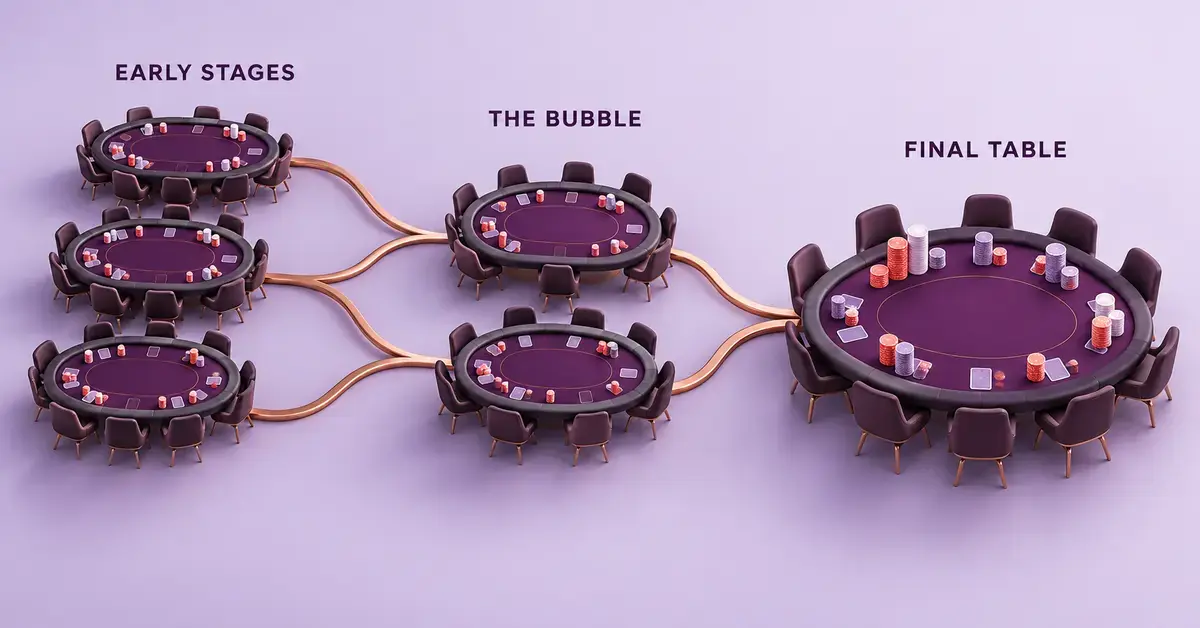
Poker tournament strategy is the art of adjusting your play as the blinds climb, your stack shrinks or grows, and the money gets closer. Unlike a cash game, a tournament is a single long event with a fixed buy-in, rising stakes and a payout structure that rewards survival as much as chip count. The correct play with 80 big blinds on level two is often the opposite of the correct play with nine big blinds on the bubble. This guide walks through each stage of a multi-table tournament, from the first hand to the final table, and explains the three concepts beginners most often miss: measuring your stack properly, the Independent Chip Model, and push-or-fold play.
Key Points
- Tournament chips cannot be cashed out, and the blinds keep rising — survival and chip accumulation both matter.
- Measure your stack in big blinds and in your M-ratio, never in raw chips.
- Play tight-aggressive early, attack the blinds once antes arrive, and respect ICM pressure near the money.
- The bubble is the biggest equity swing in the event — big stacks attack, medium stacks wait, short stacks pick a spot.
- Below roughly 10–15 big blinds, switch to a push-or-fold game to keep your fold equity.
What makes tournament poker different from a cash game?
In a tournament, chips cannot be cashed out and the blinds rise on a timer, so the value of doing nothing falls every level. You start with a set number of chips, the blinds and antes increase at fixed intervals, and you are eliminated when you lose them all. A chip you win is not worth the same as a chip you lose, because you can only be knocked out once. That single fact — one life, not infinite buy-ins — shapes almost every tournament decision.
Cash games work the other way: the stakes stay flat, every chip equals a fixed amount of money, and you can rebuy at any time. If you want the full side-by-side on chip value, rake, variance and bankroll needs, see how cash games and tournaments differ. The practical upshot for strategy is this: in a tournament you are managing a depleting resource against a rising cost, so patience early and precision late both matter.
How should you play the early stages?
Play tight and aggressive in the early levels, because the blinds are tiny relative to your stack and there is little to win by taking big risks. With 100 big blinds or more and no antes in play, the pot you can pick up preflop is small and the pot you can lose is your whole tournament. There is no reward worth gambling your stack on a marginal hand this early.
- Enter pots with strong hands. Favour big pairs, big broadway cards and suited connectors you can play well after the flop. Disciplined starting-hand selection saves you from the tough, chip-draining spots beginners walk into.
- Use position. Open more hands from late seats and fewer from early ones. Acting last gives you more information on every street, which is why acting in position is worth more than most people realise.
- Don’t try to win it early. You cannot win a tournament in the first hour, but you can lose it. Build gradually and avoid flipping a coin for your whole stack without a clear edge.
A common myth is that you must gamble early to “get chips.” In reality, a steady, low-variance early game keeps you alive to use your skill when the stakes get meaningful.
How should you adjust in the middle stages?
Open up and start attacking the blinds once antes come into play and the field thins. Most modern tournaments use a big blind ante — a single ante, usually equal to the big blind, posted only by the player in the big-blind seat, which covers the whole table for that hand. It speeds up play and, more importantly for strategy, it adds dead money to every pot before the cards are dealt. With roughly 2.5 big blinds already in the middle, stealing the blinds becomes far more profitable, so good players widen their opening ranges.
In the middle stages your stack depth, measured in big blinds, should drive your decisions:
- 40+ big blinds: a comfortable stack. Keep applying pressure, play pots in position, and avoid bloating pots out of position with weak holdings.
- 20–40 big blinds: a working stack. Three-betting all-in and re-stealing become strong weapons, and you should avoid calling off chips in spots that leave you crippled.
- Under 20 big blinds: a short stack. Your fold equity — the chance that a raise makes everyone fold — is now your main asset, so look to move all-in rather than make small raises you cannot defend.
How do you measure your stack: big blinds and the M-ratio
Measure your stack in big blinds and in your M-ratio, not in raw chips, because the number of chips in front of you is meaningless without knowing what a round of play costs. Big-blind depth (your stack divided by the current big blind) tells you how much room you have to manoeuvre. The M-ratio, popularised by Dan Harrington, tells you how many full orbits you can survive by folding every hand: it divides your stack by the total of the small blind, big blind and all antes for one round.
The lower your M, the more urgently you need to act before the blinds grind you down. Harrington grouped M values into zones that give a quick read on how freely you can play.
The M-Zone System
| M-ratio | Zone | What it means for your play |
|---|---|---|
| 20 or more | Green | Full, flexible game — play normal, well-rounded poker. |
| 10 to under 20 | Yellow | Tighten up; favour stronger hands and cut speculative calls. |
| 6 to under 10 | Orange | Look for spots to move all-in while you still have fold equity. |
| 1 to under 6 | Red | All-in or fold only — act before you are blinded away. |
| Below 1 | Dead | Little fold equity left; commit with any reasonable hand. |
The key insight is that you should take action while you still have fold equity, not after it is gone. A player who waits for a premium hand until they have two big blinds left has thrown away the leverage that would have let them steal the blinds uncontested.
What is ICM and why don’t tournament chips equal money?
ICM — the Independent Chip Model — is the maths that converts your chip stack into its real cash value, and it shows that doubling your chips almost never doubles your prize equity. Because you can only finish in one place and the payouts are fixed, chips you could win are worth less, in dollar terms, than the chips you would lose by busting. That asymmetry is strongest near the money and at the final table, where one bust-out can mean a real jump in your pocket.
You do not need to run the calculations at the table. You need to understand what they imply:
- Losing hurts more than winning helps when pay jumps are close. A call that would be correct for chips can be a clear fold once real dollars are on the line.
- The pressure is on big stacks to apply and short stacks to absorb. A big stack can threaten everyone’s tournament life cheaply; medium stacks, who have the most to lose by busting before a shorter stack, should play the tightest.
- There is no ICM on the final pay jump. Heads-up for first place, every chip is back to being worth its face value, so you can open up completely.
ICM is why tournament bankroll swings are so large and why disciplined bankroll management matters even more than in cash games — you can play well for hours and still min-cash or bust through no fault of your own.
How should you play the bubble?
Play the bubble according to your stack, because it is the point where ICM pressure is at its most extreme. The bubble is the last elimination before anyone gets paid, so busting there means you win nothing after surviving the whole field — the single biggest equity swing in the event.
- Big stack: attack relentlessly. Medium stacks cannot call you lightly because busting on the bubble is a disaster for them, so you can steal blinds and antes almost at will.
- Medium stack: play tight and avoid confrontations with the big stacks. You have a lot to lose and should let the short stacks take the risks.
- Short stack: look for a spot to move all-in with fold equity before you are blinded out, but if another player is shorter than you, you can sometimes fold your way to a pay jump.
What is laddering, and how do pay jumps work after the money?
Laddering means surviving past other players to climb the payout ladder one pay jump at a time, and it is a real source of value once you are in the money. Each place you move up adds money with no cards played. That does not mean you should fold into oblivion — blinding away your whole stack to sneak up one spot usually costs you more equity than it saves — but it does mean you should weigh the next pay jump when deciding whether to risk your tournament life.
The balance is between accumulating chips to give yourself a shot at the top prizes, where most of the prize pool sits, and protecting the equity you have already locked up. As a rule, short stacks lean toward survival and big stacks lean toward pressure.
How do you play the final table?
At the final table, let ICM and stack sizes dictate aggression, because the pay jumps are now large and every elimination moves real money. The player who understands that medium stacks are trapped — unable to call without risking a costly bust — can run over a cautious table with a big stack. The same player, if short, should pick the best available all-in spot rather than wait for a monster that may never come.
- Identify the stacks that cannot afford to tangle with you and apply pressure to them.
- Respect the stacks that can bust you, and avoid marginal flips when a smaller stack is likely to go out first.
- As players are eliminated and you get shorter-handed, your hand values rise — a hand that is a fold five-handed is a raise three-handed.
- Heads-up, open aggressively: position and initiative decide most pots, and the ICM tax is gone.
Reading how opponents respond to pressure matters most here; learn to spot the betting and timing cues in our guide to reading opponents and poker tells.
When should you switch to push-or-fold?
Switch to a push-or-fold game once your stack falls to roughly 10–15 big blinds, because at that depth raising and then folding to a re-raise wastes chips you cannot spare. Push-or-fold means each hand you either move all-in or fold — there is no raising to a smaller size. Shoving keeps your fold equity intact and takes tricky post-flop decisions out of your opponents’ hands.
Study of these spots has produced well-known shove-or-fold ranges (often called Nash ranges) that widen sharply as your stack gets shorter and as fewer players are left to act behind you. You do not have to memorise charts to benefit from the idea: the shorter you are and the later your position, the wider you can profitably jam. A useful anchor is that with antes in play, winning the blinds and antes uncontested already grows a 10-big-blind stack meaningfully, so the all-in does not need to get called to be worthwhile.
What are the most common tournament strategy mistakes?
The most common tournament mistakes come from playing one fixed style instead of adjusting to the stage and stack. Watch for these leaks:
- Gambling too early. Risking your whole stack on a coin flip in level one, when there is nothing to win and everything to lose.
- Playing too passively late. Letting the blinds eat a short stack while waiting for aces, until your fold equity is gone.
- Ignoring stack sizes. Making the same raise with 8 big blinds that you would with 80, instead of shoving when you are short.
- Over-valuing the min-cash. Tightening up so much to limp into the money that you forfeit the chips you need to reach the real prizes.
- Ignoring ICM on the bubble. Calling off a medium stack in a spot that is fine for chips but a disaster once the payouts are factored in.
- Chasing losses between events. Jumping into buy-ins you cannot afford after a bust. These and other leaks are covered in our guide to common beginner mistakes.
Who does tournament poker suit, and how do you get started?
Tournament poker suits patient players who can handle long sessions and high variance for the chance at an outsized payday relative to the buy-in. You can play for hours and cash nothing, then one deep run can return many buy-ins, so a tournament player needs both discipline at the table and a bankroll built to absorb long losing stretches. Players who want steadier, more frequent results often prefer cash games.
If you are new, start with low buy-in events or satellites, learn one format well, and build on the broader poker strategy fundamentals — position, hand selection, odds and bankroll — before adding tournament-specific tools like ICM. For an overview of the events, buy-ins and series available locally, see our guide to poker tournaments in Canada.
A note on responsible play
This article is educational information about tournament poker strategy, not betting advice or a promise of profit. No strategy removes the element of chance: tournaments carry high variance, most entrants finish out of the money, and you should only ever play with money you can afford to lose. Set limits before you sit down and never chase losses from one event into the next. If gambling is affecting you or someone you know, free, confidential help is available across Canada — read our guide to responsible gambling for warning signs, limit-setting and province-by-province support lines.
Sources
Frequently Asked Questions (FAQ)
What is the best strategy for a poker tournament?
There is no single best strategy — the correct play changes with the stage and your stack. Play tight and aggressive early, open up and attack the blinds once antes arrive, tighten under ICM pressure on the bubble, and switch to push-or-fold when you drop to around 10–15 big blinds. Measuring your stack in big blinds and adjusting to it is the core skill.
What is ICM in poker tournaments?
ICM, the Independent Chip Model, is the maths that converts a chip stack into its real cash value based on the payout structure. It shows that chips are not worth their face value: because you can only bust once, the chips you could lose are worth more in dollars than the chips you could win, which is why you tighten up near the money.
What is the M-ratio and why does it matter?
The M-ratio is your stack divided by the cost of one full round (small blind, big blind and all antes). It tells you how many orbits you can survive by folding, and it warns you to take action while you still have fold equity. An M of 20 or more lets you play freely; an M under 6 means all-in or fold.
When should I go all-in in a tournament?
Move all-in rather than making a small raise once your stack is short — roughly 10–15 big blinds or fewer. At that depth, shoving preserves your fold equity, avoids tough post-flop spots, and lets you pick up the blinds and antes uncontested. The shorter your stack and the later your position, the wider the range you can profitably jam.
How is tournament strategy different from cash game strategy?
In a cash game the blinds stay flat, every chip equals fixed money and you can rebuy, so play is consistent throughout. In a tournament the blinds rise, chips cannot be cashed out, and survival carries real value under ICM, so your strategy must shift from patient early play to short-stack precision as the event goes on.
