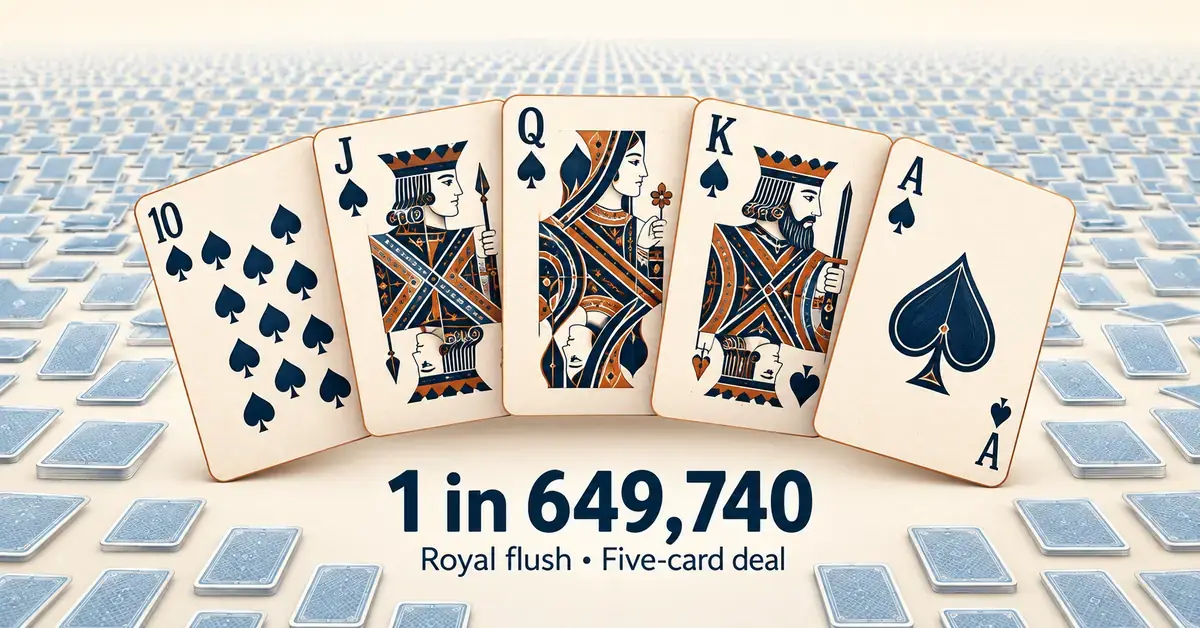
The odds of getting a royal flush are about 1 in 649,740 if you are dealt exactly five cards, and about 1 in 30,940 if you get to use the seven cards available in a game like Texas Hold’em. A royal flush — ten, jack, queen, king and ace all of the same suit — is the single rarest hand in standard poker, and understanding exactly how rare it is opens the door to the wider topic of poker hand probabilities. This guide gives the exact numbers for every hand, shows where they come from, and explains how the odds shift once extra cards are in play.
Key Points
- A royal flush is the rarest hand in poker: only 4 exist in a 52-card deck.
- Five-card odds: 1 in 649,740 (0.000154%).
- Seven-card (Texas Hold’em) odds: 1 in 30,940 (0.0032%).
- Flopping a royal flush: about 1 in 649,740.
- All poker odds come from one number: 2,598,960 possible five-card hands.
- Extra cards raise the odds of every hand but never change the ranking order.
How poker hand probabilities are calculated
Every five-card poker probability starts from one number: there are exactly 2,598,960 different five-card hands that can be dealt from a standard 52-card deck. That figure is the number of ways to choose 5 cards from 52 without caring about the order, written in mathematics as “52 choose 5” (52! / (5! × 47!)). Because every one of those 2,598,960 hands is equally likely, the chance of making any particular type of hand is simply the number of hands that qualify divided by 2,598,960.
So the whole subject comes down to counting. To find the odds of a royal flush, you count how many five-card combinations are a royal flush (the answer is 4) and divide by the total. Do the same counting exercise for every hand category and you get the complete probability table. The counts never change — they are fixed properties of a 52-card deck — so these are facts, not estimates.
What are the odds of getting a royal flush?
The odds of being dealt a royal flush in a five-card hand are 1 in 649,740, or 0.000154%. There are only 4 royal flushes in the entire deck, so the probability is 4 divided by 2,598,960. Expressed as odds “against,” that is 649,739 to 1 — you would expect to go roughly 650,000 hands between royal flushes if you were dealt five fresh cards each time.
Royal Flush at a Glance
| The hand | 10, J, Q, K, A — all the same suit |
| Distinct royal flushes in a deck | 4 (one per suit) |
| Five-card odds | 1 in 649,740 (0.000154%) |
| Seven-card / Hold’em odds | 1 in 30,940 (0.0032%) |
| Odds of flopping it | about 1 in 649,740 |
| Rank | Highest possible hand (top straight flush) |
Why there are only four royal flushes
A royal flush is always the same five ranks — ten, jack, queen, king and ace — and all five cards must share one suit. Because there are exactly four suits (spades, hearts, diamonds and clubs), there are exactly four possible royal flushes and no more. There is nothing to “almost” make it rarer or more common: it is a fixed, tiny set of four hands. This is also why a royal flush is really just the highest possible straight flush rather than a separate category of its own.
Royal flush odds in Texas Hold’em (using seven cards)
In Texas Hold’em your best hand is built from seven cards — your two hole cards plus the five community cards — so your chance of ending up with a royal flush is much better than the raw five-card figure. Across all seven cards, 4,324 of the 133,784,560 possible seven-card combinations contain a royal flush, which works out to about 1 in 30,940, or 0.0032%. That is roughly twenty times more likely than the pure five-card number, simply because you have more cards and more ways to hit the right five.
What are the odds of flopping a royal flush?
Flopping a royal flush — making it with your two hole cards and the first three community cards — happens about once in 649,740 attempts. The maths lines up neatly: you first need to be dealt two suited cards somewhere between ten and ace, which happens only about 3% of the time, and the three-card flop then has to deliver the exact other three royal cards out of 19,600 possible flops. Multiply those two steps together and you land back on 1 in 649,740, the same number as a straight five-card deal.
Poker hand probabilities: the full five-card table
The table below lists every poker hand from most to least likely, with the exact number of qualifying five-card combinations, the probability as a percentage, and the odds against making the hand. Each category is counted so that it does not overlap with a higher one — for example, the “flush” count excludes straight flushes, and the “straight” count excludes straight flushes.
| Hand | Combinations | Probability | Odds against |
|---|---|---|---|
| Royal flush | 4 | 0.000154% | 1 in 649,740 |
| Straight flush (non-royal) | 36 | 0.00139% | 1 in 72,193 |
| Four of a kind | 624 | 0.0240% | 1 in 4,165 |
| Full house | 3,744 | 0.144% | 1 in 694 |
| Flush (non-straight) | 5,108 | 0.197% | 1 in 509 |
| Straight (non-flush) | 10,200 | 0.392% | 1 in 255 |
| Three of a kind | 54,912 | 2.11% | 1 in 47.3 |
| Two pair | 123,552 | 4.75% | 1 in 21 |
| One pair | 1,098,240 | 42.26% | 1 in 2.37 |
| High card (no pair) | 1,302,540 | 50.12% | 1 in 2.0 |
| Total | 2,598,960 | 100% | — |
A few things jump out of this table. More than half of all random five-card hands are nothing but a high card, and about 42% are a single pair, so the strong hands poker players chase are genuinely rare. The ranking order you learn as a beginner is simply the rarity order: the rarer the hand, the higher it beats. If you want the full list of what beats what, see our poker hand rankings guide.
Poker hand odds with seven cards
With seven cards to choose from, every hand becomes more likely because you have more chances to connect. Games such as Texas Hold’em and Seven-Card Stud let you make your best five-card hand out of seven, so the realistic odds at the table come from the seven-card table below, not the five-card one. There are 133,784,560 possible seven-card combinations in total.
| Hand | Combinations | Probability | Odds against |
|---|---|---|---|
| Royal flush | 4,324 | 0.0032% | 1 in 30,940 |
| Straight flush (non-royal) | 37,260 | 0.0279% | 1 in 3,590 |
| Four of a kind | 224,848 | 0.168% | 1 in 595 |
| Full house | 3,473,184 | 2.60% | 1 in 38.5 |
| Flush | 4,047,644 | 3.03% | 1 in 33.1 |
| Straight | 6,180,020 | 4.62% | 1 in 21.6 |
| Three of a kind | 6,461,620 | 4.83% | 1 in 20.7 |
| Two pair | 31,433,400 | 23.5% | 1 in 4.26 |
| One pair | 58,627,800 | 43.8% | 1 in 2.28 |
| High card (no pair) | 23,294,460 | 17.4% | 1 in 5.74 |
| Total | 133,784,560 | 100% | — |
How the odds change from five cards to seven
Adding two cards changes which hands are common, but it never changes the ranking order. A royal flush goes from 1 in 649,740 to 1 in 30,940, a four of a kind from 1 in 4,165 to 1 in 595, and a full house from a 0.14% long shot to a 2.6% regular occurrence. The biggest practical shift is at the bottom: with seven cards, a bare “high card” hand becomes uncommon (17.4%) while two pair becomes a frequent result (23.5%), because extra cards make it hard to avoid pairing something.
The key takeaway is that the rarity of each hand relative to the others stays the same — a flush still beats a straight because a flush is still rarer — but you should never use the five-card odds to judge your real chances in a seven-card game. Doing so is one of the most common mistakes in reading poker probabilities.
How to actually use these odds at the table
Knowing the overall rarity of a royal flush is interesting, but day-to-day poker decisions use a different, more useful number: the chance of completing a specific draw right now. That is where counting your outs comes in. If you hold four cards to a flush, you have nine cards left that complete it, and simple shortcuts turn that into a percentage. Our guide to poker odds and outs explains the Rule of 2 and 4 for exactly this.
Once you know your chance of hitting, you compare it to what the pot is paying you to keep playing. That comparison is the heart of pot odds and equity, and it is what separates a good call from a bad one. These everyday probabilities matter far more to your results than the once-in-a-lifetime royal flush, which brings us to the mistakes people make.
Common mistakes people make with poker odds
Most misunderstandings about poker probability come from a handful of recurring errors. Avoiding them will make the numbers above genuinely useful rather than just trivia.
- Thinking a royal flush is “due.” Cards have no memory. After a million hands without one, the odds on the next hand are still 1 in 649,740 (or 1 in 30,940 with seven cards). This is the gambler’s fallacy, and it costs players money.
- Confusing five-card and seven-card odds. Quoting “1 in 649,740” at a Hold’em table is wrong; the real figure there is 1 in 30,940 because you use seven cards, not five.
- Overrating suited cards. Being dealt two suited cards feels promising, but a made flush is still only about 0.2% of random five-card hands. Suited cards add value mainly through flush draws, not finished flushes.
- Chasing the royal for a jackpot. Some rooms pay a bonus for a royal flush, but the hand is so rare that chasing it costs far more than it ever pays. Decisions should follow pot odds, not jackpot dreams.
- Ignoring kickers and ties. Probability tells you how often you make a hand, not whether it wins. Two players can both make a flush; the higher cards decide it. See which poker hand wins for how kickers and split pots work.
Who should care about hand probabilities
Hand probabilities matter most to anyone making real decisions with their chips, but they help casual players too. Beginners use the rarity order to remember why a full house beats a flush. Recreational players use outs and pot odds to stop chasing hopeless draws. Serious players treat the exact frequencies as the foundation of expected-value thinking. Even if you only play Texas Hold’em for fun, knowing that a royal flush is a 1-in-30,940 event helps keep the game in perspective: the magic hands are rare, and skill comes from playing the common ones well.
Responsible play
This article explains poker probabilities for educational purposes only. The figures describe how often hands occur across many deals; they do not predict any single hand, improve your chances of winning, or guarantee a profit. Poker involves risk, and no mathematical fact changes the fact that you can lose money. Only play with money you can afford to lose, and if gambling stops being fun, support is available through our responsible gambling resources.
Sources
Frequently Asked Questions (FAQ)
What are the exact odds of getting a royal flush?
In a five-card hand the odds are 1 in 649,740 (0.000154%), because only 4 of the 2,598,960 possible hands are a royal flush. In a seven-card game such as Texas Hold’em, where you build your best five cards from seven, the odds improve to about 1 in 30,940 (0.0032%).
Is a royal flush the rarest poker hand?
Yes. A royal flush is the single rarest hand in standard poker, with only four possible versions in the deck — one for each suit. It is technically the highest straight flush, which is why it sits at the very top of the hand rankings and beats everything else.
Can you improve your chances of making a royal flush?
No strategy changes the per-hand odds, because the cards are dealt at random. Playing more hands simply gives you more attempts over time; it does not make any individual hand more likely. Starting with two suited broadway cards is the only way to be “live” for a royal on a given deal, and even then it is a long shot.
Why is a royal flush more likely in Texas Hold’em than in five-card draw?
Because Hold’em lets you make your best five-card hand out of seven available cards, while five-card draw gives you only five. More cards mean more ways to complete the exact ten-through-ace suited combination, so the odds rise from 1 in 649,740 to about 1 in 30,940.
What is the second rarest poker hand?
A straight flush (five cards in sequence, all one suit, but not ten through ace) is the second rarest hand. There are 36 non-royal straight flushes in five-card poker, giving odds of about 1 in 72,193. Four of a kind is next, at 1 in 4,165.
