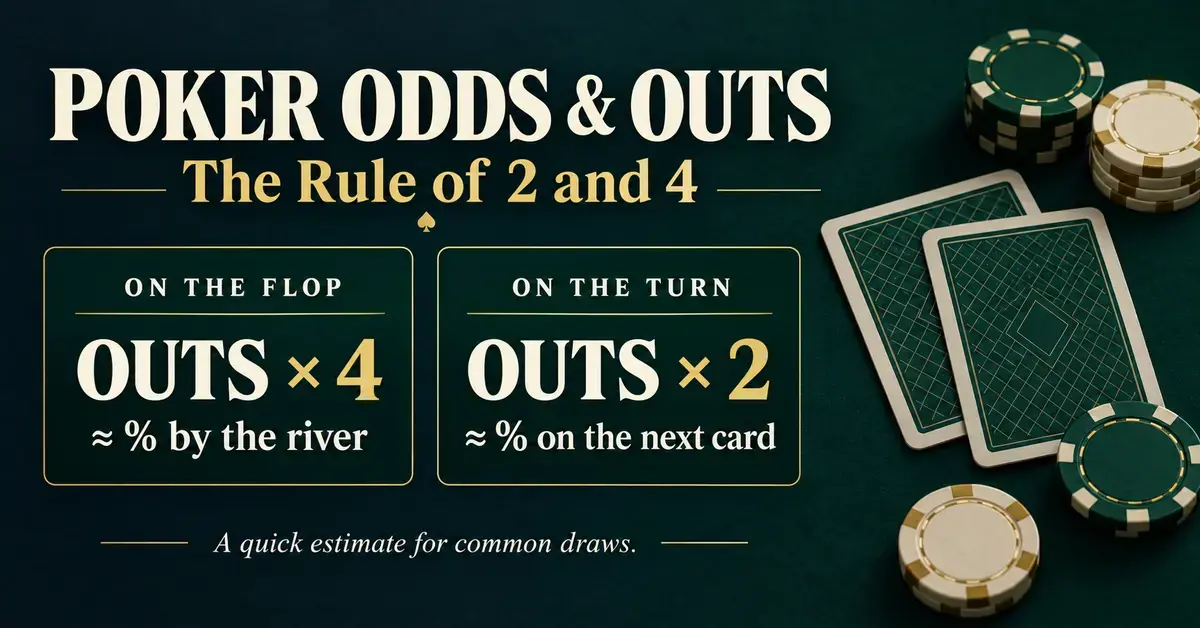
Poker odds are simply the chance that the card you need will arrive. In games like Texas Hold’em you often finish the flop with an incomplete hand — a flush that needs one more suited card, or a straight that is one card short. The cards that would complete your hand are called outs, and once you can count them you can estimate your chance of hitting with a shortcut called the Rule of 2 and 4. This guide shows you how to count outs for the most common draws and turn that number into a percentage in a couple of seconds at the table.
Key Takeaways
- Outs are the unseen cards that complete your hand; count only cards you cannot see (47 unseen after the flop, 46 after the turn).
- Common draws: flush = 9 outs, open-ended straight = 8 outs, two overcards = 6 outs, gutshot = 4 outs.
- Rule of 4: on the flop, outs × 4 estimates your chance of hitting by the river.
- Rule of 2: on the turn, outs × 2 estimates your chance on the single remaining card.
- The rule is accurate for small draws but overestimates above ~9 outs — trim a point or two for big combo draws.
- Add outs for combined draws, but never count a card that fills two draws twice (flush + straight = 15, not 17).
If you are completely new to the game, it helps to first read how to play poker and the poker hand rankings, because counting outs assumes you already know which five-card hand beats which.
What are poker odds and outs?
Poker odds are the probability that a future card will improve your hand to a winner. Outs are the specific unseen cards that would do it. The two ideas work together: you count the outs, then convert that count into a percentage or an “X-to-1” chance.
A worked example makes it concrete. On the flop you hold two hearts and two more hearts appear on the board, so you have four hearts and need one more for a flush. There are 13 hearts in the deck; you can see four of them, so nine hearts remain unseen. Those nine cards are your outs. Knowing you have nine outs is what lets you say the flush will complete roughly a third of the time by the river.
Two counting details matter. First, you only count cards you cannot see — your two hole cards and the community cards on the board. Everything else is “unseen,” including cards in opponents’ hands and the undealt deck, because from your seat they are all equally unknown. Second, after the flop there are 47 unseen cards (52 minus your 2 and the 3 on the board); after the turn there are 46.
What is an “out” in poker?
An out is any unseen card that turns your current hand into the hand you expect to win with. If you are drawing to a flush, every remaining card of your suit is an out. If you are drawing to a straight, the ranks that complete the run are outs.
Not every card that improves you is a true out, though. An out should give you a hand you actually expect to win with. If the board is paired, some of the cards that complete your straight could simultaneously give an opponent a full house, so they are not clean outs. Experienced players discount their count on dangerous boards — a habit covered more broadly in general poker strategy.
How to count your outs
Counting outs comes down to recognising a handful of common draws and remembering how many cards complete each one. The table below lists the four draws you will meet most often, with the verified chance of hitting on the next card (the turn) and by the river.
| Draw | Outs | Turn (one card) | By river (two cards) | Odds against (by river) |
|---|---|---|---|---|
| Flush draw | 9 | 19.6% | 35.0% | ~1.9 : 1 |
| Open-ended straight draw | 8 | 17.4% | 31.5% | ~2.2 : 1 |
| Two overcards | 6 | 12.8% | 24.1% | ~3.1 : 1 |
| Gutshot straight draw | 4 | 8.7% | 16.5% | ~5 : 1 |
Flush draw — 9 outs
A flush draw has nine outs. You hold two cards of one suit and two more of that suit are on the board, giving you four of the 13 cards in the suit. Thirteen minus four leaves nine unseen cards that complete the flush. A flush draw hits about 35% of the time by the river, making it the strongest of the common single draws.
Open-ended straight draw — 8 outs
An open-ended straight draw (OESD) has eight outs. You hold four cards in a row — for example 6-7-8-9 — and can complete the straight at either end, with a 5 or a 10. There are four 5s and four 10s in the deck, so 4 + 4 = 8 outs. An open-ender completes roughly 31.5% of the time by the river.
Gutshot (inside) straight draw — 4 outs
A gutshot, or inside straight draw, has four outs. Here you are missing one card in the middle of the run — for example 6-7-_-9-10, needing an 8. Only one rank fills the gap, and there are four cards of that rank, so you have four outs. A gutshot is weak, hitting only about 16.5% of the time by the river.
Two overcards — 6 outs
Two overcards give you six outs. If you hold two cards that are both higher than everything on the board (say A-K on a 9-7-2 flop), pairing either one would give you top pair. Each rank has four cards and you hold one of them, leaving three; two ranks give 3 + 3 = 6 outs. Overcards are the least reliable draw here because pairing up does not always win — an opponent may already hold a pair or better.
Combining draws — don’t double-count
When you hold two draws at once, add the outs but count each card only once. A combined flush-and-straight draw is the classic case: a flush draw (9 outs) plus an open-ended straight draw (8 outs) looks like 17 outs, but two of those cards complete both draws, so the real count is 15 outs. Fifteen outs is a monster — about 54% to improve by the river — but only if you avoid double-counting the overlap.
The Rule of 2 and 4 explained
The Rule of 2 and 4 turns your out count into a percentage without any hard arithmetic. You multiply your outs by 2 or by 4 depending on how many cards are still to come. It is the single most useful mental shortcut in poker draw odds.
The Rule of 4 — on the flop (two cards to come)
On the flop, multiply your outs by 4 to estimate your chance of hitting by the river. With a nine-out flush draw, 9 × 4 = 36%, close to the true figure of 35%. With an eight-out straight draw, 8 × 4 = 32% against an actual 31.5%. The Rule of 4 assumes you will see both the turn and the river, so it is most honest when you or your opponent are already all-in on the flop and no more betting can force you to fold.
The Rule of 2 — on the turn (one card to come)
On the turn, only the river is left, so multiply your outs by 2. A nine-out flush draw becomes 9 × 2 = 18% (true value 19.6%), and a four-out gutshot becomes 4 × 2 = 8% (true value 8.7%). Use the Rule of 2 any time there is a single card left to come, including a flop decision where you expect to pay again on the turn to keep drawing.
How accurate is the Rule of 2 and 4?
The shortcut is accurate enough for in-game decisions and errs on the generous side. For small draws it is almost exact: a four-out gutshot gives 16% by the rule versus 16.5% actual. The error grows as outs increase, because the rule ignores the small chance of pairing the board or the overlap between the two cards. Above about nine outs the Rule of 4 starts to overshoot — with 15 outs it reports 60% when the true figure is closer to 54%. A common fix is to subtract a point or two from the rule’s answer once you have more than nine outs.
Outs-to-odds reference chart
The chart below converts every out count from 1 to 15 into both the Rule of 2 and 4 estimate and the exact probability, for the turn (one card) and from the flop to the river (two cards). Keep it handy until the common figures become second nature.
Outs to Odds Chart
| Outs | Rule of 2 (turn) | Exact turn % | Rule of 4 (flop→river) | Exact by river % |
|---|---|---|---|---|
| 1 | 2% | 2.2% | 4% | 4.3% |
| 2 | 4% | 4.3% | 8% | 8.4% |
| 3 | 6% | 6.5% | 12% | 12.5% |
| 4 (gutshot) | 8% | 8.7% | 16% | 16.5% |
| 5 | 10% | 10.9% | 20% | 20.4% |
| 6 (overcards) | 12% | 13.0% | 24% | 24.1% |
| 7 | 14% | 15.2% | 28% | 27.8% |
| 8 (straight) | 16% | 17.4% | 32% | 31.5% |
| 9 (flush) | 18% | 19.6% | 36% | 35.0% |
| 10 | 20% | 21.7% | 40% | 38.4% |
| 11 | 22% | 23.9% | 44% | 41.7% |
| 12 | 24% | 26.1% | 48% | 45.0% |
| 13 | 26% | 28.3% | 52% | 48.1% |
| 14 | 28% | 30.4% | 56% | 51.2% |
| 15 (flush + straight) | 30% | 32.6% | 60% | 54.1% |
Turning your odds into a decision
Knowing you are 35% to hit is only half of a decision — the other half is the price you are being asked to pay, known as pot odds. In short, you compare your chance of hitting with the share of the final pot your call represents: if your hit percentage is higher than the price, calling is profitable in the long run. A flush draw that is 35% to get there can comfortably call a bet when the pot is laying better than roughly 2-to-1. The full method for comparing your draw odds to the pot price — including fold equity and implied odds — is a topic of its own and sits alongside this guide in the same cluster.
Common mistakes when counting outs
Most out-counting errors come from a handful of repeatable habits. Avoiding them matters more than memorising decimals.
- Counting cards that don’t win. On a paired or two-suited board some of your “outs” complete a bigger hand for someone else. Discount those cards rather than counting them at full value.
- Double-counting combined draws. As with the 15-out flush-straight draw, cards that fill two draws at once are still one card. Add outs, then subtract the overlap.
- Using the Rule of 4 when you will fold on the turn. The Rule of 4 assumes two free cards. If you expect to face another bet on the turn, use the Rule of 2 for the next card only.
- Forgetting opponents can also improve. Hitting your straight is no use if the same card gives an opponent a flush. Clean outs beat raw outs.
- Counting backdoor draws as full outs. A draw that needs both the turn and the river (a “runner-runner”) is worth only about a single clean out, not the full flush or straight count.
A full worked example
You hold the K♥ Q♥. The flop comes 9♥ 5♥ 2♠. You have a flush draw: four hearts seen, so nine hearts remain — nine outs. You could also argue your king and queen are overcards, but on a drawn-out hand it is safer to lean on the clean flush outs.
Applying the Rule of 4 on the flop, 9 × 4 = 36%, so you expect to make the flush just over a third of the time by the river (the exact figure is 35%). If you only plan to call one street and see the turn, switch to the Rule of 2: 9 × 2 = 18% to hit on the turn alone. Either number then gets compared to the price of the call to decide whether continuing is worth it. This same three-step routine — count outs, apply the rule, compare to the price — works for every draw you will ever face.
Responsible play
Odds describe long-run probabilities, not guarantees. A 35% draw still misses most of the time, and no amount of out-counting removes the variance or the house’s edge in the long run. Poker is a form of gambling and should be treated as entertainment, not income. If gambling is affecting you or someone you know, see our responsible gambling resources for Canadian help lines and self-exclusion tools.
Sources
Frequently asked questions (FAQ)
What is an out in poker?
An out is any unseen card that turns your current hand into the one you expect to win with. If you have a flush draw, every remaining card of your suit is an out. You only count cards you cannot see, so there are 47 unseen cards after the flop and 46 after the turn.
How many outs does a flush draw have?
A flush draw has nine outs. There are 13 cards in each suit; when you hold two and two more are on the board, nine of that suit remain unseen. Those nine cards complete the flush about 35% of the time by the river.
What is the Rule of 2 and 4 in poker?
It is a shortcut for turning outs into a percentage. Multiply your outs by 4 on the flop to estimate your chance of hitting by the river, or by 2 on the turn for the single remaining card. For example, eight outs give roughly 32% on the flop and 16% on the turn.
How accurate is the Rule of 2 and 4?
It is close enough for real decisions and slightly generous. For small draws it is almost exact, but the error grows above about nine outs: with 15 outs the rule says 60% while the true figure is nearer 54%. Trimming a point or two from large counts keeps it reliable.
How many outs does an open-ended straight draw have?
An open-ended straight draw has eight outs because you can complete the straight at either end, and each end has four cards of the needed rank. A gutshot (inside) straight draw has only four outs because a single rank fills the gap.
